

Introduction
User-Generated Content (UGC) is content created by real customers, not by the brand. In e-commerce, UGC has become one of the strongest marketing assets, directly impacting trust, conversion, repeat purchases, and acquisition cost reduction.
According to Stackla and Bazaarvoice research:
- 79% of people say UGC highly impacts their purchasing decisions
- 75% of shoppers trust UGC more than branded content
- Product pages with UGC have 20-40% higher conversion
- UGC reduces CAC (Customer Acquisition Cost) by 30-50%
- User-generated content generates 6.9x higher engagement than branded content
For search engines, UGC creates constantly updated content covering long-tail queries – real phrases customers use when describing products.
UGC psychology is simple: people trust people. Other buyers are perceived as an independent source without commercial interest. This is the social proof effect – when we see others bought and are satisfied, risk seems lower.

Types of UGC for E-commerce
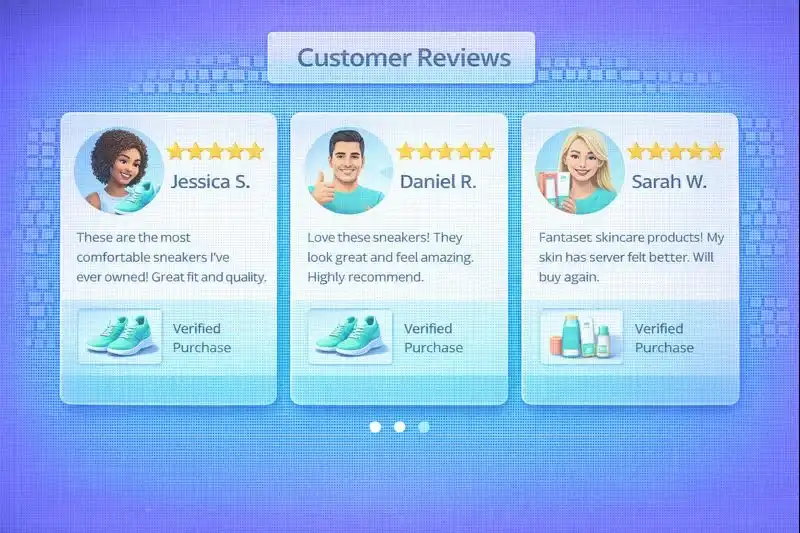
Text Reviews and Ratings
Foundation of social proof. Even short comments reduce purchase uncertainty.
Effective review structure:
- Rating (1-5 stars) – quick visual assessment
- Text (50-300 words) – experience details
- Context – buyer profile (verified purchase)
- Date – information freshness
Impact on conversion:
- 0 reviews → baseline conversion
- 1-5 reviews → +10% conversion
- 5-50 reviews → +20-30% conversion
- 50+ reviews → +30-40% conversion (plateau)
Important: Presence of negative reviews (4-10%) increases trust – absolutely positive ratings look suspicious.
Customer Photos
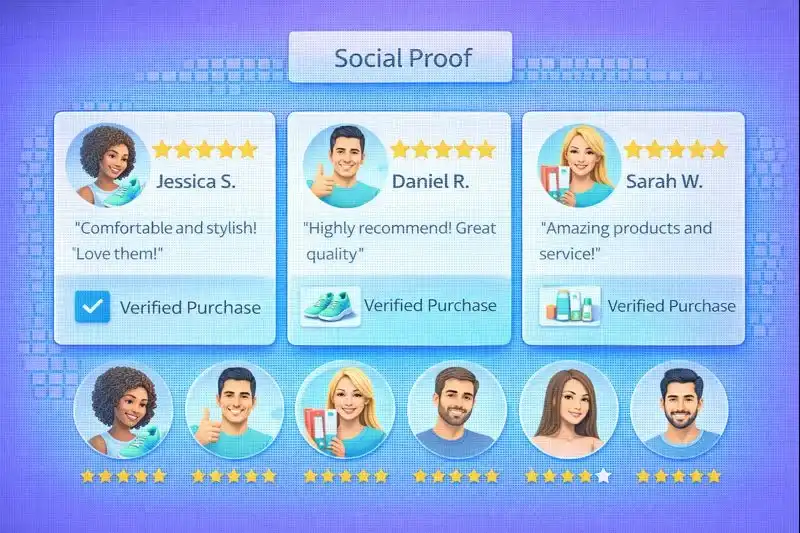
Photos of products in real life demonstrate:
- Scale and size – how product looks in hands, in interior
- Real colors – without studio lighting
- Usage context – how people apply the product
- Material quality – textures, detail processing
Statistics:
- Product pages with customer photos have 35% higher conversion
- Buyers who see customer photos 28% less likely to return items
- User photos attract 5x more attention than stock photos
Customer photos complement professional shots detailed in Product Photography.
Customer Videos
Highest level of trust and engagement.
Popular formats:
- Unboxing – unpacking, first impression, contents
- Reviews – detailed breakdown after use
- Demonstrations – how product works in real conditions
- Before/After – usage results (cosmetics, clothing, gadgets)
- Tutorials – users show creative product usage
Video UGC ROI:
- Conversion increases 80-130% on pages with video
- Average time on page +2-4 minutes
- Return rate decreases 25-40% (buyers better understand what they're getting)
Social Media UGC
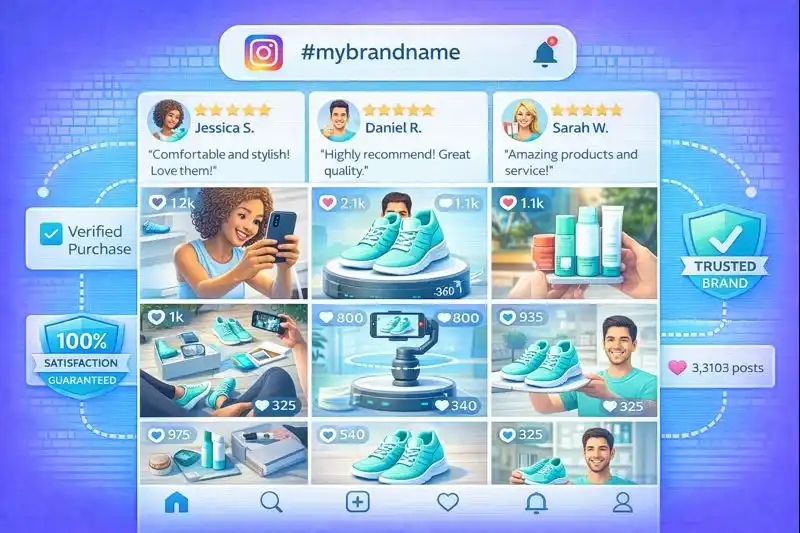
UGC platforms:
| Platform | UGC Type | Audience | Best for |
|---|---|---|---|
| Photos, Reels, Stories | 18-45 | Fashion, beauty, lifestyle | |
| TikTok | Short videos | 16-35 | Viral campaigns, trends |
| Photos, reviews | 25-55 | Groups, communities | |
| YouTube | Video reviews | 18-65 | Electronics, tutorials |
| Photo collages | 25-50 | Home decor, DIY, fashion |
Branded hashtags:
- #mybrand – general brand hashtag
- #mybrand_style – for fashion/lifestyle
- #mybrand_unboxing – for unboxings
- #mybrand_review – for reviews
Customer Q&A
Real customer answers to other buyers' questions remove barriers better than FAQ.
Why Q&A works:
- Questions formulated in buyer language (not marketers')
- Answers from product owners more authentic
- Often cover non-standard use cases
Customer Success Stories
UGC in "before/after" format, transformation stories, real product usage scenarios.
Strongest for:
- Cosmetics and health – physical results
- Productivity tools – workflow changes
- Courses and education – career achievements
- B2B – business metric growth
UGC Collection Methods
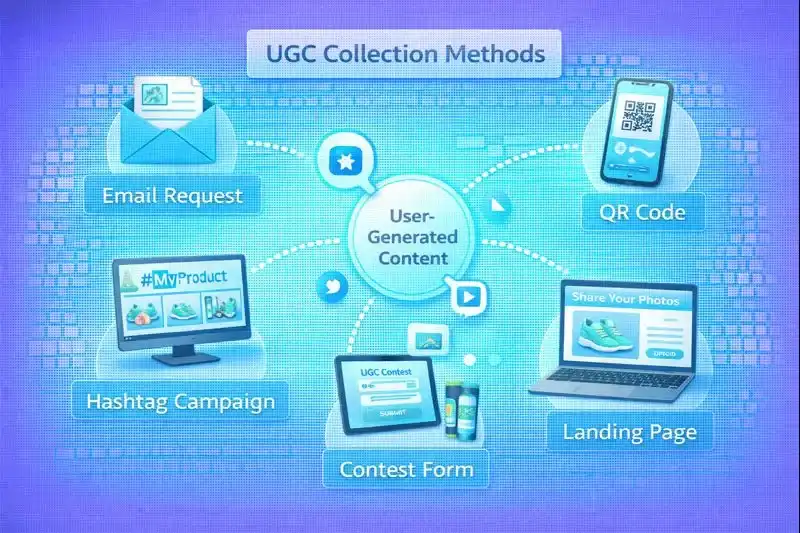
1. Post-Purchase Email Campaigns
Most effective channel. Automated through scenarios described in Email Marketing.
Optimal timing sequence:
- Day 7 after delivery – first review request (product experience)
- Day 14 – photo request if review submitted
- Day 30 – video review request for active users
Email template example:
Subject: [Name], how's your [Product Name]? 🤔

Hi [Name]!

You've had [Product Name] for 7 days now.
We'd love to hear your thoughts!

⭐ Share quick review (2-3 sentences) → get 100 bonus points
📸 Add product photo in use → +200 points
🎥 Record short video (30 sec) → 15% discount on next purchase

[CTA: Leave Review]

Your experience helps other buyers make the right choice!

Thanks,
[Brand] Team
Email request conversion rate:
- Basic request without incentives: 3-8%
- With non-monetary motivation ("help others"): 8-12%
- With discount/bonuses: 15-25%
- Personalized request from founder: 20-30%
2. SMS After Delivery
Short requests with direct link to review form.
Features:
- High open rate (98% vs 20-30% email)
- Shorter conversion window (response within 5 minutes or never)
- Works better for impulse purchases
3. Social Media and Branded Hashtags
Branded hashtag campaign mechanics:
- Create unique hashtag (#mybrand_style)
- Launch seed content (first 20-30 posts from ambassadors/team)
- Announce campaign via email, social, website
- Incentivize participation (featured on site, prizes)
- Repost best UGC on official channels
4. On-Site Requests (Pop-ups, Embedded Forms)
Optimal popup triggers:
- After 2nd site visit (returning customer)
- On exit intent (user leaving product page)
- After 3 minutes on product page
- After adding item to cart
5. QR Codes on Packaging
Direct path to review page from product.
Where to place QR:
- Inside box (unboxing experience)
- On insert card in package
- On instruction manual
- On warranty card
6. Loyalty Programs – UGC for Points
UGC integration into loyalty system:
| Activity | Points | Conversion |
|---|---|---|
| Text review | 50 points | 12-18% |
| Review + photo | 100 points | 8-15% |
| Video review | 200 points | 2-5% |
| Answer question | 20 points | 15-25% |
7. Ambassador and Affiliate Programs
Regular content contributors with highest LTV and greatest impact on Customer Lifetime Value.
Ambassador program structure:
- Selection: top clients by LTV or social media activity
- Requirements: minimum 2 UGC per month (photo/video)
- Rewards: free products, exclusives, 10-20% commission
- Support: messenger group, early access to new releases
UGC Incentives
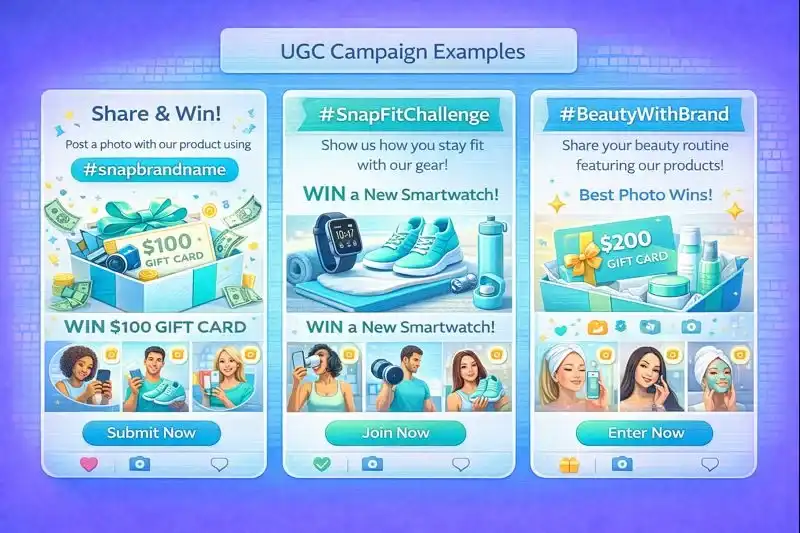
Incentive Types and Effectiveness
| Incentive | Conversion rate | Content quality | Long-term effectiveness | When to use |
|---|---|---|---|---|
| Discounts (5-15%) | 15-25% | Medium | Low (one-time) | Quick wins, UGC launch |
| Loyalty points | 12-18% | High | High (repeat) | Ongoing program |
| Free product | 20-30% | Very high | High | Ambassadors, influencers |
| Social recognition | 8-15% | Highest | High | Authenticity focus |
| Contests/Giveaways | 10-20% | Varies | Medium | Viral campaigns |
| Emotional motivation | 5-12% | Highest | Highest | Organic advocacy |
Monetary Incentives
Discount tiers:
- 5% – basic text review
- 10% – review with photo
- 15% – video review
Issue: When incentives too high, content may seem unnatural or purchased.
Gamification
Levels system:
- Beginner – 1-2 reviews → Bronze badge
- Contributor – 5-10 reviews → Silver badge
- Expert – 20+ reviews → Gold badge, featured profile
Benefits per level:
- Bronze: 5% permanent discount
- Silver: 10% + early access
- Gold: 15% + free shipping + exclusives
Social Recognition (Featured Customer)
Strongest incentive for engaged customers – recognition and opportunity to be heard.
Mechanics:
- Best weekly UGC on homepage
- Post on official brand social media with author tag
- Monthly "Customer of the Month" with interview
Legal Aspects of UGC
Copyright and Content Rights
Important to understand:
- Author retains copyright by default
- Brand CANNOT use UGC without permission
- Social media post with branded hashtag ≠ usage permission
Obtaining Permissions
Where to specify rights:
- Terms of Service – general UGC submission terms
- Review submission form – checkbox "I grant permission to use"
- Direct request – email/DM asking for permission
GDPR and Personal Data
Requirements:
- Consent for personal data processing (name, email, photo)
- Ability to delete UGC upon request
- Data anonymization (show only name, not email)
FTC Guidelines (USA) for Sponsored Content
If user received product free or compensation – this must be disclosed.
Disclosure examples:
- "#ad" or "#sponsored" in Instagram posts
- "Received product for free" in reviews
- "Affiliate link" for affiliate links
Moderation and Quality Control
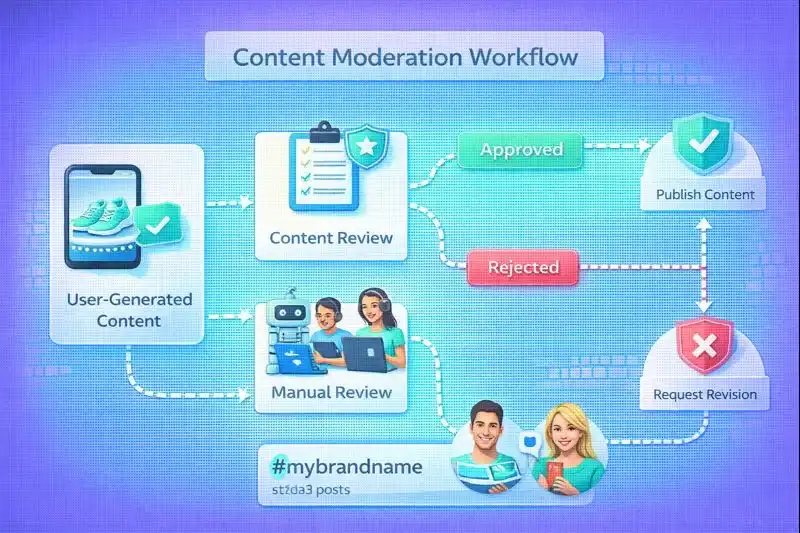
Automated Moderation
AI-based filters:
- Spam detection – template texts, repeats, gibberish
- Profanity filter – obscene language
- Inappropriate content – NSFW images
- Fake review patterns – mass submissions from one IP, identical phrases
- Competitor mentions – competitor brands in text
Tools:
- OpenAI Moderation API
- Google Cloud Vision API (for images)
- AWS Rekognition
- Built-in platform tools (Yotpo, Bazaarvoice)
Manual Review Workflow
Two-tier system:
Tier 1 – Automated pre-approval (80% content):
- ✅ Verified purchase
- ✅ No spam signals
- ✅ No inappropriate content
- ✅ Minimum length (>20 characters)
Tier 2 – Manual review (20% content):
- Content with negative rating (1-2 stars)
- Competitor mentions
- Complaints about content from other users
- Very high ratings from new accounts
Responding to Negative Reviews
Negative reviews are opportunities to show service level.
Response framework:
- Acknowledge – recognize problem, apologize
- Explain – if there's explanation (not excuse!)
- Resolve – offer specific solution
- Take offline – invite to DM/email for details
What NOT to do:
- ❌ Ignore negative reviews
- ❌ Delete (except spam/inappropriate)
- ❌ Defend or blame customer
- ❌ Template responses
Fake Reviews Detection
Manual checks:
- Check purchase history (verified purchase badge)
- Review reviewer profile (how many reviews left)
- Compare IP addresses of submissions
- Check text similarity (plagiarism check)
Automated detection:
- Pattern recognition (mass reviews from one IP)
- Time-based analysis (50 reviews in 1 hour = suspicious)
- Text similarity analysis
- Behavioral signals (mouse movements, time on page)
Where and How to Use UGC
Product Pages
Most effective UGC placement – near CTA.
Optimal placement:
- Above fold – rating and review count near price
- Mid-page – customer photos gallery (6-12 photos)
- Below CTA – top 3 most helpful reviews
- Bottom section – full review list with filters
UGC near buy button reduces returns, directly related to Returns Management.
Homepage and Landing Pages
UGC as hero block:
- Rotating customer photos/videos
- Featured testimonial
- Real-time reviews ticker
Email Marketing
Real review inserts increase CTR by 15-30%.
Use cases:
- Abandoned cart – "Other buyers love this product"
- Product recommendation – review on recommended product
- Re-engagement – customer success stories
- Post-purchase – "Here's what others say about your product"
Social Media Content
60/40 rule:
- 60% UGC repost (authentic, community-driven)
- 40% branded content
Repost best practices:
- Always tag author (@username)
- Ask permission in DM before repost
- Credit in caption ("📸 by @customer")
- Reply to comments under repost
Advertising (Facebook Ads, Google Ads)
UGC in ads often has:
- Lower CPC – 20-50% lower cost per click
- Higher CTR – 30-70% higher CTR
- Better ROAS – 25-40% better return on ad spend
Why it works:
- Looks less "ad-like"
- Authentic messiness beats polished corporate
- Shoppers trust other shoppers
Technical UGC Integration
UGC Management Platforms
| Platform | Strengths | Pricing | Best for |
|---|---|---|---|
| Yotpo | Reviews + Loyalty + UGC galleries | $79-399/mo | All-in-one solution |
| Loox | Photo/Video reviews, Shopify native | $9.99-299/mo | Shopify stores, visual focus |
| Bazaarvoice | Enterprise-grade, analytics | Custom | Large e-commerce, B2C brands |
| Stamped.io | Flexibility, customization | $23-149/mo | Mid-sized stores |
| Trustpilot | Independent platform, SEO | $199-999/mo | Trust focus, Google integration |
API Integrations with Social Media
Instagram Graph API:
- Collect posts by branded hashtag
- Automatic moderation (approval queue)
- Display on site in real-time gallery
Challenges:
- API limitations (rate limits)
- Permission requirements (users must be in follower list)
Solution: Hybrid approach – API for monitoring + manual approval + usage rights request.
Structured Data Markup for SEO
Rich snippets in Google search increase CTR by 20-35%.
Schema.org markup example:
{
  "@context": "https://schema.org/",
  "@type": "Product",
  "name": "Product Name",
  "aggregateRating": {
    "@type": "AggregateRating",
    "ratingValue": "4.7",
    "reviewCount": "287"
  }
}
Result: Stars in Google results, review count, increased CTR.
Automation via Zapier/Make
Example automation workflows:
Workflow 1: Instagram → Website
- Trigger: New post with #mybrand_hashtag
- Filter: Check follower status
- Action: Send approval request via email
- Action: After approve → add to gallery on website
Workflow 2: Review → Thank You Email
- Trigger: New review submitted
- Action: Send thank you email with discount code
- Action: Add points to loyalty account
- Condition: If review contains photo → extra bonus
More about automation in Marketing Automation.
UGC Metrics and ROI
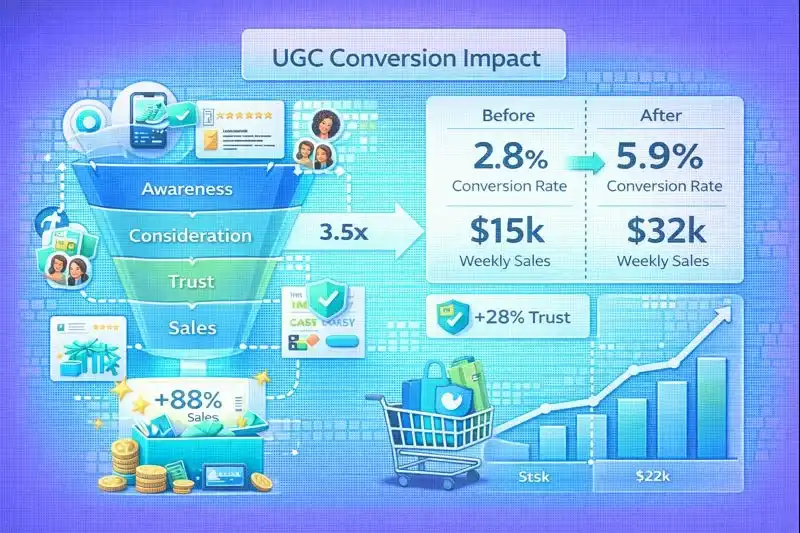
Key UGC Metrics
Acquisition metrics:
-
UGC submission rate = (UGC submitted / Total orders) × 100%
- Benchmark: 5-15% for email requests, 20-30% for loyalty programs
-
Cost per UGC piece = Total UGC costs / Number of UGC pieces
- Benchmark: $2-10 (vs $50-200 for branded content creation)
Conversion metrics:
-
Conversion rate lift = (CR with UGC - CR without UGC) / CR without UGC × 100%
- Benchmark: +20-40% on product pages with reviews
-
Average Order Value (AOV) – UGC increases confidence → higher AOV
- Lift: +10-20%
-
Return rate – better product understanding → fewer returns
- Reduction: -15-30%
UGC ROI Calculation
Formula:
ROI UGC = (Additional profit from UGC - UGC costs) / UGC costs × 100%
Example calculation:
Given:
- Average conversion without UGC: 2%
- Average conversion with UGC: 2.7% (+35% lift)
- Product page traffic: 50,000 visitors/mo
- AOV: $75
- UGC program costs: $1,500/mo (incentives, platform, moderation)
Calculation:
Additional profit:
- Without UGC: 50,000 × 2% × $75 = $75,000
- With UGC: 50,000 × 2.7% × $75 = $101,250
- Lift: $101,250 - $75,000 = $26,250

ROI UGC:
($26,250 - $1,500) / $1,500 × 100% = 1,650%
UGC Impact on CAC
UGC reduces CAC through:
- Organic traffic – SEO lift reduces paid traffic need
- Higher conversion – less traffic needed to achieve revenue goals
- Word-of-mouth – UGC stimulates recommendations
- Lower ad costs – UGC creatives have lower CPC
CAC reduction:
- Average CAC decrease: 20-40%
- Especially strong effect for brands with high LTV
Scaling UGC Strategies
From 0 to First 100 Reviews
Phase 1: Cold Start (0-10 reviews)
Challenge: No one wants to be first.
Tactics:
- Seed reviews – personally ask first 5-10 customers (email/call)
- Founder outreach – personal email from founder
- High incentives – 20-30% discount for first reviewers
- Friends & Family – BUT clearly label as such
- Beta testers – if there's pre-launch group
Timeline: 2-4 weeks
Phase 2: Early Growth (10-50 reviews)
Tactics:
- Automated email campaign – all buyers after 7 days
- Lower incentives – 10-15% sufficient
- Social proof – "Join 25 buyers who already reviewed"
Timeline: 1-2 months
Phase 3: Momentum (50-100 reviews)
Tactics:
- Gamification – levels, badges for top reviewers
- Featured reviews – showcase on homepage
- Contests – best review of month
Timeline: 2-3 months
Creating UGC Flywheel
UGC Flywheel – self-reinforcing cycle:
Purchase → Positive experience → UGC creation →
Social proof → More purchases → More UGC → ...
How to launch flywheel:
- Product excellence – basic condition, poor products won't create positive UGC
- Frictionless UGC submission – extremely simple process
- Immediate gratification – instant incentives (not "receive in a week")
- Visibility – UGC must be visible (site, social, emails)
- Community building – make reviewers part of community
Case Studies
Case 1: Fashion Brand – Instagram UGC Campaign
Brand: [Boutique Fashion Label] Challenge: Low conversion (1.5%), difficulty conveying material quality through photos
Strategy:
- Launch #mybrand_style hashtag campaign
- Incentive: featured on site + 20% discount on next purchase
- Collaboration with 20 micro-influencers (10K-50K followers)
- Integration: Instagram API → shoppable gallery on homepage
Results (6 months):
- ✅ 2,400+ UGC posts with hashtag
- ✅ Conversion rate: 1.5% → 2.1% (+40%)
- ✅ Return rate: 22% → 16% (-27%)
- ✅ Organic traffic: +35% (SEO lift from reviews)
- ✅ CAC: -18%
ROI: 850%
Case 2: Electronics Store – Video Reviews Program
Brand: [Online Electronics Retailer] Challenge: High return rate (18%) due to "product not as expected"
Strategy:
- Video review request in post-purchase email (day 14)
- Incentive: $15 store credit for 30+ second video
- Moderation: manual review for quality control
- Placement: videos on product pages under CTA
Results (4 months):
- ✅ 340 video reviews collected
- ✅ Return rate: 18% → 12% (-33%)
- ✅ Conversion on pages with video: +65%
- ✅ Time on page: +3.5 minutes
- ✅ Cost per video: $18 (including $15 credit + moderation)
ROI: 1,240%
Case 3: Beauty Brand – Ambassador Program
Brand: [Indie Beauty Brand] Challenge: High CAC ($45), dependence on paid ads
Strategy:
- Select 50 top clients by LTV (>$500 lifetime spend)
- Ambassador package: free products ($50/mo) + 15% commission + exclusives
- Requirements: 2 UGC posts per month (Instagram/TikTok) + 1 blog review
- Private Telegram group for ambassadors
Results (12 months):
- ✅ 50 ambassadors → 1,200 UGC pieces
- ✅ 3,500+ sales attributed through referral links
- ✅ CAC through ambassadors: $12 (vs $45 paid ads)
- ✅ Ambassador LTV: +80% vs non-ambassadors
- ✅ Program cost: $3,000/mo (products + commission)
- ✅ Revenue attributed: $45,000/mo
ROI: 1,400%
UGC Strategy Launch Checklist
Preparation (Week 1-2):
- Define UGC program goals (reviews, photos, videos, social posts)
- Choose UGC management platform (Yotpo, Loox, Stamped, custom)
- Create Terms of Service for UGC submission
- Set up GDPR compliance (consent forms, data processing)
- Prepare email templates for UGC requests
Technical Integration (Week 2-3):
- Integrate UGC platform with e-commerce platform
- Set up review widget on product pages
- Add structured data markup (schema.org) for SEO
- Create UGC gallery on homepage or separate page
- Configure automation (post-purchase emails, SMS)
Incentives and Motivation (Week 3):
- Define incentives (discounts, points, contests)
- Create loyalty program integration (if exists)
- Prepare contest mechanics (if planned)
Moderation (Week 4):
- Configure automated filters (spam, profanity, inappropriate content)
- Create manual review workflow (who, when, criteria)
- Prepare response templates for negative reviews
- Train team on moderation best practices
Launch (Week 5):
- Seed content – first 10-20 reviews (personal outreach)
- Launch automated email campaign for all buyers
- Announce UGC program via social, site, newsletter
- Monitor first submissions and quick response
Optimization (Ongoing):
- Weekly metrics analysis (submission rate, quality, conversion impact)
- A/B test incentives, email copy, timing
- Feature best UGC on homepage and social
- Scale: ambassador program, influencer partnerships
Common UGC Strategy Mistakes
- Not asking for UGC at all – only 2-5% create UGC spontaneously
- Asking too early – wait 7-14 days after delivery
- Ignoring legal aspects – get explicit permission, terms of service
- No moderation – risks spam, inappropriate content
- Using fake reviews – detection improving, risk not worth it
- Ignoring negative reviews – respond publicly, show care
- Complex submission process – minimize required fields
FAQ
1. How to get first reviews when there are none?
Personal requests to first 10-20 customers. Founder email + high incentive (20-30% discount). Transparency – "We're new brand, your review helps others."
2. How much to pay for UGC?
Text review: 5-10% discount or 50-100 loyalty points. Photo: 10-15% or 100-200 points. Video: $10-20 store credit. Non-monetary often works better.
3. What to do with negative reviews? Can they be deleted?
DON'T delete (except spam). Negative reviews increase trust – ideal rating 4.5-4.7/5.0. Respond within 24 hours: acknowledge, apologize, offer solution.
4. Can Instagram customer photos be used without permission?
NO. Branded hashtag ≠ usage permission. Always ask via DM before using.
5. Best tools for collecting UGC?
Startup: Judge.me, Loox ($15-50/mo). Growing: Stamped.io, Yotpo ($100-400/mo). Enterprise: Bazaarvoice (custom pricing).
6. How to fight fake reviews?
Verified purchase badges, IP analysis, text similarity, reviewer history, timing patterns, manual review for new accounts.
7. What % of requests convert to UGC?
Basic email: 3-8%. With motivation: 8-12%. With discount: 15-25%. Loyalty members: 20-30%. Ambassadors: 40-60%.
8. How much UGC needed to see conversion impact?
5-10 reviews on key products: +5-10% CR. 20-30 reviews: +15-20% CR. 50+ reviews: +20-30% CR plateau. Timeline: 3-6 months to critical mass.
Conclusion
User-Generated Content isn't just "nice to have" – it's a critical marketing asset for e-commerce in 2025. UGC works better than advertising, cheaper than branded content, and has long-term compounding effect.
Success principles:
- Proactivity – actively request, don't wait for spontaneous UGC
- Incentivization – monetary or non-monetary, always reward
- Authenticity – avoid fake reviews, value real voices (even negative)
- Moderation – balance automated and manual for quality control
- Visibility – UGC must be visible on site, emails, ads, social
- Long-term – build flywheel, not one-time campaigns
LetsCommerce platform:
LetsCommerce provides comprehensive UGC management tools:
- UGC collection: Integration with post-purchase flows via Email Marketing
- Automation: UGC requests via Marketing Automation
- Moderation: AI-powered filters + manual review workflow
- Display: Customizable widgets for product pages, homepage, galleries
- Analytics: Real-time metrics (submission rate, conversion lift, ROI)
- SEO: Automatic structured data markup for rich snippets
- Rewards: Loyalty points for UGC automatically
UGC reduces CAC, increases conversion, decreases returns (detailed in Returns Management), and directly impacts Customer Lifetime Value.
Start small, test, scale. In 6 months of active UGC strategy, you'll see transformation of your e-commerce business.
Related Articles
- Customer Lifetime Value – how UGC increases trust and LTV through social proof
- Email Marketing – automated email campaigns for UGC collection
- Marketing Automation – UGC request and reward automation scenarios
- Returns Management – how UGC reduces return rate through realistic expectations
- Product Photography – comparing professional photos vs customer UGC photos