Introduction
Marketing automation sits at the center of profitable e-commerce in 2025 because it scales revenue without scaling headcount. Teams face rising acquisition costs, more channels, tighter privacy rules, and higher customer expectations. Automation turns customer behavior into timely messages across email, SMS, push, ads, and on-site personalization.
Companies keep investing because automation delivers measurable efficiency. In a 2024 survey summary, marketers named "identify ideal customers" (47%), "improve data quality" (40%), and "decrease costs" (39%) as the top automation goals (Ascend2, 2024). Gartner also projects rapid automation expansion across enterprises – 30% of enterprises will automate more than half of their network activities by 2026, up from under 10% in mid-2023 (Gartner, 2024).
This guide shows how to choose tools, design workflows, implement scenarios, measure ROI, and build a stack that keeps working as your catalog and customer base grow.
What is Marketing Automation
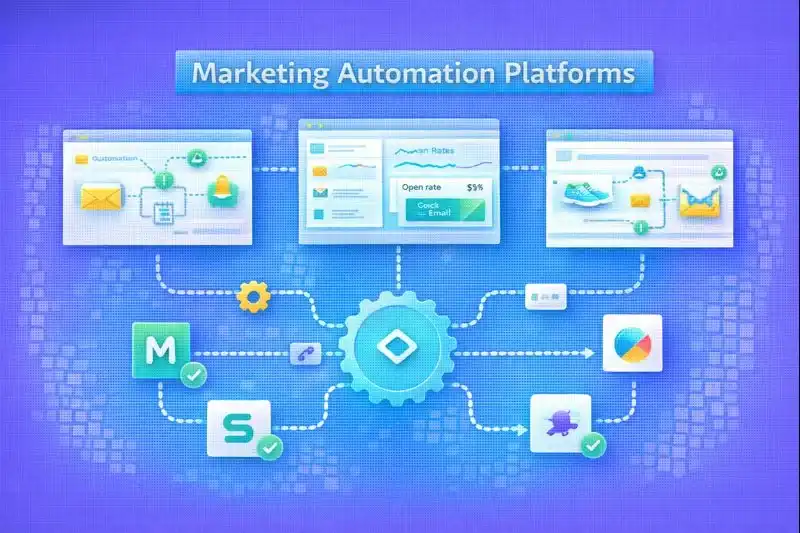
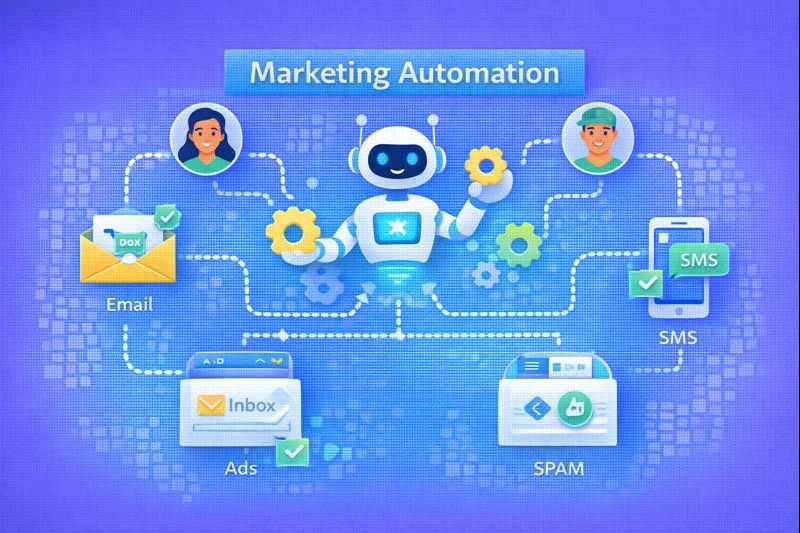
Marketing automation combines data, triggers, rules, and actions to deliver relevant messages at the right time – automatically. For e-commerce, it connects store events (views, add-to-cart, purchase, returns) with communications (email, SMS, push, ads) and on-site experiences (recommendations, banners, offers).
Salesforce highlights how modern marketing depends on AI, data, and orchestration across channels, based on insights from 4,800+ marketers across 29 countries (Salesforce, 2024). HubSpot's 2024 ROI report shows the operational upside of automation – customers can generate 107% more leads and close 35% more deals with strong platform adoption (HubSpot, 2024).
Core Components:
| Component | What it does in e-commerce | Example |
|---|---|---|
| Data layer | Captures events, attributes, consent | AddToCart, Purchase, UTM |
| Identity | Links sessions to customers | Email, phone, customer ID |
| Segmentation | Groups people by intent and value | "Cart abandoners 1–3 days" |
| Workflow engine | Runs triggers, conditions, actions | If cart > $50, send free shipping |
| Personalization | Adapts content per customer | Dynamic product blocks |
| Measurement | Tracks revenue, attribution, lift | Incremental ROAS, holdouts |
A practical definition: Marketing automation is a rules-and-ML system that converts customer behavior into personalized messages and experiences across channels, with measurable revenue impact.
Customer Journey Automation
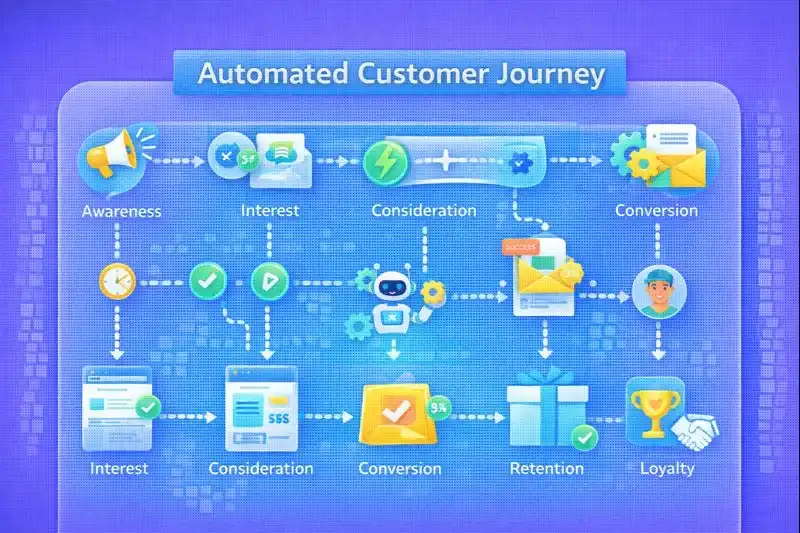
A winning automation plan maps the customer journey and assigns workflows to each stage. This approach eliminates random "set-and-forget" sequences and creates consistent outcomes.
McKinsey reports personalization leaders achieve 5–15% revenue increases and 10–30% marketing-spend efficiency gains through tactics like recommendations and triggered communications (McKinsey, 2024). Ascend2's survey also shows teams prioritize customer understanding (ideal customer identification – 47%) when they plan automation improvements (Ascend2, 2024).
Journey Stages and Automation Goals:
| Stage | Customer intent | Automation goal | Primary workflows |
|---|---|---|---|
| Discover | Exploration | Capture identity | Welcome capture, browse follow-up |
| Consider | Evaluation | Reduce friction | Browse abandonment, category education |
| Purchase | Ready to buy | Recover revenue | Abandoned cart, checkout reminders |
| Post-purchase | Trust building | Reduce support load | Order, shipping, returns guidance |
| Growth | Higher AOV | Cross-sell and upsell | Bundles, replenishment, accessories |
| Loyalty | Repeat behavior | Build habit | VIP tiers, early access drops |
| Win-back | Dormant | Reactivate efficiently | Win-back, price-drop, back-in-stock |
Journey Mapping Checklist:
- Define "first conversion" for your store (purchase, subscription, lead)
- List customer events you track today (view, cart, checkout, purchase)
- Assign at least 1 automation per stage
- Define an exclusion rule per workflow (avoid overlaps)
- Decide measurement method (incrementality, holdouts, attribution)
Building Automation Workflows
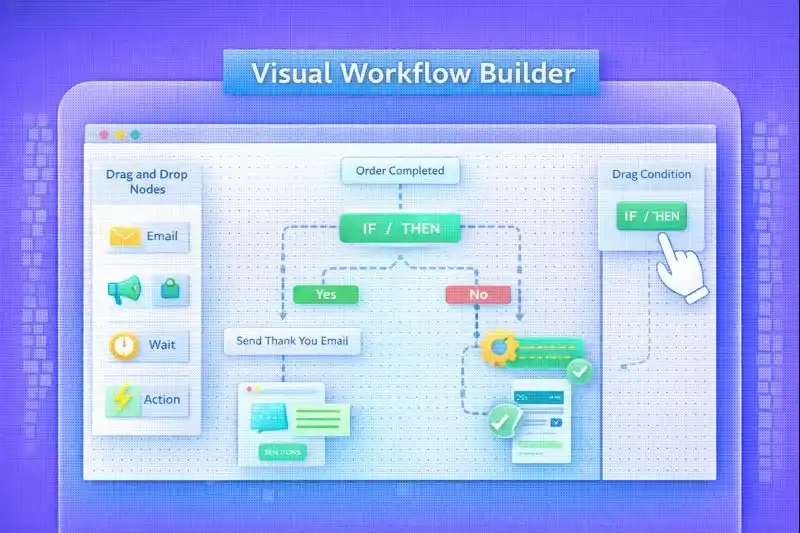
Workflows turn events into outcomes. In 2025, teams win by building workflows that follow three principles: clear triggers, minimal branching, and strong exclusions.
HubSpot's 2024 ROI report links strong platform usage to business outcomes like 107% more leads (HubSpot, 2024). Gartner also signals broader automation momentum (enterprises automating more than half of activities – 30% by 2026) which pushes e-commerce teams to standardize workflows and governance now (Gartner, 2024).
Workflow Building Blocks:
| Block | Purpose | Example |
|---|---|---|
| Trigger | Starts workflow | Cart created |
| Conditions | Branch logic | Cart value > $50 |
| Actions | Do something | Send email, add tag |
| Wait steps | Timing control | Wait 24 hours |
| Exclusions | Prevent conflicts | Exclude purchasers |
| Goals | Stop when achieved | Purchase event occurs |
Example Workflow Logic (Abandoned Cart):
TRIGGER: Cart created + No purchase + 1 hour elapsed
  ↓
CONDITION: Cart value > $50?
  ├─ YES → Send Email: "Complete your order" + Free shipping offer
  └─ NO  → Send Email: "You left something behind" (no offer)
  ↓
WAIT: 24 hours
  ↓
CONDITION: Purchased?
  ├─ YES → Exit workflow
  └─ NO  → Send SMS reminder
  ↓
WAIT: 48 hours
  ↓
CONDITION: Purchased?
  ├─ YES → Exit workflow
  └─ NO  → Send Email: 10% discount + urgency
  ↓
END
Workflow Quality Checklist:
- Use one primary goal per workflow (purchase, review, repeat order)
- Add purchase-based exit conditions early
- Set channel priorities (email first, SMS second)
- Add frequency protection (cap messages per week)
- Log every step with event properties for analytics
Lead Scoring and Qualification
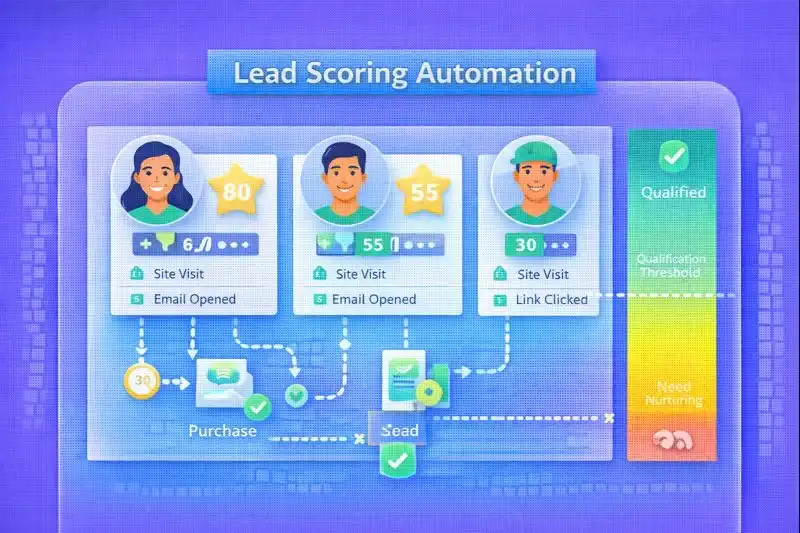
E-commerce teams often skip scoring because they think "we sell products, not leads." Scoring still matters – it helps you decide who needs a discount, who needs education, and who needs a VIP experience.
Ascend2 shows customer identification drives automation priorities (47%) – scoring supports that goal by ranking intent signals (Ascend2, 2024). Salesforce also emphasizes data activation challenges even when teams have real-time data "at their disposal" (Salesforce, 2024) – scoring gives that data a direct operational use.
E-commerce Scoring Model:
| Signal | Points | Why it matters |
|---|---|---|
| Viewed product 2+ times in 7 days | +10 | Strong intent |
| Added to cart | +25 | Purchase momentum |
| Initiated checkout | +35 | Highest intent |
| Viewed shipping/returns page | +8 | Risk or readiness |
| Opened 2 emails in 14 days | +6 | Channel engagement |
| Purchased in last 30 days | +40 | LTV potential |
| Returned item in last 30 days | –15 | Friction signal |
Engagement Score Formula:
EngagementScore = (ProductViews × 2) + (AddToCart × 10) + (CheckoutStarts × 15)
                 + (EmailClicks × 5) + (Purchases × 20) – (Returns × 10)
Scoring Thresholds:
| Score range | Segment | Recommended actions |
|---|---|---|
| 0–19 | Cold | Content, education, low pressure |
| 20–49 | Warm | Browse abandonment, reviews, benefits |
| 50–79 | Hot | Cart recovery, shipping reassurance |
| 80+ | VIP-ready | Early access, bundles, loyalty perks |
Scoring Setup Checklist:
- Define signals from your store events
- Assign points based on margin and conversion likelihood
- Update scores daily, decay weekly
- Use score-based exclusions (avoid discounting VIPs too fast)
- Validate scoring against conversion rate by segment
Multichannel Automation
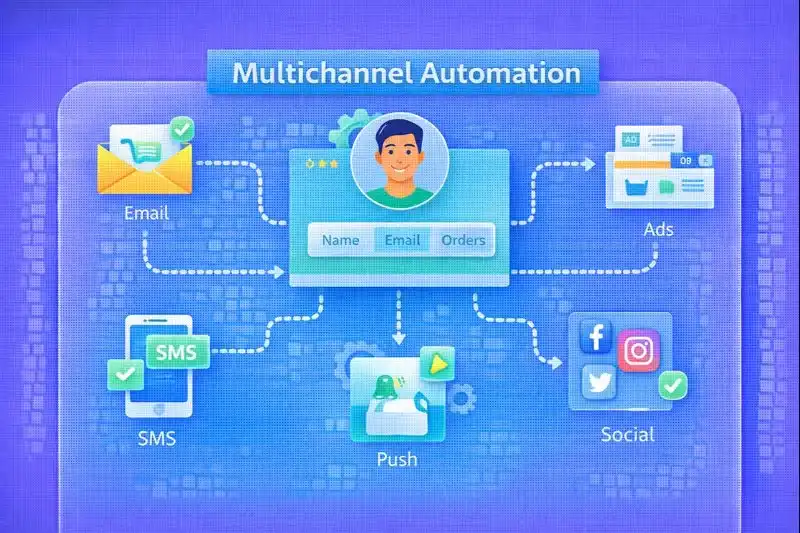
Multichannel automation coordinates messages so customers receive one coherent narrative across touchpoints. You avoid sending an SMS discount 10 minutes after a customer already purchased from an email.
Salesforce's marketing research focuses on cross-channel engagement and operational efficiency across large global samples (Salesforce, 2024). McKinsey also links triggered communications and recommendations to measurable revenue and efficiency gains (revenue +5–15%, spend efficiency +10–30%) (McKinsey, 2024).
Channel Orchestration Rules:
| Priority | Channel | Best for | Risk |
|---|---|---|---|
| 1 | On-site | Immediate intent | Needs identity or session logic |
| 2 | Rich storytelling, low cost | Deliverability risk | |
| 3 | Push | Fast reminders | Opt-in constraints |
| 4 | SMS | High urgency | Compliance, fatigue |
| 5 | Ads | Scale | Attribution noise |
Example – Multichannel Cart Recovery Policy:
| Day | Channel | Message | Exclusions |
|---|---|---|---|
| 0 | Cart reminder + image | Exclude purchasers | |
| 1 | Push | Price and stock reminder | Exclude un-subscribed |
| 2 | SMS | Short reminder or offer | Cap 1 per week |
| 3–7 | Ads | Dynamic retargeting | Exclude purchasers |
Multichannel Governance Checklist:
- Set message caps per channel (weekly limits)
- Create a single "global suppression" segment (recent buyers)
- Align naming conventions across tools (segments, events)
- Define channel conflict rules (which channel wins)
- Use consistent UTMs across every action
AI-Powered Personalization
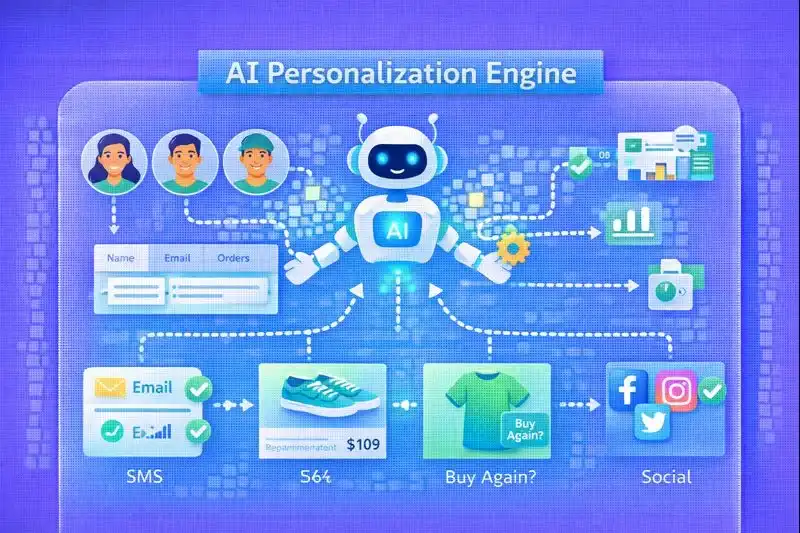
AI now powers product recommendations, dynamic content blocks, send-time optimization, churn prediction, and next-best-action logic. You win when you pair AI with clean data and tight constraints.
McKinsey reports personalization most often drives 10–15% revenue lift (range 5–25%) when teams execute well (McKinsey, 2024). Salesforce also highlights how teams use AI to automate interactions and analyze performance – at scale across thousands of respondents (Salesforce, 2024).
Where AI Helps Most in E-commerce Automation:
| Use case | Input | Output | Example |
|---|---|---|---|
| Recommendations | Views, purchases | Product list | "Frequently bought together" |
| Predictive churn | Recency, frequency | Churn probability | Trigger win-back earlier |
| Send-time optimization | Past opens | Best time | Deliver at personal peak |
| Offer optimization | Margin, propensity | Offer type | Free shipping vs discount |
| Content generation | Catalog data | Draft copy | Category email variations |
Dynamic Block Logic (Example):
IF customer.segment = "VIP"
  SHOW block: Early access + premium bundle
ELSE IF customer.last_viewed_category = "Running Shoes"
  SHOW block: Top sellers in Running Shoes
ELSE
  SHOW block: Store-wide best sellers
AI Implementation Checklist:
- Train recommendations on profit-aware signals (margin, returns)
- Set guardrails (exclude out-of-stock, low-rated items)
- Keep fallback logic for missing data
- Run holdout tests to prove lift
- Refresh models and catalog mappings on a schedule
Essential Automation Scenarios
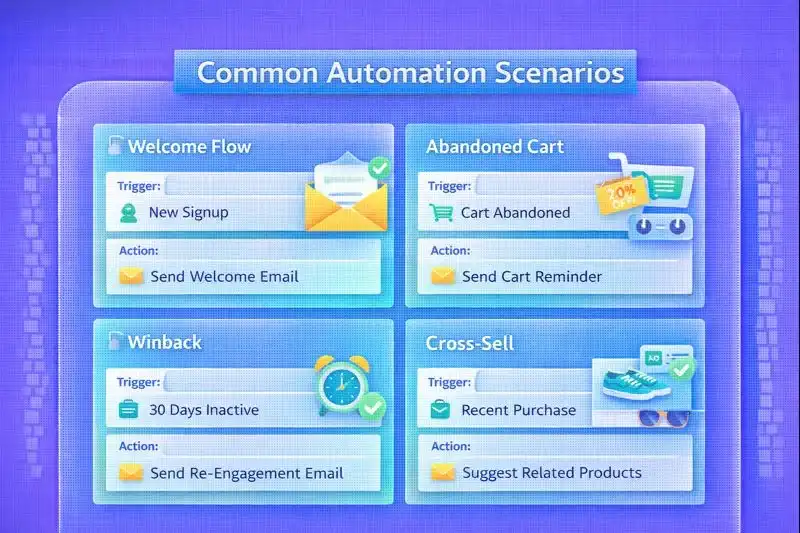
This section lists 15 scenarios you can implement and improve for years. Teams keep these flows because they map to durable customer behaviors.
Ascend2 shows cost reduction drives automation goals (39%) – these scenarios deliver that by automating repeatable tasks (Ascend2, 2024). McKinsey links triggered communications and recommendations to 10–30% marketing-spend efficiency gains when companies execute well (McKinsey, 2024).
Scenario Library (Triggers and Actions):
| Scenario | Trigger | Conditions | Actions |
|---|---|---|---|
| 1. Welcome series | Signup | Source, consent | 3–5 emails + preference capture |
| 2. Abandoned cart | AddToCart + no purchase | Cart value, stock | Email → SMS → offer |
| 3. Browse abandonment | Product view + no cart | Category | Education + best sellers |
| 4. Post-purchase follow-up | Purchase | Delivery status | Thank you + how-to |
| 5. Review request | Delivered | Product type | Ask review + photo incentive |
| 6. Cross-sell / upsell | Purchase | Category | Accessories bundle |
| 7. Replenishment | Purchase consumable | Usage window | Reminder + subscription |
| 8. Win-back | Inactive 60–90 days | Past LTV | Incentive ladder |
| 9. Birthday/Anniversary | Date event | Consent | Gift or points bonus |
| 10. VIP tier upgrades | Spend threshold | Returns rate | Tier badge + perks |
| 11. Price drop alerts | Price decreased | Watchlist | Alert + urgency |
| 12. Back-in-stock | Inventory restored | Watchlist | Alert + fast checkout |
| 13. Loyalty automation | Points change | Tier | Balance + next reward |
| 14. Referral triggers | Purchase completed | NPS or rating | Referral ask |
| 15. Sunset / re-engagement | No opens 90–120 days | Consent | Reconfirm → suppress |
Segment Example (Pseudo-JSON):
{
  "segment_name": "Cart Abandoners – 1–3 Days",
  "rules": [
    { "event": "AddToCart", "within_days": 3 },
    { "event": "Purchase", "within_days": 3, "negate": true }
  ],
  "exclusions": [
    { "tag": "Support Escalation" },
    { "event": "Refund", "within_days": 14 }
  ]
}
Membership Duration Guidance:
- Cart abandoners: 3–14 days (depends on purchase cycle)
- Browse abandoners: 7–30 days
- Win-back: 60–180 days
- VIP: 180–365 days (value decays slowly)
Scenario Rollout Checklist:
- Start with 5 core flows (welcome, cart, post-purchase, win-back, back-in-stock)
- Add exclusions before you launch (buyers, refunds, support cases)
- Set message caps across all flows
- Define success metric per flow (recovered revenue, repeat rate)
- Add a monthly "flow review" cadence
Marketing Tech Stack and Integrations
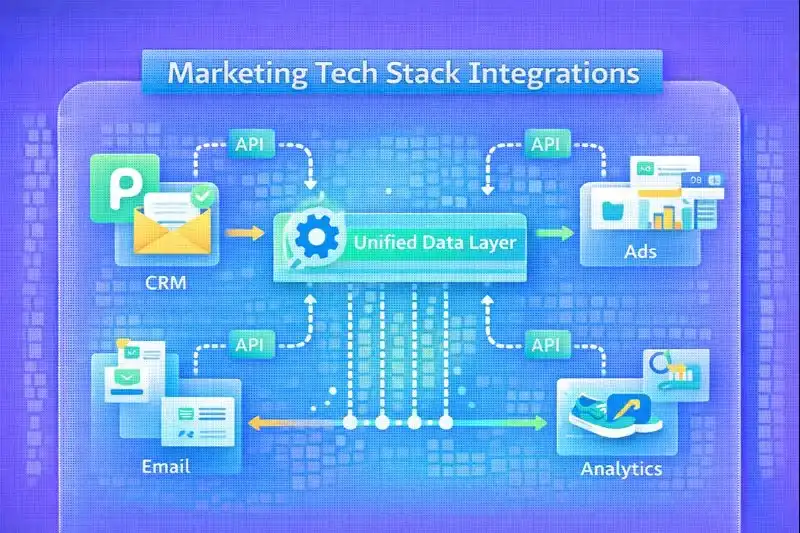
Automation succeeds when your stack shares data reliably. You need consistent events, product data, identity resolution, and attribution.
Salesforce reports many marketers have real-time data but struggle to activate it without technical help (Salesforce, 2024). Ascend2 shows "improving data quality" ranks as a top automation goal (40%) – integrations directly address that (Ascend2, 2024).
Platform Comparison (E-commerce Fit):
| Platform | Best fit | Strengths | Tradeoffs |
|---|---|---|---|
| Klaviyo | E-commerce | Deep store events, email focus | SMS costs rise fast |
| Omnisend | Multichannel SMB | Email + SMS + push | Less flexible than enterprise tools |
| ActiveCampaign | SMB + service | Automation builder, CRM-lite | Catalog personalization needs work |
| HubSpot | Enterprise-ready | Unified CRM, workflows, reporting | Higher cost, setup complexity |
| Mailchimp | Starter | Simple campaigns, templates | Advanced segmentation limits |
| Drip | DTC brands | Strong journey automation | Smaller ecosystem than Klaviyo |
Integration Map (What You Must Connect):
| Category | Tools | Why it matters |
|---|---|---|
| E-commerce platform | Shopify, WooCommerce, Magento | Events, catalog, customers |
| CRM | HubSpot, Salesforce | Identity, lifecycle |
| Analytics | GA4, Mixpanel | Measurement, funnels |
| Ads | Google, Meta | Retargeting, exclusions |
| SMS | Twilio, Attentive | Urgency channel |
| CDP | Segment, mParticle | Unify events and identity |
Minimal Event Schema (Recommended):
Event: ProductViewed
Properties: product_id, category_id, price, currency, url, referrer, customer_id

Event: AddToCart
Properties: cart_id, product_id, quantity, cart_value, currency, customer_id

Event: Purchase
Properties: order_id, order_value, currency, items[], discount_code, customer_id
Integrations Checklist:
- Standardize IDs (product_id, customer_id, order_id)
- Sync catalog fields (title, image, availability, price)
- Implement consent and suppression sync
- Send server-side events where possible
- Unify UTMs and attribution parameters
Measuring Automation Performance
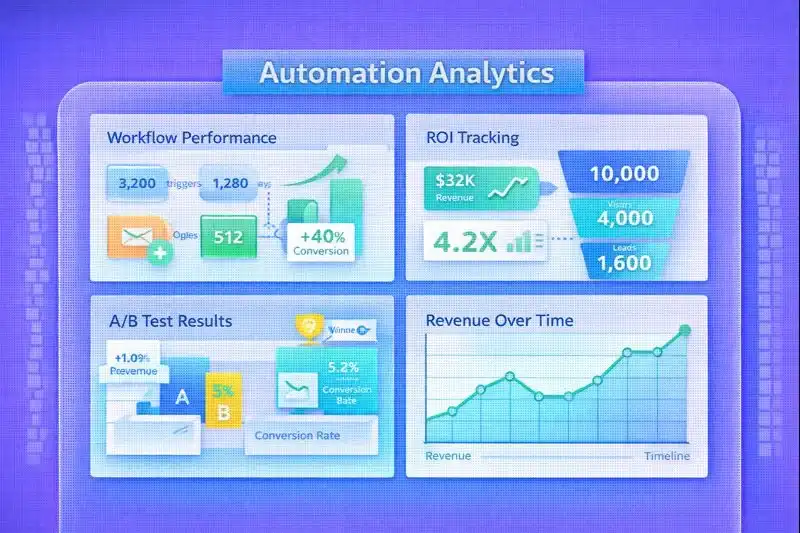
If you do not measure automation, you manage it by opinion. Strong measurement turns workflows into a compounding system.
HubSpot's 2024 ROI report highlights outcome lifts from strong adoption, including 107% more leads and 35% more deals (HubSpot, 2024). McKinsey also quantifies the upside of personalization and triggered communications (revenue +5–15%, spend efficiency +10–30%) (McKinsey, 2024).
KPIs by Workflow Type:
| Workflow | Primary KPI | Secondary KPIs |
|---|---|---|
| Welcome | First purchase rate | Time to first purchase |
| Abandoned cart | Recovered revenue | Discount rate, margin |
| Browse | Add-to-cart rate | CTR, category interest |
| Post-purchase | Repeat purchase rate | Support tickets per order |
| Review request | Review rate | Photo reviews, NPS |
| Win-back | Reactivation rate | CAC payback, unsubscribes |
ROI Formula (Automation):
AutomationROI = (IncrementalGrossProfit – ToolCost – OpsCost) / (ToolCost + OpsCost)

Example: ($100,000 - $5,000 - $10,000) / ($5,000 + $10,000) = 567% ROI
Incrementality Methods:
| Method | How it works | When to use |
|---|---|---|
| Holdout group | Randomly exclude 5–10% from flow | Mature lists, high volume |
| Geo split | Compare regions | Multi-region stores |
| Time split | Alternate weeks | Smaller volume |
| Matched cohorts | Similar users comparison | When randomization not possible |
Measurement Checklist:
- Track revenue and gross profit, not only orders
- Separate "attributed" from "incremental"
- Use holdouts for cart and win-back flows
- Track fatigue signals (unsubscribes, spam complaints)
- Review workflow results monthly, not daily
Frequently Asked Questions
What marketing automation should an e-commerce store implement first?
Start with five flows: Welcome series, Abandoned cart recovery, Post-purchase follow-up, Back-in-stock notifications, Win-back campaigns. These flows cover the full lifecycle and generate the fastest payback. They address the highest-intent moments and recover revenue that would otherwise be lost.
How many workflows should a growing store run?
Run 10–15 core workflows and keep them clean with strict exclusions. More workflows without governance creates channel conflicts and customer fatigue. Quality beats quantity – a well-optimized abandoned cart flow outperforms ten mediocre sequences.
Do discounts always improve automation performance?
Discounts improve short-term conversions but can compress margin and train customers to wait. Use value-first messaging and apply incentives only on high-intent segments or high-margin products. Reserve discounts for final touchpoints in recovery flows.
How do privacy changes affect automation in 2025?
First-party data wins. Build consent-aware tracking, server-side events, and identity resolution based on email or phone. Reduce reliance on third-party cookies. Invest in zero-party data collection (preferences, surveys, quizzes).
How do I prevent automation from spamming customers?
Set global message caps, add suppression segments for recent buyers, and enforce channel priorities. Then review flow overlaps monthly. Create a "quiet period" after purchase (3–7 days minimum). Monitor unsubscribe and spam complaint rates weekly.
Related Articles
- Email Marketing for E-commerce — Funnels, triggers, and segmentation
- Remarketing and Retargeting — Win back customers with paid ads
- CRO for E-commerce — Increase conversion at every funnel stage
- Google Ads for E-commerce — Performance Max and Shopping setup
Conclusion
Marketing automation in 2025 decides who grows profitably and who burns budget on manual work and fragmented messaging. Build your foundation with clean events, strong segmentation, and a workflow library that maps to the customer journey. Then layer multichannel orchestration and AI personalization with clear guardrails and incrementality measurement.
Marketing Automation Success Priorities:
- Events and data — clean tracking, unified identity
- Core workflows — welcome, cart, post-purchase, win-back
- Segmentation — lifecycle stages, scoring, exclusions
- Multichannel — orchestrated messaging, frequency caps
- AI personalization — recommendations, dynamic content
- Measurement — incremental revenue, holdout testing
Success Formula: Clean Data + Smart Workflows + Measured Outcomes = Compounding Growth.
LetsCommerce offers native integrations with leading automation platforms — connect Klaviyo, Omnisend, or ActiveCampaign and launch revenue-driving workflows in minutes.