
Introduction
Every e-commerce store loses potential customers daily. Users browse products, add items to carts, and leave without purchasing. In 2025, remarketing and retargeting are essential strategies for recovering these lost opportunities and maximizing customer lifetime value.
According to Baymard Institute, the average cart abandonment rate is 70.19% (Baymard Institute, 2024). Without remarketing, most of these potential buyers never return.
Criteo reports that retargeted visitors are 70% more likely to convert compared to first-time visitors (Criteo, 2024). This guide covers everything you need to implement effective remarketing and retargeting campaigns for your e-commerce business.
Remarketing vs Retargeting: Key Differences
Although marketers often use the terms interchangeably, remarketing and retargeting serve different roles.
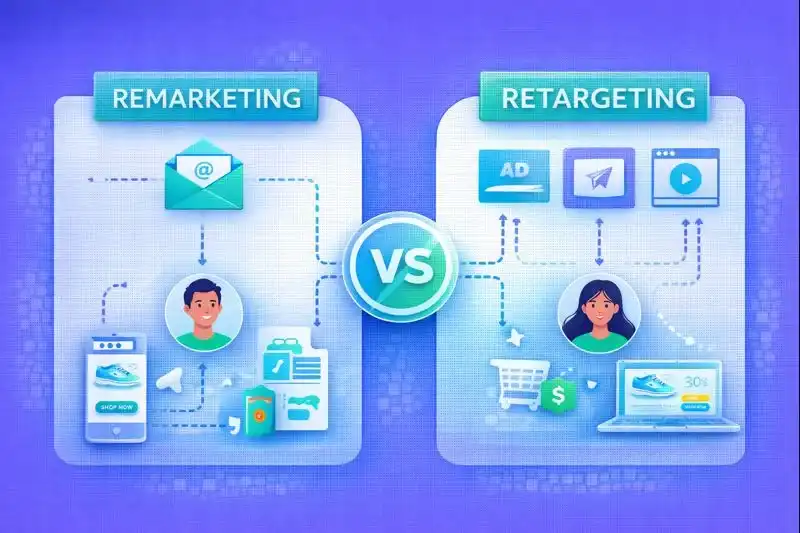
72% of marketers use both strategies simultaneously to cover the full funnel (Statista, 2024).
Definitions:
| Concept | Description | Primary Channels |
|---|---|---|
| Remarketing | Re-engagement via owned channels | Email, CRM, SMS |
| Retargeting | Paid ads to previous visitors | Google, Meta, Display |
Remarketing works best for:
- Existing customers
- Known email subscribers
- Loyalty programs
Retargeting works best for:
- Anonymous visitors
- Product viewers
- Cart abandoners
Audience Segmentation Strategies
Segmentation determines remarketing success. Generic "all visitors" audiences underperform in modern e-commerce.
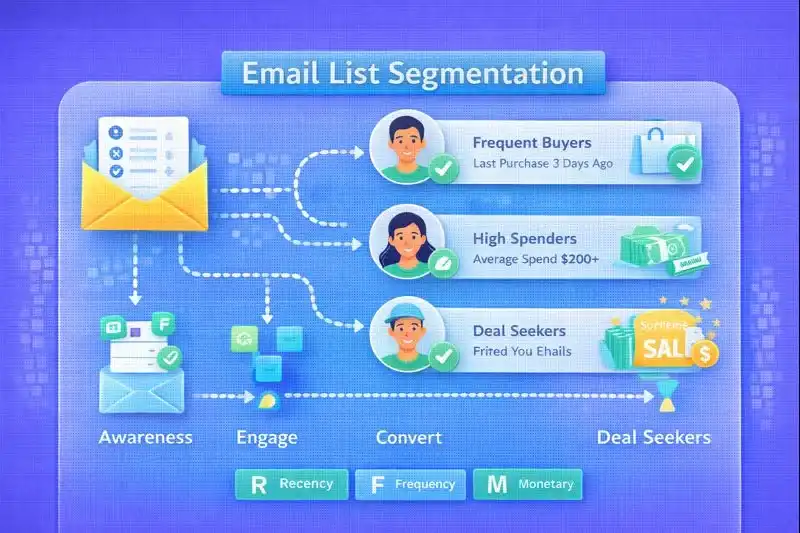
Google data shows segmented remarketing increases conversion rates by 50% compared to broad audiences (Google, 2024).
Core E-commerce Segments:
| Segment | Behavior | Typical Window |
|---|---|---|
| Product viewers | Viewed product page | 7–30 days |
| Cart abandoners | Added to cart | 3–14 days |
| Checkout abandoners | Started checkout | 1–7 days |
| Past buyers | Completed purchase | 30–180 days |
| High-value customers | Top LTV percentile | 180–365 days |
Example: Audience Logic (Pseudo-Code):
IF viewed_product = true
AND added_to_cart = false
AND days_since_visit <= 14
THEN audience = "Product Viewers – No Cart"
Segmentation Checklist:
- Create separate audiences for each funnel stage
- Set appropriate membership durations
- Exclude converters from lower-funnel audiences
- Build high-value customer segments for upsell
Google Ads Remarketing
Google Ads remarketing reaches users across Search, Display, YouTube, and Gmail.
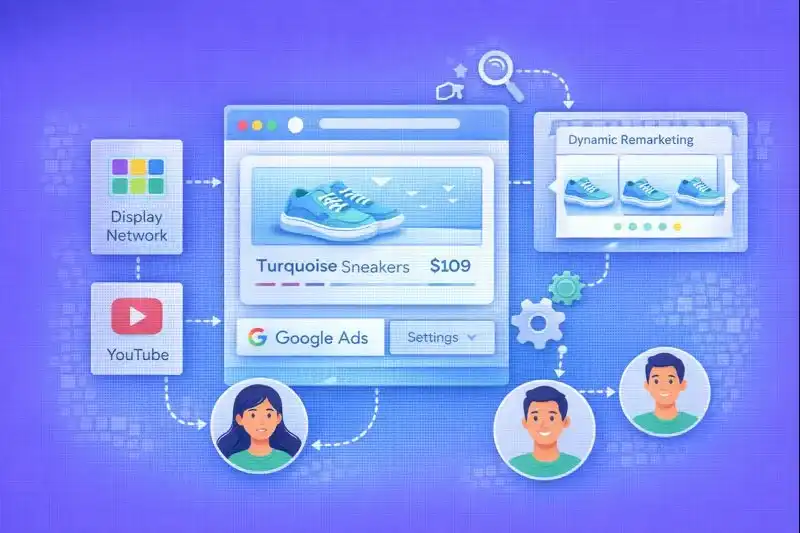
WordStream reports remarketing ads deliver 2–3× higher CTR than standard display ads (WordStream, 2024).
Google Remarketing Campaign Types:
| Campaign Type | Use Case |
|---|---|
| Display Remarketing | Visual re-engagement |
| RLSA | Higher bids on returning searchers |
| YouTube Remarketing | Upper-funnel reactivation |
| Dynamic Remarketing | Product-level personalization |
Dynamic Remarketing Setup Essentials:
- Google Ads tag
- Google Merchant Center feed
- Custom parameters (ecomm_prodid, ecomm_pagetype)
Google Remarketing Checklist:
- Install Google Ads remarketing tag
- Link Google Merchant Center
- Create audience segments by behavior
- Set up dynamic remarketing feed
- Configure RLSA for search campaigns
Facebook and Instagram Retargeting
Meta platforms dominate social retargeting due to native formats and algorithmic optimization.
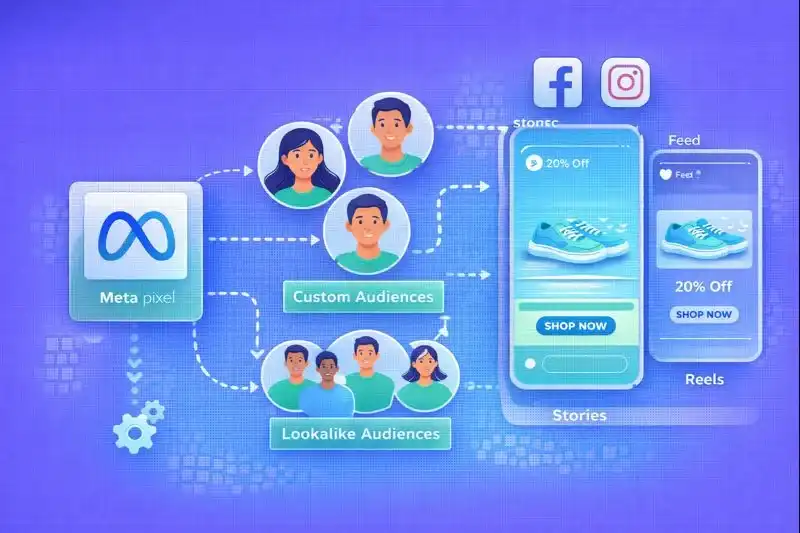
Meta reports retargeting campaigns generate 43% higher ROAS than prospecting campaigns (Meta, 2024).
Key Components:
| Component | Purpose |
|---|---|
| Meta Pixel | Event tracking |
| Custom Audiences | Visitor segmentation |
| Lookalike Audiences | Scaled acquisition |
Recommended Event Hierarchy:
ViewContent → AddToCart → InitiateCheckout → Purchase
Post–iOS 14.5, Meta prioritizes aggregated events and modeled conversions, making first-party data critical.
Meta Retargeting Checklist:
- Install Meta Pixel with Conversions API
- Configure 8 priority events
- Create Custom Audiences by event
- Build Lookalike Audiences from buyers
- Test Advantage+ catalog campaigns
Email Remarketing Automation
Email remains the highest-ROI remarketing channel.
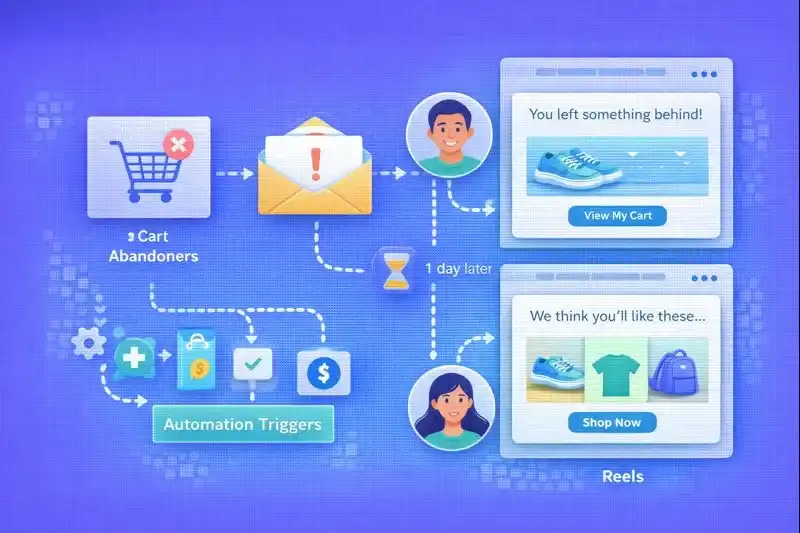
Klaviyo reports abandoned cart emails recover 10–15% of lost revenue on average (Klaviyo, 2024).
High-Impact Email Flows:
| Flow | Trigger | Timing |
|---|---|---|
| Cart abandonment | Add to cart, no purchase | 1h, 24h, 72h |
| Browse abandonment | Product view only | 24h |
| Post-purchase | Purchase | 3–14 days |
| Win-back | No activity | 60–120 days |
Abandoned Cart Email Sequence Example:
Email 1 (1 hour): Reminder + product image
Email 2 (24 hours): Social proof + benefits
Email 3 (72 hours): Incentive or urgency
Email Remarketing Checklist:
- Set up abandoned cart flow (3 emails)
- Create browse abandonment sequence
- Build post-purchase cross-sell flow
- Configure win-back campaign
- Personalize with dynamic product blocks
Dynamic Remarketing
Dynamic remarketing shows users the exact products they viewed or added to cart.
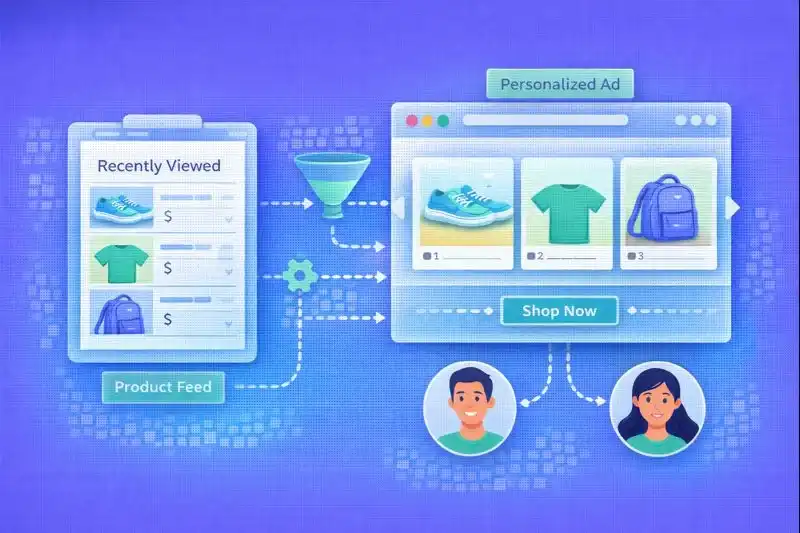
Criteo reports dynamic ads outperform static ads by 76% in CTR (Criteo, 2024).
Dynamic Feed Requirements:
| Attribute | Purpose |
|---|---|
| product_id | Matching |
| image_link | Visual |
| price | Purchase intent |
| availability | Eligibility |
Dynamic remarketing supports:
- Cross-sell (accessories)
- Upsell (premium variants)
- Price-drop messaging
Frequency Capping and Ad Fatigue
Too much exposure kills performance.
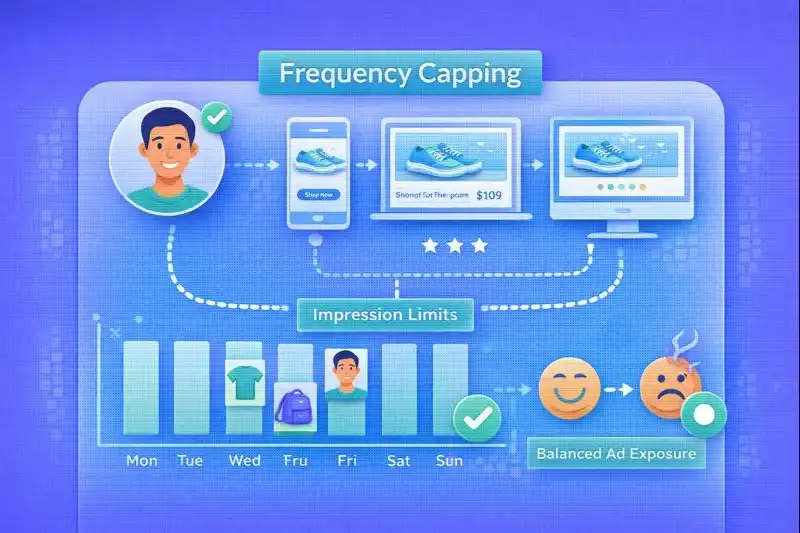
Google research shows conversion rates drop after 7–10 impressions per user per week (Google, 2024).
Recommended Frequency Limits:
| Channel | Ideal Frequency |
|---|---|
| Display | 3–5 / week |
| Social | 4–6 / week |
| YouTube | 2–3 / week |
| 2–4 / month |
Frequency Formula:
Frequency = Impressions / Unique Users
Rotate creatives every 30–45 days to avoid fatigue.
Frequency Management Checklist:
- Set frequency caps per campaign
- Monitor impression-to-conversion ratio
- Rotate ad creatives monthly
- Exclude high-frequency users from prospecting
Measuring Remarketing Performance
Measurement validates profitability and guides scaling.
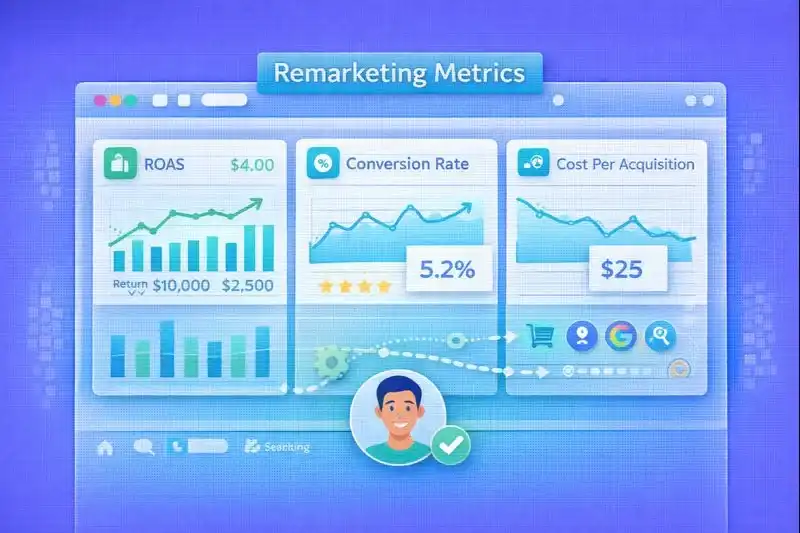
According to Statista, remarketing campaigns achieve 20–40% higher ROAS than cold acquisition (Statista, 2024).
Core Metrics:
| Metric | Meaning |
|---|---|
| ROAS | Revenue efficiency |
| CPA | Cost per conversion |
| Conversion window | Attribution time |
| Assisted conversions | Funnel influence |
Key Formulas:
ROAS:
ROAS = Revenue / Ad Spend

Example: $10,000 Revenue / $2,000 Spend = 500% ROAS
Conversion Window Effectiveness:
Attributed Conversions / Total Conversions
Use multi-touch attribution models where possible.
Common Mistakes to Avoid
WordStream reports over 40% of remarketing budgets get wasted due to poor segmentation (WordStream, 2024).
Common Errors:
| Mistake | Impact |
|---|---|
| One audience for all users | Low relevance |
| No frequency cap | Ad fatigue |
| No exclusions | Budget waste |
| Ignoring privacy rules | Data loss |
Avoidance Checklist:
- Segment by funnel stage
- Exclude recent buyers
- Set frequency limits
- Refresh creatives quarterly
- Implement consent management
- Use first-party data strategies
Frequently Asked Questions
How long should users stay in remarketing audiences?
Typical durations range from 7 to 180 days depending on product price and buying cycle. High-consideration products (electronics, furniture) benefit from longer windows (60–180 days). Impulse purchases (fashion, accessories) convert faster with shorter windows (7–30 days). Test different durations and measure conversion rates by cohort.
Is abandoned cart remarketing always effective?
Yes for most stores, especially when combined with email and dynamic ads. Cart abandonment sequences are the highest-ROI remarketing tactic for e-commerce. The key is timing: first touchpoint within 1 hour, follow-ups at 24 and 72 hours. Add incentives strategically in the final email only.
How does privacy impact remarketing in 2025?
First-party data, server-side tracking, and consent management now define success. iOS 14.5 reduced Meta tracking accuracy. Cookie deprecation affects Display retargeting. Winning strategies focus on email capture, server-side Conversions API, and Customer Match uploads. Build owned audiences aggressively.
Should I discount in remarketing?
Use incentives selectively; over-discounting reduces long-term margins. Reserve discounts for final-stage abandoners (checkout) or win-back campaigns. Test discount depth (5% vs 10% vs free shipping) and measure impact on margin, not just conversion rate. Personalized product recommendations often outperform blanket discounts.
Can remarketing replace acquisition campaigns?
No. Remarketing amplifies acquisition but cannot replace top-of-funnel growth. Remarketing pools shrink without fresh traffic. Sustainable growth requires balanced investment: 60–70% acquisition, 30–40% remarketing. High ROAS from remarketing is partially funded by acquisition efforts.
Related Articles
- Google Ads for E-commerce — Performance Max and Shopping campaign setup
- E-commerce SEO Guide — Technical and content optimization for organic traffic
- CRO for E-commerce — How to increase conversion at every funnel stage
- Checkout Optimization — Reduce cart abandonment at the final step
Conclusion
Remarketing and retargeting form the backbone of sustainable e-commerce profitability in 2025. Abandoned cart recovery, dynamic personalization, precise segmentation, and first-party data strategies separate high-ROAS brands from budget burners. Winning teams treat remarketing as a system, not a single campaign.
Remarketing Success Priorities:
- Segmentation — separate audiences by funnel stage and value
- Multi-channel — combine email, Google, and Meta
- Dynamic ads — personalize with viewed products
- Frequency control — prevent fatigue and wasted spend
- First-party data — build owned audiences for privacy era
- Measurement — track ROAS, CPA, and assisted conversions
Success Formula: Smart Segmentation + Dynamic Personalization + Frequency Control = Sustainable ROAS.
LetsCommerce provides built-in remarketing integrations with Google, Meta, and email platforms — set up your winning-back campaigns in minutes, not hours.