
Introduction
E-commerce SEO in 2025 is a key channel for sales growth, catalog scaling, and reducing customer acquisition costs. According to Google, 53% of all e-commerce traffic comes from organic search (Google, 2024).
Ahrefs research shows: position #1 in search results gets 39.8% CTR, position #2 — 18.7%, position #3 — 10.2% (Ahrefs, 2024).
For online stores, SEO directly drives stable revenue, predictable demand, and controlled growth without constantly increasing ad budgets. This guide covers technical SEO, content optimization, and e-commerce specifics with practical examples.
Technical SEO Fundamentals for E-commerce
Technical SEO is the foundation of any online store. Without proper crawlability and indexability, search engines ignore even quality content.

Key Technical SEO Elements:
| Element | Description | Importance |
|---|---|---|
| Crawlability | Page accessibility for Googlebot | Critical |
| Indexability | Ability to be added to index | Critical |
| Site Architecture | Logical category hierarchy | High |
| Robots.txt | Service page control | High |
| Sitemap.xml | Map of all SEO pages | High |
Google officially confirms: page depth beyond 3 clicks from homepage causes crawl budget loss (Google Search Central, 2024).
Optimal E-commerce Architecture:
Homepage (1 click)
    └── Categories (2 clicks)
            └── Subcategories (3 clicks)
                    └── Products (3-4 clicks)
Technical SEO Checklist:
- Sitemap.xml created and submitted to Google Search Console
- Robots.txt configured correctly
- SSL certificate installed (HTTPS)
- Canonical tags on all pages
- 404 errors fixed
- Redirects configured (301, not 302)
URL Structure for Online Stores
URL is a strong relevance signal for search engines. Ahrefs confirms: short URLs with keywords rank better in 74% of cases (Ahrefs, 2024).
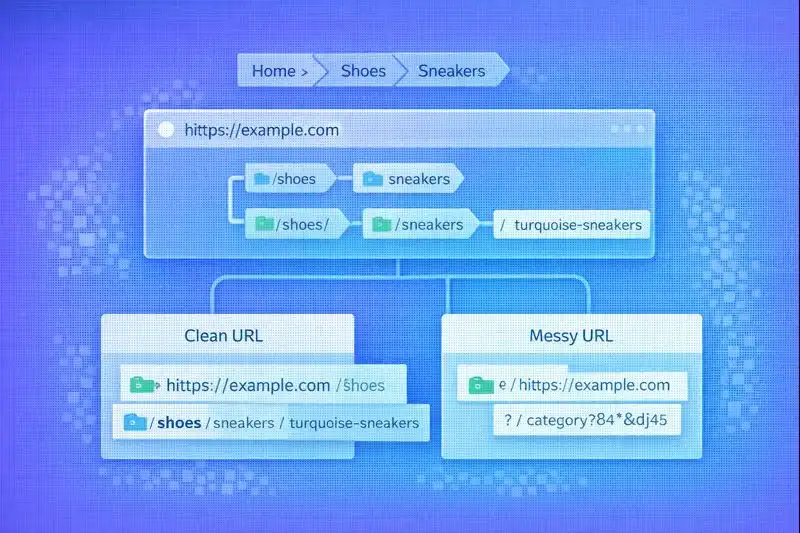
Correct URL Structure:
✅ CORRECT:
/women/shoes/sneakers/nike-air-max-90
/men/clothing/t-shirts/
/electronics/smartphones/apple-iphone-15-pro

❌ INCORRECT:
/catalog.php?cat=123&subcat=456&id=789
/product?id=12345
/p/789456123
Key Principles:
- Human-readable URLs — with keywords
- Category hierarchy — reflects catalog structure
- One URL — one content — no duplicates
- Canonical for variations — color, size
- Trailing slash — single standard (with or without
/)
Canonicalization:
<link rel="canonical" href="https://example.com/category/product" />
Use canonical for:
- Product variants (color, size)
- Pages with sorting parameters
- Mobile versions (if separate URL)
Page Speed and Core Web Vitals
Speed directly drives conversion growth and search rankings. According to Google, 1 second delay causes 7% conversion drop (Google, 2024).
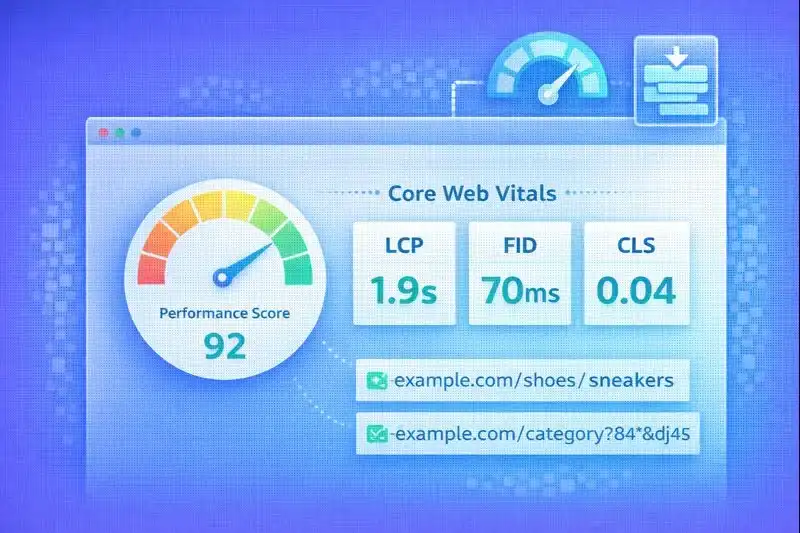
Core Web Vitals — 2025 Standard:
| Metric | Target | What It Measures |
|---|---|---|
| LCP | ≤ 2.5 sec | Main content loading |
| FID | ≤ 100 ms | Time to interactivity |
| CLS | ≤ 0.1 | Visual stability |
Practical Speed Improvements:
- WebP for images — 30% smaller size
- Lazy loading — load on scroll
- CDN — global content delivery
- Server-side rendering — faster TTFB
- JS/CSS minification — smaller file size
- Browser caching — faster repeat visits
Testing Tools:
- Google PageSpeed Insights
- GTmetrix
- WebPageTest
- Chrome DevTools (Lighthouse)
Mobile Optimization
Google uses mobile-first indexing for 100% of sites (Google, 2024). Mobile version is primary for indexing.

What Works in 2025:
| Approach | Status | Comment |
|---|---|---|
| Responsive design | ✅ Required | One URL for all devices |
| Touch-friendly UI | ✅ Required | Minimum 44px for buttons |
| AMP | ❌ Not needed | Google dropped requirement |
| Separate m.site | ❌ Outdated | Hard to maintain |
Mobile Optimization Checklist:
- Responsive design implemented
- Font readable without zoom (≥16px)
- Buttons adequate size (≥44px)
- No horizontal scroll
- Pop-ups don't block content
- Core Web Vitals green on mobile
- Mobile-Friendly Test passed
Duplicate Content Issues
Filters, sorting, pagination create thousands of duplicates in e-commerce. Semrush notes: duplicates cause up to 30% organic traffic loss (Semrush, 2024).
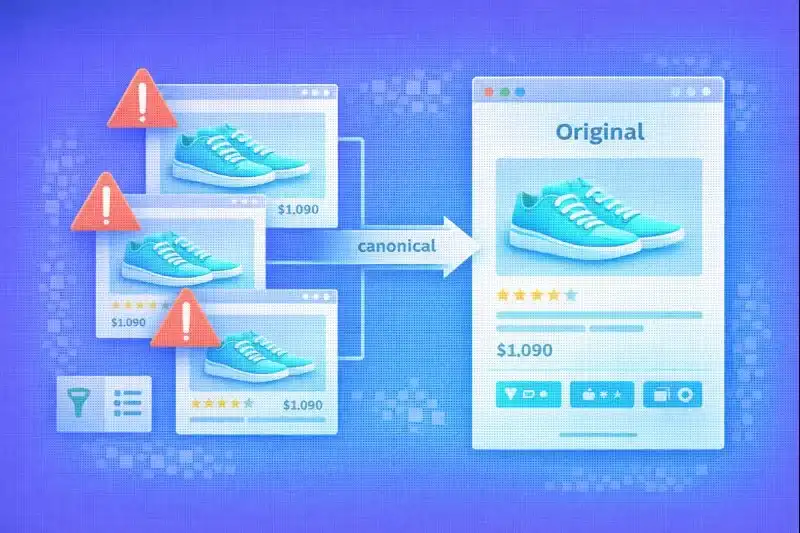
Sources of Duplicates:
| Source | Example | Solution |
|---|---|---|
| Filters | ?color=black&size=42 |
Canonical or noindex |
| Sorting | ?sort=price-asc |
Noindex |
| Pagination | ?page=2 |
rel="next/prev" |
| Product variants | /product-red, /product-blue |
Canonical to main |
| HTTP/HTTPS | Different protocols | 301 redirect to HTTPS |
| www/non-www | Different domains | 301 redirect |
Filter Strategy:
/category/shoes                    ← index
/category/shoes?color=black        ← canonical to /shoes
/category/shoes?size=42            ← canonical to /shoes
/category/shoes?color=black&size=42 ← noindex
/category/shoes?sort=price-asc     ← noindex
/category/shoes?page=2             ← rel="next/prev"
Robots.txt for E-commerce:
User-agent: *
Disallow: /cart/
Disallow: /checkout/
Disallow: /account/
Disallow: /*?sort=
Disallow: /*?filter=
Disallow: /search?
Sitemap: https://example.com/sitemap.xml
Schema.org Structured Data
Schema drives rich snippets and higher CTR. Moz confirms: CTR with schema increases by 20-30% (Moz, 2024).
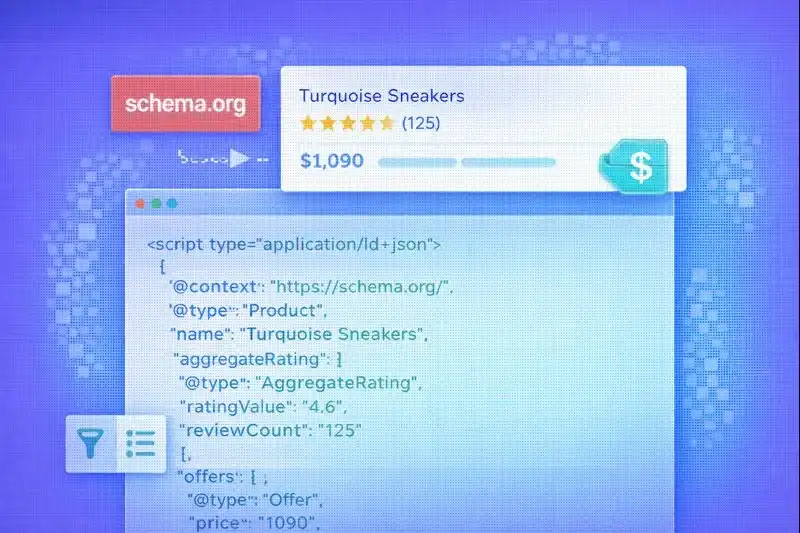
Required Schema Types for E-commerce:
| Type | Where to Use | Search Result |
|---|---|---|
| Product | Product page | Price, availability, rating |
| Review | Reviews | Star rating |
| BreadcrumbList | All pages | Navigation chain |
| FAQ | Categories, products | Expanded answers |
| Organization | Homepage | Logo, contacts |
Schema Product Example:
{
  "@context": "https://schema.org",
  "@type": "Product",
  "name": "Nike Air Max 90",
  "image": "https://example.com/image.jpg",
  "description": "Classic Nike Air Max 90 sneakers",
  "brand": {
    "@type": "Brand",
    "name": "Nike"
  },
  "offers": {
    "@type": "Offer",
    "price": "149.99",
    "priceCurrency": "USD",
    "availability": "https://schema.org/InStock",
    "seller": {
      "@type": "Organization",
      "name": "Your Store"
    }
  },
  "aggregateRating": {
    "@type": "AggregateRating",
    "ratingValue": "4.8",
    "reviewCount": "127"
  }
}
Validation Tools:
- Google Rich Results Test
- Schema.org Validator
- Google Search Console (Rich Results report)
Keyword Research for E-commerce
SEO without keywords is chaos. Ahrefs confirms: long-tail queries drive 70% of sales in large catalogs (Ahrefs, 2024).
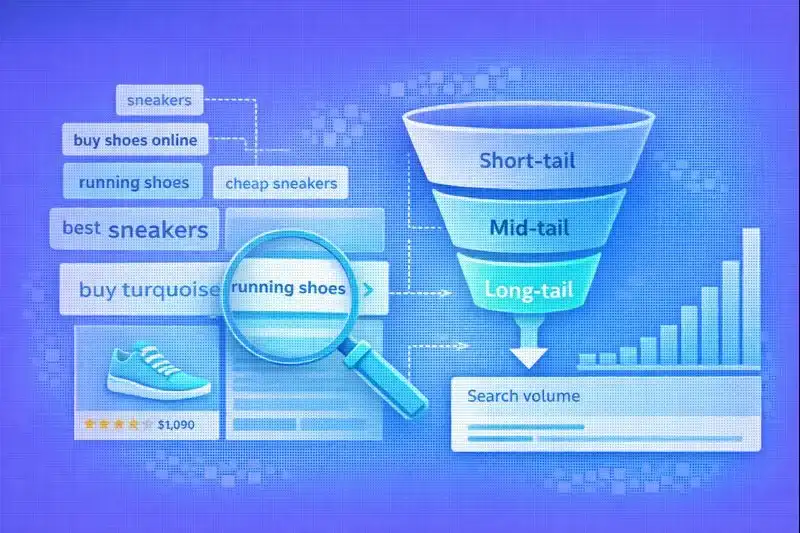
Query Types for E-commerce:
| Type | Example | Intent | Priority |
|---|---|---|---|
| Transactional | "buy Nike sneakers" | Purchase | Highest |
| Commercial | "iPhone 15 Pro price" | Comparison | High |
| Navigational | "Amazon sneakers" | Brand | Medium |
| Informational | "how to choose a laptop" | Research | For blog |
Keyword Structure for Catalog:
Category: "women's sneakers" (high volume)
    └── Subcategory: "Nike women's sneakers" (medium volume)
            └── Product: "Nike Air Max 90 women's white" (low volume)
Keyword Research Tools:
- Ahrefs Keywords Explorer
- Semrush Keyword Magic Tool
- Google Keyword Planner
- Serpstat
- Answer The Public (for questions)
Category Page Optimization
Categories are main organic traffic growth points. Backlinko confirms: categories with unique text rank higher in 62% of cases (Backlinko, 2024).
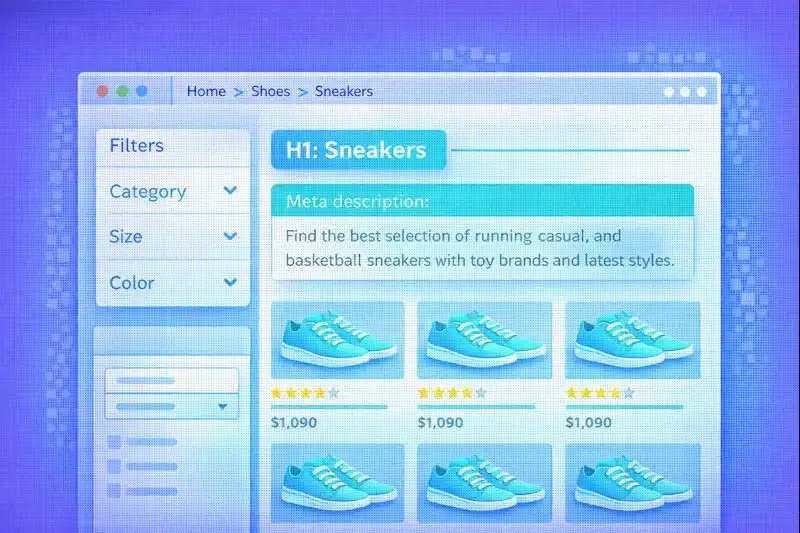
Required SEO Elements for Category:
| Element | Requirements | Example | | --------------- | ----------------------- | ------------------------------------------------------------------------- | ------ | | H1 | Unique, with keyword | "Women's Nike Sneakers" | | Title | ≤ 60 characters | "Women's Nike Sneakers — Buy Online | Store" | | Description | ≤ 160 characters | "Women's Nike Sneakers ✓ 150+ models ✓ Free shipping ✓ Official warranty" | | SEO text | 300-500 words at bottom | Unique category description |
Category Page Structure:
[Breadcrumbs]
[H1: Women's Nike Sneakers]
[Filters] [Sorting]
[Products — 12-24 per page]
[Pagination]
[SEO text 300-500 words]
[FAQ — 3-5 questions]
[Related categories]
Mistakes to Avoid:
- ❌ Same Title for all categories
- ❌ Missing H1
- ❌ Duplicate Description
- ❌ SEO text at top (repels users)
Product Page Optimization
Product pages drive final conversion and long-tail ranking.
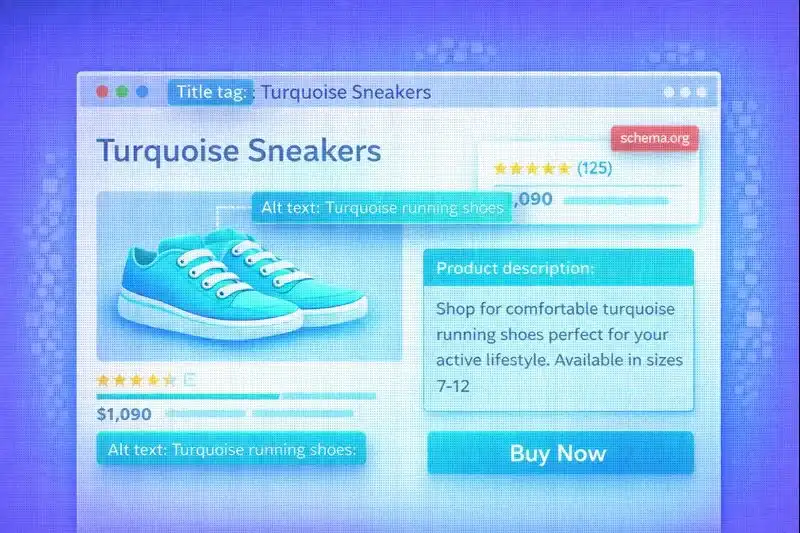
SEO Elements for Product Page:
| Element | Recommendations |
|---|---|
| Title | Brand + Name + Key Feature |
| Description | Unique, 150-160 chars, with CTA |
| H1 | Full product name |
| Alt tags | Image description with keyword |
| Description | 300-1000 words, unique |
| Schema | Product + Review + FAQ |
Template vs Unique Content:
| Approach | Pros | Cons | When to Use |
|---|---|---|---|
| Template | Fast, scalable | Low uniqueness | Thousands of similar products |
| Unique | High rankings | Expensive, slow | Top-100 products |
| Hybrid | Balance | Needs system | Optimal for most |
Product Title Formula:
[Brand] [Name] [Key Feature] | [Store]

Example:
Nike Air Max 90 White Women's Sneakers | YourStore
More details: Product Page Optimization
Content Marketing for E-commerce
Blog drives organic demand and informational traffic. Semrush confirms: SEO ROI is 5.3x higher than PPC (Semrush, 2024).
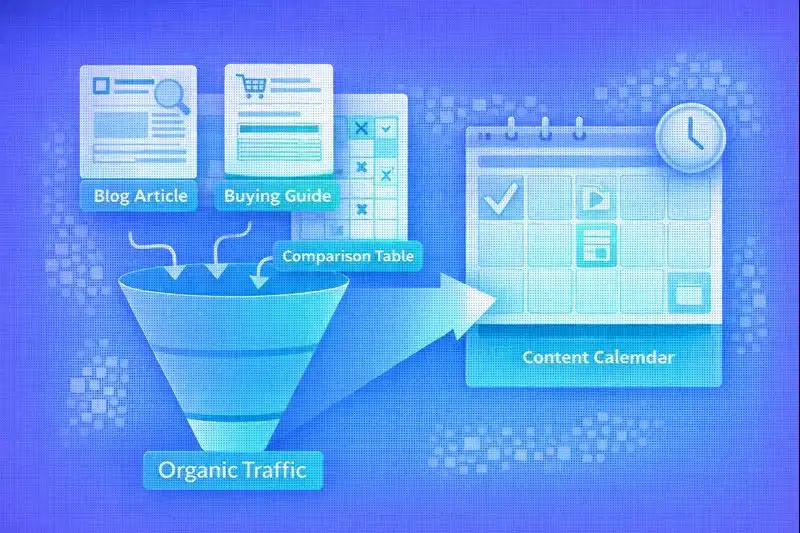
Content Formats for E-commerce:
| Format | Example | Goal |
|---|---|---|
| Guides | "How to choose running shoes" | Informational traffic |
| Comparisons | "Nike vs Adidas: what to choose" | Commercial traffic |
| Top lists | "Top 10 laptops 2025" | Transactional traffic |
| How-to | "How to care for leather shoes" | Retention, expertise |
| Reviews | "iPhone 15 Pro review" | Commercial traffic |
Internal Linking Strategy:
Blog post: "How to choose running shoes"
    ↓
Category: "Running shoes"
    ↓
Products: Nike Pegasus, Adidas Ultraboost
Content Plan for E-commerce:
- 2-4 articles per month
- 70% informational queries
- 30% commercial comparisons
- Internal links to products
- Update old articles quarterly
Frequently Asked Questions
How long does it take to see SEO results?
First results appear in 3-4 months, stable growth — in 6-9 months. Speed depends on competition, domain age, content quality. New sites need more time for Google's "sandbox." Technical fixes show effect faster (1-2 months), content SEO — slower but more stable.
How to optimize thousands of products?
Templates + unique blocks + automation. Create Title/Description templates with dynamic variables: {Brand} {Name} {Feature}. Unique descriptions — for top-100 products by sales. Rest — automated templates with technical specs. Tools: Screaming Frog for audit, scripts for meta tag generation.
Does an online store need a blog?
Yes, blog drives informational traffic that converts through internal linking. Users search "how to choose", "what's better", "review" — this is funnel entry point. Without blog you only compete for transactional queries where competition is highest. Blog builds expertise, trust, backlinks.
How to deal with duplicates from filters?
Canonical + noindex + faceted navigation control. Main category — canonical to itself. Filters with 1 parameter — canonical to category. Filter combinations — noindex. Sorting — always noindex. Pagination — rel="next/prev" or canonical to first page. In robots.txt block parameter crawling: Disallow: /*?filter=.
SEO vs PPC — what to choose?
SEO is long-term asset, PPC is fast traffic. SEO needs 6-12 months investment, but then delivers traffic "for free." PPC gives traffic immediately, but stopping ads = stopping sales. Maximum effect comes from combination: PPC for new products and promotions, SEO for stable demand. Long-term SEO ROI is 5-8x higher than PPC.
Related Articles
- Product Page Optimization — Detailed guide to product card optimization
- CRO for E-commerce — How to increase conversion at every funnel stage
- A/B Testing in E-commerce — How to make data-driven decisions
Conclusion
E-commerce SEO in 2025 is systematic work with technical foundation, content, and UX. Proper architecture, speed, mobile-friendliness, and content drive stable sales growth without ad dependency.
E-commerce SEO Priorities:
- Technical foundation — crawlability, indexability, speed
- URL architecture — logical hierarchy, canonical
- Core Web Vitals — LCP, FID, CLS in green zone
- Structured data — Product, Review, BreadcrumbList
- Content — unique category and top product descriptions
- Blog — informational traffic, internal linking
Success Formula: Technical SEO + Content + Time = Organic Growth.
LetsCommerce creates a platform where SEO works from day one — optimized architecture, speed, Schema.org out of the box.