Introduction
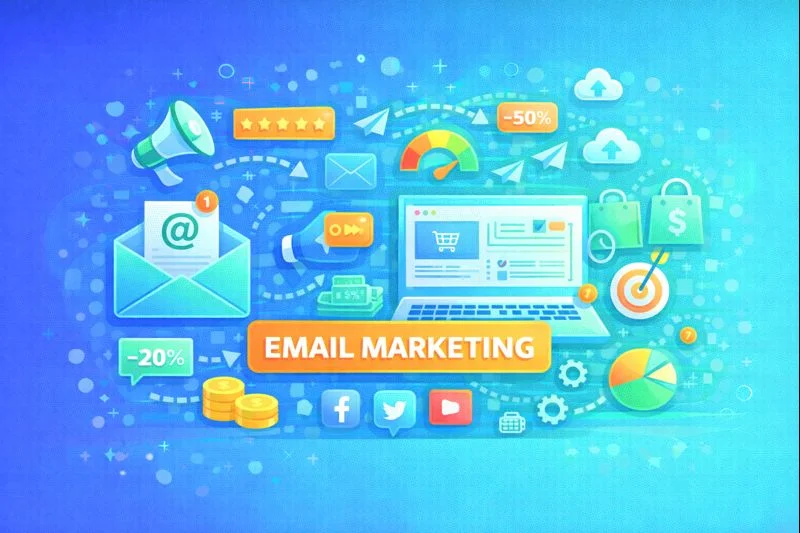
Email marketing remains the most profitable owned channel for e-commerce in 2025. While paid acquisition costs continue to rise across Google and Meta, email delivers predictable revenue with minimal marginal cost. According to the DMA, email generates an average ROI of 4200% — $42 for every $1 spent (DMA, 2024).
Klaviyo reports that email drives 30–40% of total e-commerce revenue for mature brands (Klaviyo, 2024).
Modern email marketing no longer relies on newsletters alone. Winning brands build automated funnels, behavior-based triggers, and advanced segmentation systems that respond to customer intent in real time. This guide explains how to design high-performing email funnels for e-commerce in 2025, from welcome flows to win-back campaigns.
Email Marketing Funnel for E-commerce
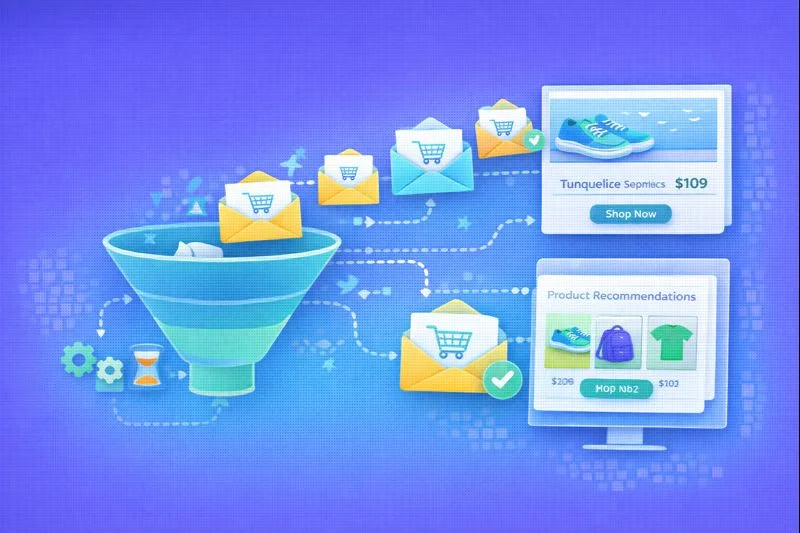
An effective email funnel mirrors the customer lifecycle — from first interaction to repeat purchases and long-term loyalty.
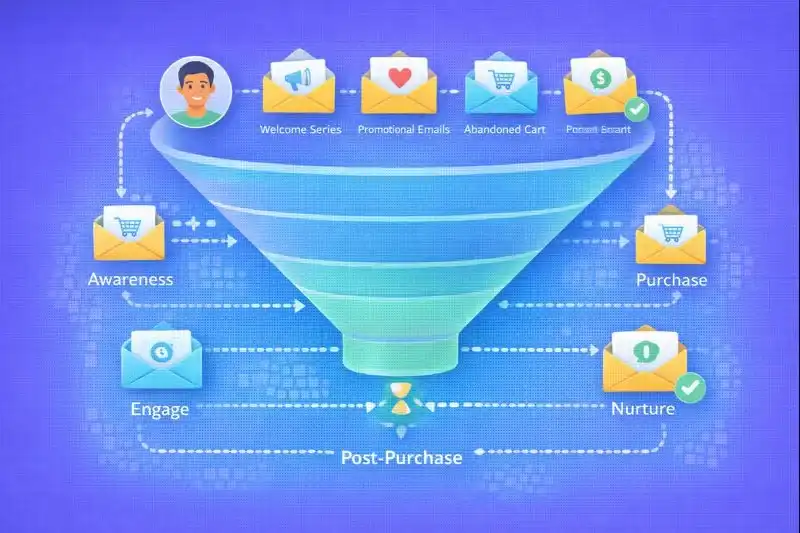
Campaign Monitor data shows that automated lifecycle emails generate 320% more revenue than one-off campaigns (Campaign Monitor, 2024).
Core Funnel Stages:
| Funnel Stage | Goal | Primary Flows |
|---|---|---|
| Acquisition | Capture emails | Welcome series |
| Activation | First purchase | Browse + cart abandonment |
| Monetization | Increase AOV | Cross-sell, upsell |
| Retention | Repeat purchases | Post-purchase flows |
| Reactivation | Win back users | Win-back campaigns |
Each stage requires different messaging, timing, and incentives.
Funnel Setup Checklist:
- Welcome series configured (3-5 emails)
- Abandoned cart flow active
- Post-purchase sequence built
- Win-back campaign scheduled
- Cross-sell flows connected to purchase data
Automation Triggers and Flows
Automation triggers define when emails send and why. Behavioral triggers consistently outperform scheduled campaigns.
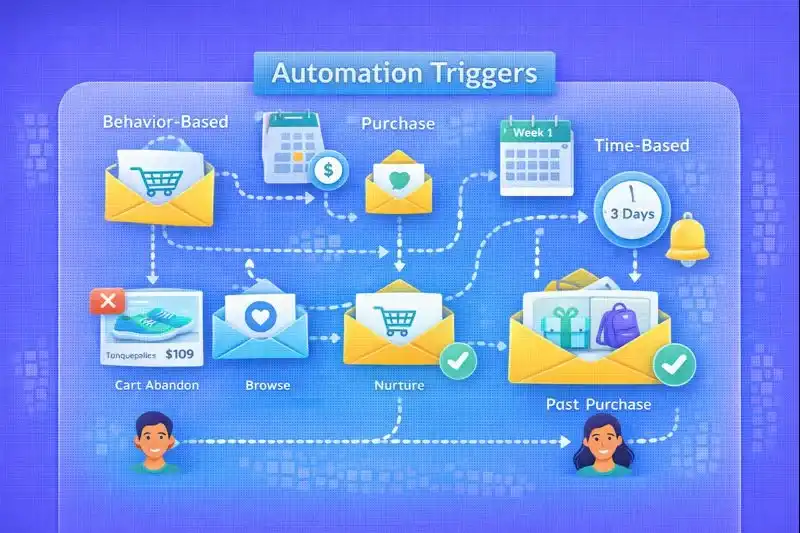
Omnisend reports that triggered emails generate 8× higher conversion rates than bulk emails (Omnisend, 2024).
Trigger Types:
| Trigger Type | Example |
|---|---|
| Behavioral | Product viewed, cart added |
| Transactional | Order placed, shipped |
| Time-based | Inactive for 60 days |
| Event-based | Birthday, anniversary |
Example Trigger Logic:
IF add_to_cart = true
AND purchase = false
AND time_since_event = 1 hour
THEN send "Abandoned Cart Email #1"
Essential Automation Flows:
| Flow | Trigger | Priority |
|---|---|---|
| Welcome series | Email signup | Critical |
| Abandoned cart | Cart + no purchase | Critical |
| Browse abandonment | Product view + no cart | High |
| Post-purchase | Order completed | Critical |
| Win-back | 60+ days inactive | High |
| Replenishment | Product cycle complete | Medium |
Audience Segmentation Strategies
Segmentation determines relevance. Sending the same email to your entire list suppresses engagement and hurts deliverability.
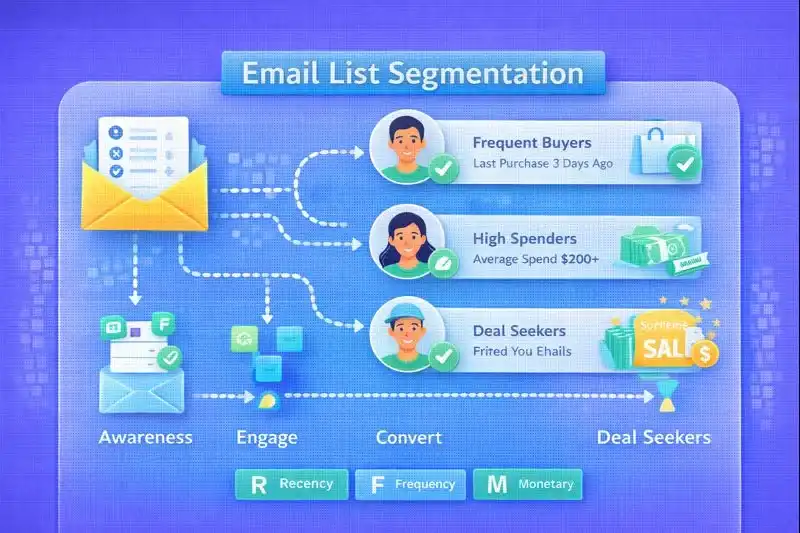
Mailchimp data shows that segmented campaigns drive 14.3% higher open rates and 100% higher click rates (Mailchimp, 2024).
RFM Segmentation Model:
| Metric | Meaning |
|---|---|
| Recency | Last purchase date |
| Frequency | Purchase count |
| Monetary | Total spend |
Lifecycle Segments:
| Segment | Definition |
|---|---|
| New subscribers | No purchase yet |
| Active buyers | Purchased in last 30 days |
| Loyal customers | 3+ purchases |
| At-risk | No activity 60–90 days |
| Inactive | No activity 120+ days |
Segmentation Checklist:
- RFM segments created
- Lifecycle stages defined
- VIP/loyalty tier identified
- Product category preferences tracked
- Engagement scoring enabled
Welcome Series
The welcome series sets expectations and drives the first conversion.
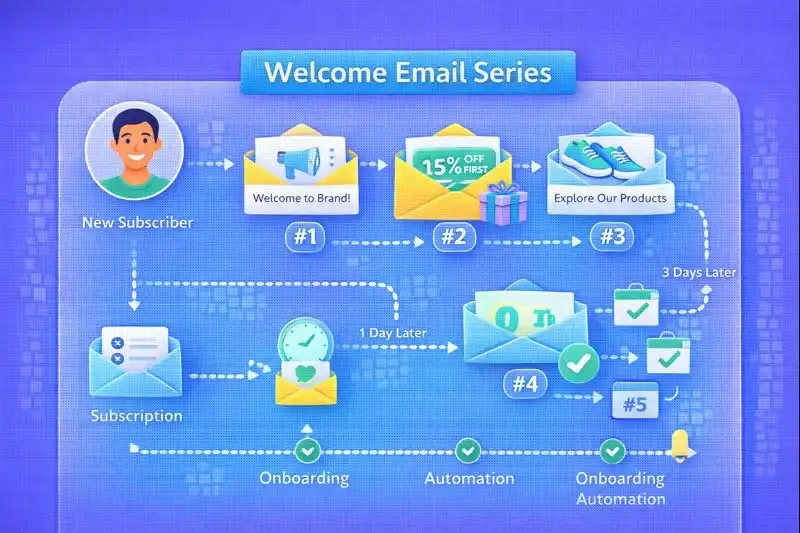
Klaviyo reports that welcome emails have an average open rate of 51% (Klaviyo, 2024).
Recommended Welcome Flow (4 Emails):
| Timing | Purpose | |
|---|---|---|
| Email 1 | Immediate | Brand intro + incentive |
| Email 2 | Day 2 | Categories / bestsellers |
| Email 3 | Day 4 | Reviews / social proof |
| Email 4 | Day 7 | Urgency reminder |
Example Subject Lines:
Welcome to [Brand] – Enjoy 10% Off Your First Order
Why 50,000 Customers Choose [Brand]
Last Chance: Your Welcome Discount Expires Tonight
Welcome Series Checklist:
- Discount code included (if applicable)
- Brand story communicated
- Bestsellers showcased
- Social proof included
- Clear CTA in every email
Abandoned Cart Emails
Cart abandonment remains the largest revenue recovery opportunity.
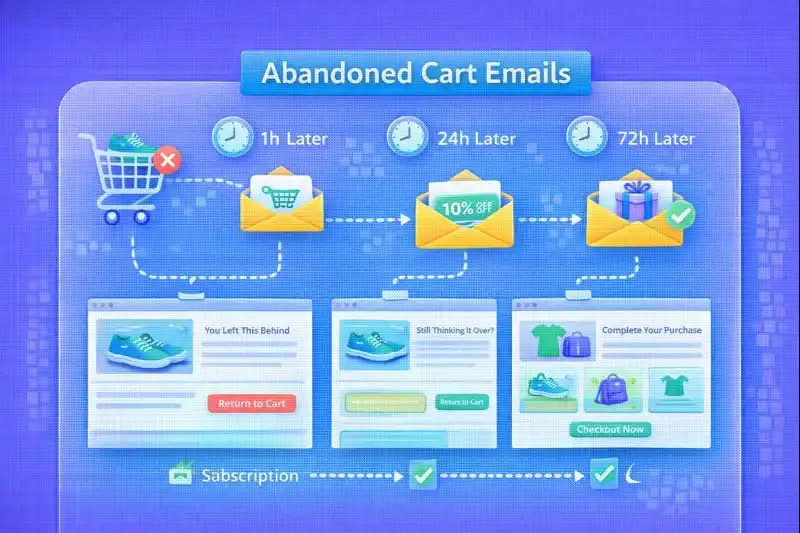
Baymard Institute data shows 69.99% of carts are abandoned, while Omnisend reports cart recovery emails convert at 10–18% (Baymard Institute, 2024).
Recommended Abandoned Cart Sequence:
| Timing | Focus | |
|---|---|---|
| Email 1 | 1 hour | Reminder |
| Email 2 | 24 hours | Benefits + proof |
| Email 3 | 72 hours | Incentive |
Flow Example:
Email 1: "You left something behind" + product image
Email 2: Reviews + FAQs
Email 3: 10% discount + urgency
Abandoned Cart Checklist:
- Product images included
- Direct cart link provided
- Social proof in Email 2
- Incentive reserved for Email 3
- Mobile-optimized template
Post-Purchase Automation
Post-purchase emails build trust and increase lifetime value.
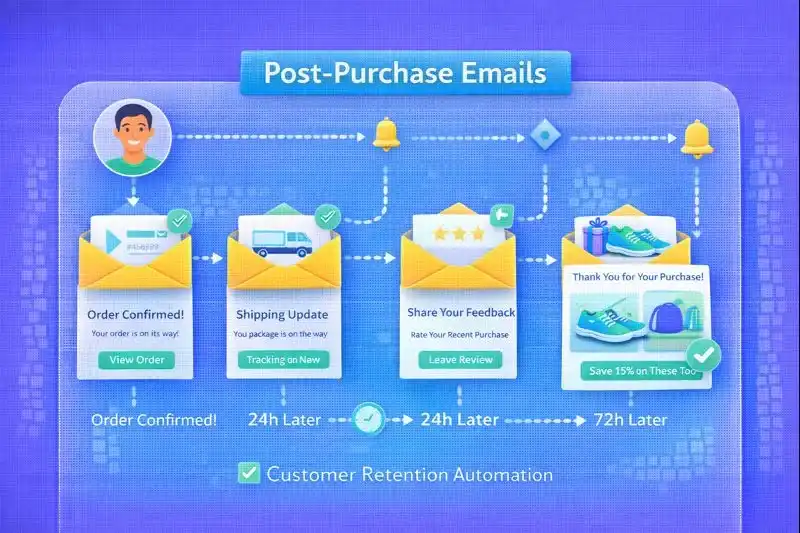
Litmus reports that post-purchase emails generate 3× higher engagement than promotional emails (Litmus, 2024).
Post-Purchase Flow Types:
| Flow | Purpose |
|---|---|
| Order confirmation | Trust |
| Shipping updates | Transparency |
| Review request | Social proof |
| Cross-sell | AOV growth |
| Replenishment | Repeat orders |
Post-Purchase Sequence:
Day 0: Order confirmation
Day 1-3: Shipping updates
Day 7: Review request
Day 14: Cross-sell recommendations
Day 30+: Replenishment reminder (if applicable)
Personalization and Dynamic Content
Personalization drives relevance beyond first-name tokens.
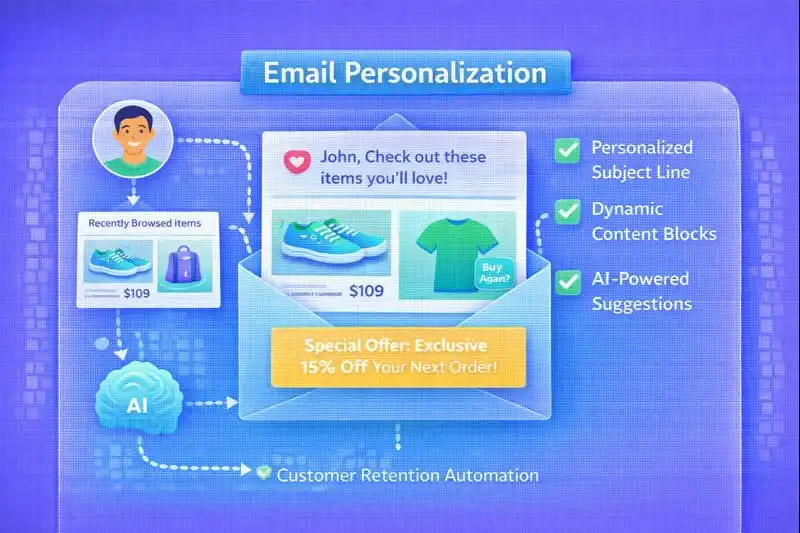
Campaign Monitor reports emails with dynamic content see 20% higher CTR (Campaign Monitor, 2024).
Personalization Elements:
| Element | Example |
|---|---|
| Subject line | Product viewed |
| Content blocks | Recommended items |
| Timing | Local time |
| Offers | Loyalty tier |
Dynamic Product Block Logic:
IF last_viewed_category = "Shoes"
SHOW recommended_products FROM "Shoes"
Personalization Checklist:
- Dynamic product recommendations enabled
- Browse history integrated
- Purchase history connected
- Location-based content (if relevant)
- Loyalty tier messaging configured
Email Metrics and KPIs
Tracking the right KPIs enables optimization without overreacting to vanity metrics.
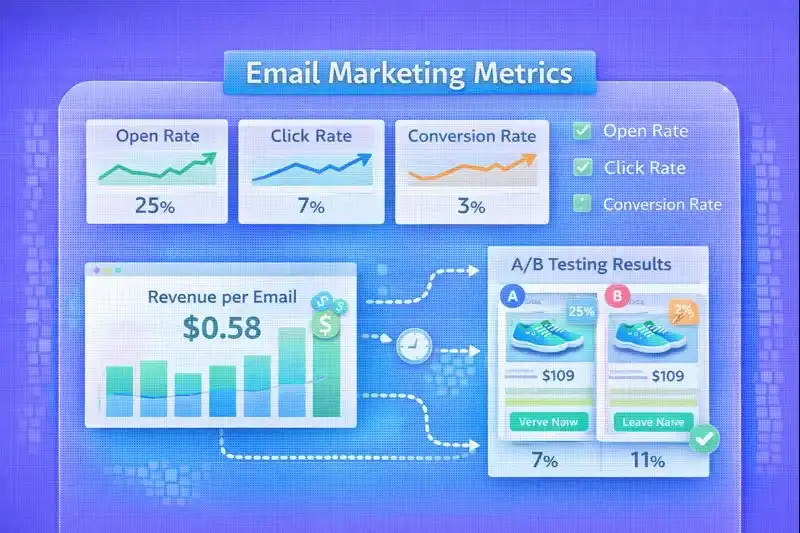
Statista reports top-performing brands generate $0.35–$0.50 revenue per email sent (Statista, 2024).
Core Email Metrics:
| Metric | Meaning |
|---|---|
| Open rate | Subject relevance |
| CTR | Content relevance |
| Conversion rate | Funnel efficiency |
| Revenue per email | Profitability |
| Unsubscribe rate | List health |
Key Formulas:
Email ROI:
ROI = (Email Revenue – Email Costs) / Email Costs

Example: ($50,000 - $2,000) / $2,000 = 2400% ROI
List Growth Rate:
List Growth Rate = (New Subscribers – Unsubscribes) / Total List Size

Example: (1,000 - 200) / 20,000 = 4% monthly growth
Benchmark Metrics:
| Metric | Good | Excellent |
|---|---|---|
| Open rate | 20–25% | 30%+ |
| CTR | 2–3% | 5%+ |
| Conversion | 1–2% | 3%+ |
| Unsubscribe | < 0.5% | < 0.2% |
Deliverability Best Practices
Inbox placement determines revenue.
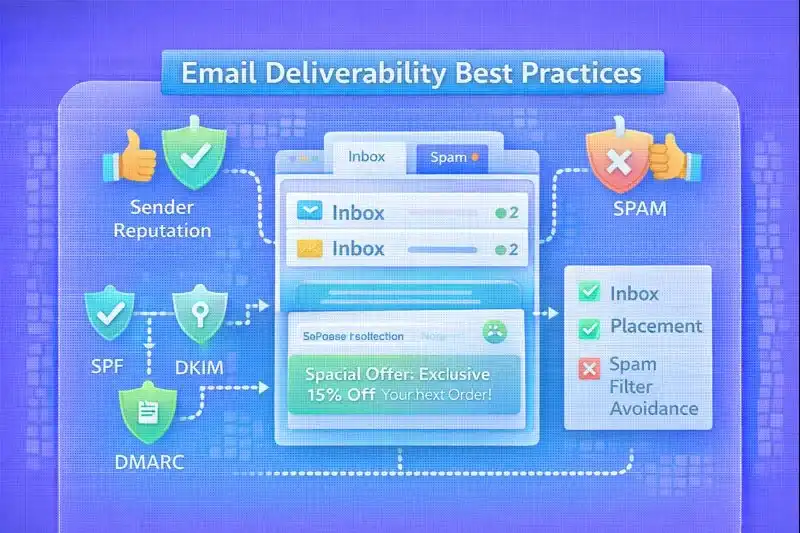
DMA reports 21% of marketing emails never reach the inbox due to deliverability issues (DMA, 2024).
Technical Essentials:
| Component | Purpose |
|---|---|
| SPF | Sender authentication |
| DKIM | Message integrity |
| DMARC | Domain protection |
Deliverability Checklist:
- SPF, DKIM, DMARC configured
- Double opt-in enabled
- Regular list cleaning (quarterly)
- Sunset flows for inactive users
- Mobile-optimized templates
- Spam trigger words avoided
- Consistent sending schedule
Spam Trigger Words to Avoid:
FREE, Act Now, Limited Time, Congratulations, Winner
100% Guaranteed, No Obligation, Click Here, Urgent
Frequently Asked Questions
How many emails should an e-commerce store send per week?
2–4 campaigns plus automation flows work best for most brands. Over-mailing causes fatigue and unsubscribes. Under-mailing leaves revenue on the table. Monitor engagement metrics weekly and adjust frequency based on segment behavior. VIP customers tolerate higher frequency; new subscribers need careful pacing.
Are discounts required for email success?
No. Value-driven content outperforms discounts long-term. Discounts train customers to wait for sales. Instead, focus on product education, social proof, and personalized recommendations. Reserve discounts for welcome series, abandoned cart recovery, and win-back campaigns where incentives move hesitant buyers.
How long should win-back campaigns run?
Typically 60–90 days of inactivity before triggering. Send 2–3 emails over 2–4 weeks. If no engagement after win-back sequence, move subscribers to sunset flow. Continuing to email inactive users damages sender reputation and deliverability scores.
Should I remove inactive subscribers?
Yes. Sunset flows protect deliverability and engagement. Inactive subscribers who don't open emails for 120+ days hurt your sender reputation. Implement a sunset flow: final re-engagement attempt, then suppress or remove. A smaller, engaged list outperforms a large, inactive one.
Is email still effective on mobile?
Yes. Over 65% of emails are opened on mobile devices (Litmus, 2024). Mobile optimization is mandatory. Use single-column layouts, large touch targets (44px minimum), readable fonts (16px+), and compressed images. Test across devices before sending.
Related Articles
- Remarketing and Retargeting — Win back customers with paid ads
- Google Ads for E-commerce — Performance Max and Shopping setup
- CRO for E-commerce — Increase conversion at every funnel stage
- Checkout Optimization — Reduce cart abandonment at checkout
Conclusion
Email marketing remains the backbone of profitable e-commerce in 2025. Automated funnels, precise segmentation, and lifecycle-based messaging drive predictable revenue while protecting margins. Brands that treat email as a system — not a channel — outperform competitors across retention, LTV, and ROAS.
Email Marketing Success Priorities:
- Automation first — build triggered flows before campaigns
- Segmentation — never send the same email to everyone
- Lifecycle approach — match messaging to customer stage
- Personalization — go beyond first-name tokens
- Deliverability — protect sender reputation
- Measurement — track revenue, not just opens
Success Formula: Automated Flows + Smart Segmentation + Personalization = Predictable Revenue.
LetsCommerce integrates with leading email platforms like Klaviyo, Omnisend, and Mailchimp — launch automated email flows that drive revenue from day one.