
Introduction
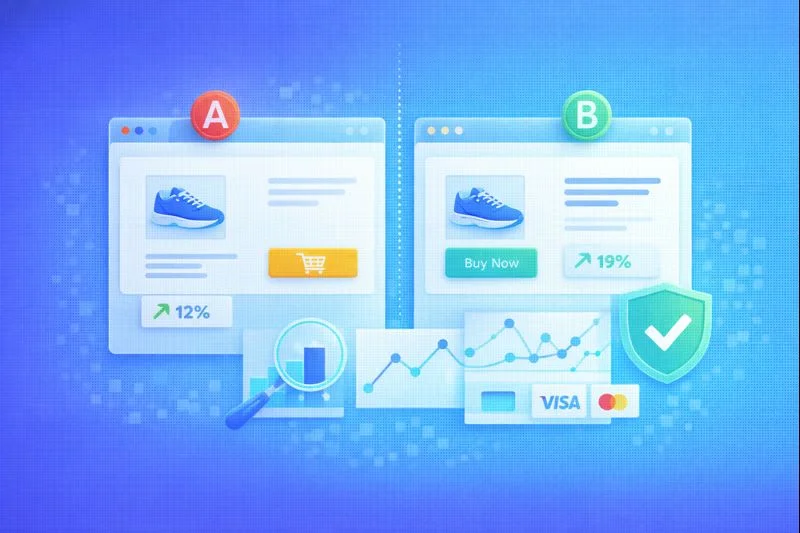
Online reputation is a critical business asset that directly impacts e-commerce survival. Reviews shape first impressions, reduce purchase uncertainty, and influence conversion more powerfully than any advertising or marketing campaign.
According to BrightLocal Consumer Review Survey:
- 93% of shoppers read reviews before purchasing
- 91% of people 18-34 trust online reviews as much as personal recommendations
- 68% of buyers willing to pay 15% more for products with higher ratings
- 94% of consumers avoid businesses due to negative reviews
Cost of bad reputation:
- Loss of 22% potential customers at 4.0 vs 4.5 rating
- 30-50% conversion decrease at ratings below 3.5
- 40-60% CAC increase
- Negative SEO impact
Opportunity:
Paradoxically, properly handling negative reviews strengthens brands rather than destroying them. Transparency, quick response, and problem resolution demonstrate business maturity and increase trust more than a suspiciously perfect 5.0 rating.

Anatomy of Online Reputation
Where Reputation Forms: Review Ecosystem Map
Reputation forms across distributed ecosystem channels. Each has different weight and impact at different customer journey stages.
Key platforms:
- Own e-commerce site - High impact (directly near CTA), full control
- Google Reviews - Highest impact for local/commercial search
- Trustpilot - High for international customers, minimal control
- Marketplaces - Critical for platform sales
- Social Media - Medium impact but emotionally significant
- Forums - Medium impact, long-term influence
Weighted Platform Impact
| Platform | SEO Impact | Conversion Impact | Trust Impact | Priority |
|---|---|---|---|---|
| Google Reviews | 10/10 | 9/10 | 9/10 | 🔴 Critical |
| Own site | 7/10 | 10/10 | 7/10 | 🔴 Critical |
| Trustpilot | 8/10 | 8/10 | 10/10 | 🟠 High |
| Marketplaces | 5/10 | 10/10 | 8/10 | 🟠 High |
Reputation Score Calculation
Reputation Score = (Average Rating × 40%) +
                   (Volume Factor × 25%) +
                   (Recency Factor × 20%) +
                   (Sentiment Factor × 15%)
High quantity of fresh reviews with positive sentiment = stable reputation.
Reputation Monitoring
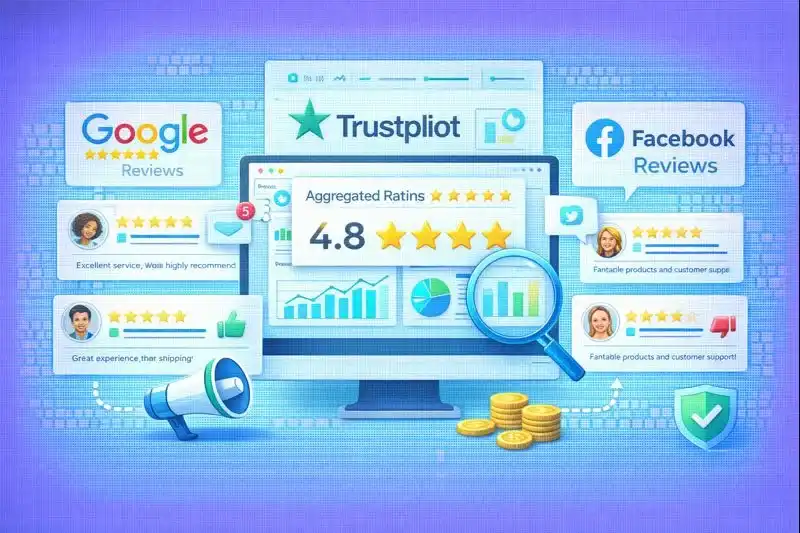
Monitoring Tools
| Tool | Purpose | Pricing | Best for |
|---|---|---|---|
| Google Alerts | Basic brand mentions | Free | Startups |
| Mention | Social media, news | $29-99/mo | Social listening |
| Brand24 | Real-time sentiment | $49-399/mo | Sentiment tracking |
| ReviewTrackers | Multi-platform aggregation | $99-499/mo | Multi-platform |
Real-Time Alerts Setup
Critical alert triggers:
- Negative review (<3 stars) - instant notification
- Rating drop >0.2 - daily digest
- Review spike - possible attack or viral event
- Competitor mentions
- Keyword triggers - "fraud", "scam", "terrible"
What to Monitor
- Ratings trends - overall trend direction
- Keywords and topics - what customers praise/criticize
- Competitor mentions - validation or threats
- Sentiment shifts - sudden mood changes
Response Time as Critical Metric
Industry standard: <24 hours for first response.
| Response Time | Customer Satisfaction | Win-back Probability |
|---|---|---|
| <2 hours | Excellent (95%) | 85% |
| 2-24 hours | Good (75%) | 60% |
| 24-48 hours | Acceptable (50%) | 35% |
| >48 hours | Poor (25%) | 15% |
Each hour of delay = -10% win-back probability.
Proactive Review Request Strategy
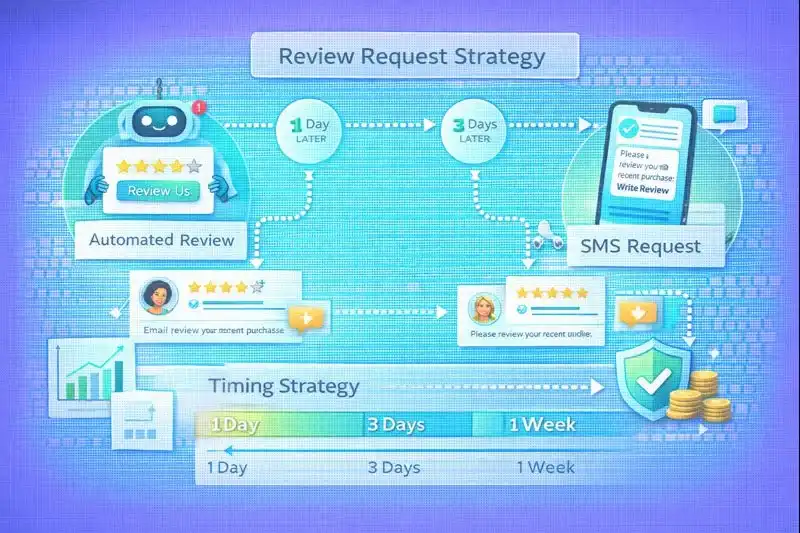
Timing Strategy
Sweet spot = 7-14 days after delivery.
Product-specific timing:
| Product Type | Optimal Timing | Why |
|---|---|---|
| Electronics | 10-14 days | Needs setup, testing |
| Clothing | 5-7 days | Quick fit assessment |
| Cosmetics | 14-21 days | Results need time |
| Food | 3-5 days | Consumed quickly |
Segmentation Approaches
VIP Customers:
- Personal email from CEO
- Exclusive perks for review
- Emphasis on influence impact
Repeat Buyers:
- Community contribution focus
- Doubled loyalty points
- "Help others like you helped yourself"
First-time Buyers:
- Simple, non-pushy request
- Standard incentive (5-10% discount)
- Emphasis on helping others
Multi-Channel Approach
- Email (primary) - 25-35% open rate, 8-15% conversion
- SMS - 98% open rate, 5-10% conversion
- In-app/Website popup - 15-20% engagement
- QR codes on packaging - 5-12% scan rate
Review collection strategies integrate with UGC.
Response Framework
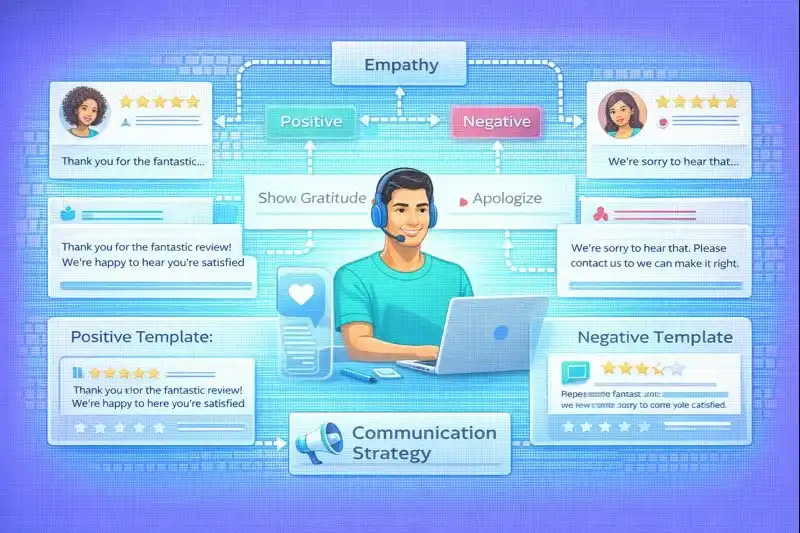
Positive Reviews (4-5 Stars)
Formula: Thank + Personalization + Soft CTA
Example:
"Thank you for the kind words, [Name]! 😊

We're glad you're satisfied with [specific detail].

If you need anything else - we're always here.

Best regards,
[Brand] Team"
Neutral Reviews (3 Stars)
Win-back opportunity.
Formula: Acknowledge + Ask for details + Offer improvement
Example:
"Hi [Name]!

Thank you for your feedback. Sorry to hear delivery took longer than expected.

Could you share more details about timing? We're actively improving logistics.

Feel free to reach out directly at [email].

Regards,
[Name], Customer Support Lead"
Negative Reviews (1-2 Stars)
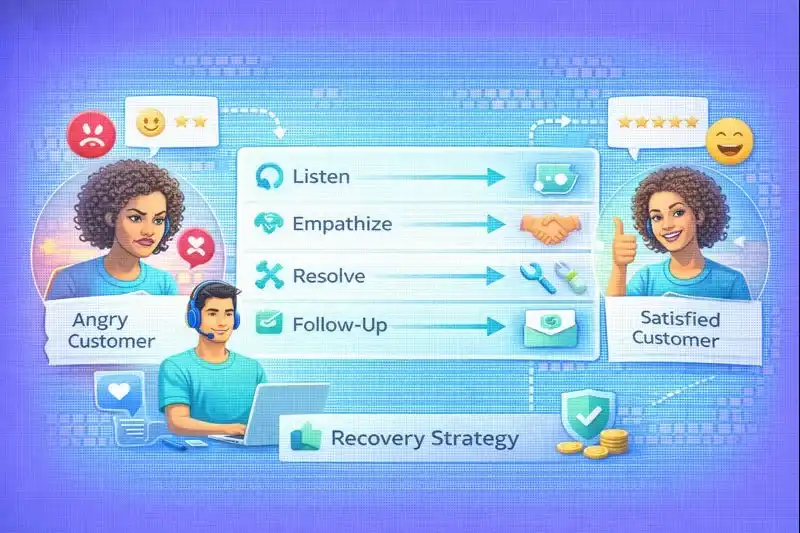
HEARD Framework:
- Hear - listen, understand problem
- Empathize - express empathy, acknowledge emotions
- Apologize - apologize (even if not directly your fault)
- Resolve - offer concrete solution
- Deliver - fulfill promise
Public response + Private resolution strategy:
Public response:
"[Name], we sincerely apologize for this experience. This is absolutely unacceptable.

We'll contact you personally within 2 hours to resolve this.

If you don't hear from us - reach me directly: [email] or [phone].

This is not the standard we strive for.

Regards,
[Name], Customer Experience Manager"
Private resolution:
- Detailed problem investigation
- Immediate refund/replacement
- Compensation for inconvenience
- Follow-up after resolution
Goal: Publicly show accountability, privately solve problem and win back customer.
Detailed connection between returns and negative reviews in Returns Management.
Fake/Spam Reviews
Identification:
- Single review account (new)
- Generic text without details
- Copy-paste pattern
- Timing anomaly
- No purchase history
Response:
"We value honest reviews. However, this review doesn't appear connected to an actual purchase.

We've contacted [Platform] for verification. If you're truly our customer - please reach us at [email]."
Crisis Management
Negative Review Psychology
Negative reviews often stem from frustration and loss of control. Quick empathetic response reduces tension.
DO's and DON'Ts
| ✅ DO | ❌ DON'T |
|---|---|
| Respond quickly (<24h) | Ignore or delay |
| Acknowledge problem publicly | Deny or be defensive |
| Offer concrete solution | Use generic phrases |
| Take details private | Publicly argue |
| Demonstrate empathy | Blame customer |
| Learn from feedback | Make excuses |
Case Study: 1-Star → 5-Star Recovery
Original (1 star): "Product doesn't work. Wasted money."
Brand action:
- Public response <2 hours
- Phone call <4 hours
- Discovered: user error + poor product UX
- Sent replacement + tutorial video + $20 credit
- Follow-up after 1 week
Updated (5 stars): "Initially had problem, but team solved EVERYTHING extremely fast. Rarely see this service level. Now my favorite store!"
Cost: $195 Value: Retained customer (LTV $800+) + social proof ROI: 400%+
Review Gating - Ethics and Risks
Review gating - requesting reviews only from satisfied customers.
Why it violates:
- Google Guidelines explicitly forbid
- FTC considers it deceptive practice
- Trustpilot auto-removes businesses
Consequences:
- Delisting from platforms
- FTC fines ($10,000+)
- Reputation damage when exposed
Ethical alternative: Request reviews from ALL customers equally, improve quality naturally.
Tools and Automation
Review Management Platforms
| Platform | Features | Pricing | Best for |
|---|---|---|---|
| Yotpo | Reviews + UGC + Loyalty | $79-399/mo | E-commerce all-in-one |
| Trustpilot | Reviews + Widgets | $199-999/mo | Trust-first brands |
| ReviewTrackers | Multi-platform aggregation | $99-499/mo | Analytics focus |
Automation integrates with Email Marketing.
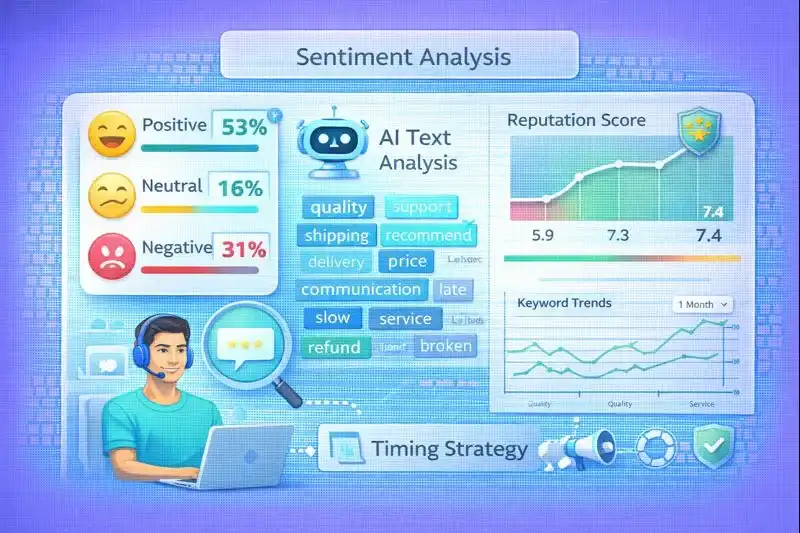
AI-Powered Sentiment Analysis
AI can automate:
- Sentiment classification (90%+ accuracy)
- Topic extraction
- Urgency detection
- Language detection
- Spam/fake detection
Reputation Recovery Plan
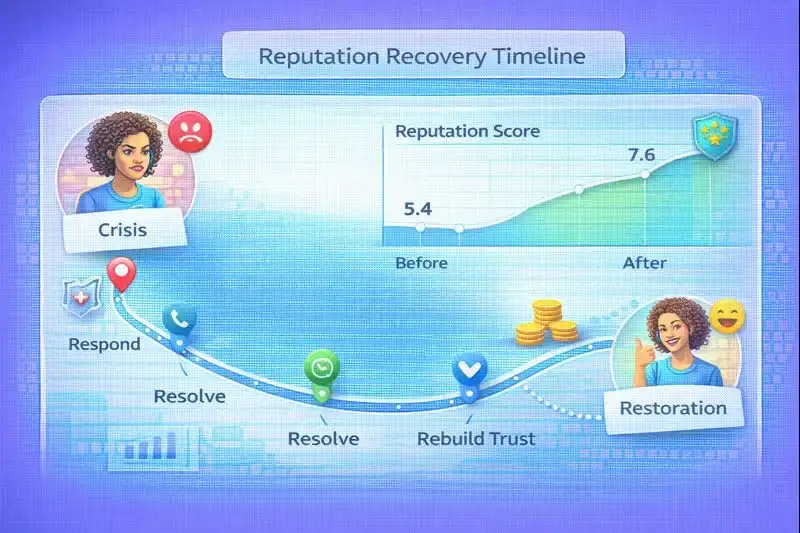
4-Phase Recovery
Phase 1: Acknowledge (Week 1)
- Public statement acknowledging problem
- Stop shipping affected products
- Proactive outreach to affected customers
- Offer immediate resolution
Phase 2: Fix Root Cause (Week 2-4)
- Identify and eliminate root cause
- Implement quality controls
- Document improvements publicly
Phase 3: Communicate Progress (Week 4-8)
- Regular updates
- Email campaigns showing improvements
- Behind-the-scenes content
Phase 4: Rebuild Trust (Week 8-24)
- Proactive positive review campaign
- Customer success stories
- Incentivized requests (ethical)
- PR highlighting improvements
Realistic timeline: 3-6 months
Competitor Reputation Analysis
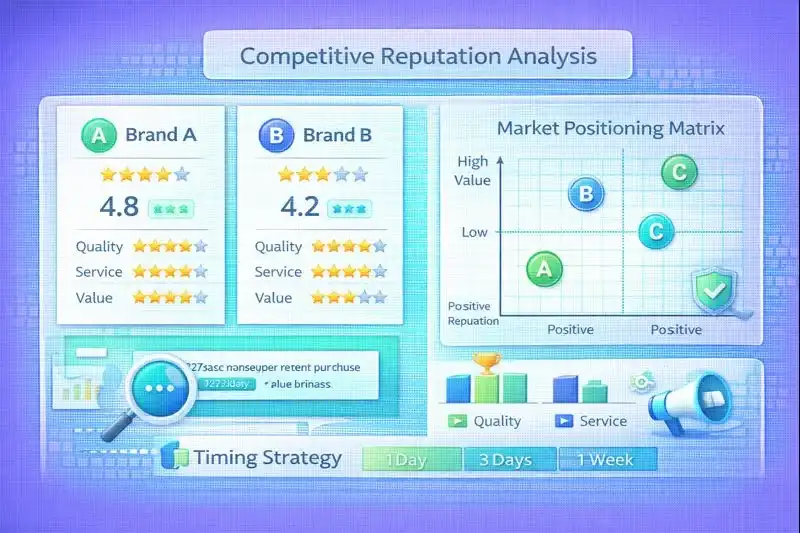
Learning from Competitor Weaknesses
What to analyze:
- Recurring complaints - systemic problems
- Product gaps - missing features
- Service failures - shipping, support issues
- Positioning opportunities
Example:
Competitor negative reviews: 32% mention "slow shipping"

Your opportunity:
✅ Emphasize "2-day shipping" in marketing
✅ Highlight fast delivery differentiator
Reputation Impact on Business Metrics
Conversion Rate Correlation
| Average Rating | Conversion Rate | vs 4.0 baseline |
|---|---|---|
| 5.0 | 3.2% | -20% (suspicious) |
| 4.7-4.9 | 4.5% | +12.5% |
| 4.5-4.6 | 4.2% | +5% |
| 4.0-4.4 | 4.0% | 0% |
| <3.5 | 1.5% | -62.5% |
Sweet spot: 4.5-4.8 (credible, excellent, not suspiciously perfect)
SEO Impact
Google ranking signals:
- Quantity - more reviews = more fresh content
- Recency - recent reviews signal active business
- Keywords - customer reviews contain long-tail terms
- Rich snippets - star ratings in SERP increase CTR 30-50%
Customer Lifetime Value
Loyal customers leave more reviews, increasing Customer Lifetime Value.
Key Metrics
Average Rating and Trend
Tracking:
- Overall average (all platforms)
- Per-platform breakdown
- Week/month-over-week change
Alert triggers:
- Drop >0.2 stars week-over-week
- Sustained decline 3+ weeks
Review Volume
Metrics:
- Absolute volume
- Reviews per 100 orders (review rate %)
- New reviews per week/month
Benchmark: 8-15% review rate
Response Rate and Time
Response Rate = (Responded reviews / Total reviews) × 100%
Target: >90%

Avg Response Time target: <24 hours
Sentiment Score
Sentiment Score = (Positive reviews / Total) × 100%

Benchmarks:
- Excellent: >85%
- Good: 75-85%
- Acceptable: 65-75%
- Poor: <65%
Advanced Tactics
Review Syndication
Distributing reviews from one platform to others for maximum reach.
Rich Snippets Optimization
Schema.org markup implementation for star ratings in Google search results.
Impact: +30-50% CTR from search.
Video Testimonials
- 10x engagement vs text reviews
- Authenticity impossible to fake
- Higher incentive needed ($20-50 credit)
Legal Aspects
Fake Reviews Legislation
USA: FTC Act forbids fake reviews, fines up to $43,000+ per violation EU: Unfair Commercial Practices Directive GDPR: Right to request review removal (personal data)
Defamation
Review crosses into defamation when contains factually false statements (not opinions) with intent to harm.
Healthy Reputation Checklist
Monitoring:
- Review monitoring tools configured
- Real-time alerts for negative reviews
- Centralized dashboard setup
- Weekly reputation report automated
Proactive Generation:
- Post-purchase email sequence automated
- SMS follow-up for non-responders
- Ethical incentive structure
- Multi-channel approach
Response Management:
- Response templates created
- <24h SLA defined
- Team trained on HEARD framework
- Escalation process ready
Metrics Tracking:
- Average rating tracked weekly
- Response rate >90%
- Sentiment score >80%
- Conversion impact measured
Common Mistakes
- Ignoring negative reviews - response rate matters
- Defensive responses - escalates conflict
- Deleting criticism - Streisand effect
- Review gating - platform violations
- Fake positive reviews - legal penalties, ban risk
- Slow response time - each hour = -10% win-back
FAQ
1. What rating is considered "good"?
4.4-4.8 stars optimal range. Industry benchmarks: Fashion 4.3, Electronics 4.5, Beauty 4.4. Perfect 5.0 appears suspicious.
2. How many reviews minimum for trust?
Minimum 50 reviews threshold. Optimal 100-200+ for statistical significance. 3-6 months timeline with active strategy.
3. What to do with fake negative review?
Verify (no purchase record?), public response stating no record found, report to platform with evidence, legal action if organized attack.
4. Can negative review be removed if unfair?
Generally NO, unless contains profanity, hate speech, fake (no purchase), threats. Cannot remove simply because customer unsatisfied. Best approach: address publicly, resolve privately.
5. How quickly to respond to reviews?
Negative (<3 star): <4 hours. Neutral (3 star): <12 hours. Positive (4-5 star): <48 hours. Each hour delay = -10% win-back probability.
6. Should you pay for positive reviews?
Absolutely NO. Illegal (FTC violations), platform bans, reputation destruction when exposed. Ethical alternative: incentivize submission (discount for ANY review, not only positive).
7. What if competitor attacks with negative reviews?
Document suspicious reviews, report to platform, public transparency statement, legal consultation if severe, focus on dilution campaign with legitimate positives.
Conclusion
Online reputation reflects product quality, service level, company culture, and customer attitude. Reputation builds over years but can be destroyed in days with wrong approach.
Success principles:
- Proactivity > Reactivity - prevent problems, not just respond
- Speed = Trust - each hour costs win-back opportunities
- Transparency > PR Spin - honesty always wins long-term
- Learn > Defend - reviews as operational insights
- Empathy First - understanding emotions over being "right"
- Quality Foundation - no shortcuts, only excellent products/service generate sustainable positive reputation
LetsCommerce platform:
LetsCommerce provides comprehensive reputation management tools:
- Centralized monitoring - all reviews in one dashboard
- Automated requests - integration with Email Marketing
- AI-powered analytics - sentiment analysis, topic extraction
- Response management - templates, personalization, SLA tracking
- Rich snippets - automatic schema.org markup for SEO
- Crisis alerts - real-time notifications for critical negatives
- Competitor tracking - benchmark against competitors
- ROI analytics - conversion impact measurement
Start today, invest consistently, and results compound over time.
Related Articles
- UGC (User-Generated Content) - review collection as part of UGC strategy
- Customer Lifetime Value - how reputation impacts LTV through retention
- Email Marketing - automated review request campaigns
- Returns Management - connection between return experience and negative reviews