Introduction
Delivery is a critical success factor for e-commerce in Ukraine. Cost, speed, and logistics predictability directly impact conversion rates, average order value, repeat purchases, and Customer Lifetime Value. Ukrainian customers expect fast delivery, transparent pricing, multiple carrier options, and transparent tracking.
Ukraine's delivery market in 2025 has formed around several major operators. Nova Poshta dominates the private segment. Ukrposhta covers the entire country. Niche services handle specific scenarios. Fulfillment is becoming standard for stores with volume.
According to e-commerce market research, 68% of Ukrainian online shoppers abandon purchases due to non-transparent delivery terms or lack of convenient delivery options. This makes logistics not just an operational function, but a strategic business element.
Nova Poshta – Private Logistics Leader
Coverage and Infrastructure
Nova Poshta is Ukraine's largest private logistics operator. As of 2025, the network includes over 11,000 branches, more than 20,000 parcel lockers, and address delivery in cities and villages across all regions.
The company invests in automation: sorting centers process up to 2 million parcels per day, average delivery time between regional centers is 1-2 days.
Rates and Terms
As of 2025, average Nova Poshta rates for e-commerce shipments:
| Delivery Type | Up to 2 kg | 2–10 kg | 10–30 kg |
|---|---|---|---|
| Branch to branch | ₴70 | ₴110 | ₴160 |
| Address delivery | ₴105 | ₴145 | ₴195 |
| Parcel locker | ₴65 | ₴95 | – |
| Courier delivery | ₴120 | ₴160 | ₴210 |
Important: Rates depend on delivery zone, dimensions, and additional services. Individual terms and discounts apply for corporate clients with high volumes.
Additional Services
Nova Poshta offers a comprehensive set of additional services for e-commerce:
- Cash on Delivery (COD) – 2% commission + ₴20, maximum ₴150
- Declared value – cargo insurance during transportation
- Packaging – branded and standard, from ₴15
- Cash return – transfer within 1-3 days
- SMS notifications – automatic customer alerts
- Content inspection – pre-payment verification (upon request)
E-commerce Platform Integration
Nova Poshta offers one of the most powerful APIs in the Ukrainian market:
API Capabilities:
- Automatic waybill (TTN) creation
- Real-time delivery cost calculation
- Branch and parcel locker list retrieval
- Shipment status tracking
- Label and waybill printing
- Webhook notifications for status changes
Ready Integrations:
- WooCommerce, Magento, OpenCart, PrestaShop
- LetsCommerce (native integration)
- CRM systems (Bitrix24, KeyCRM)
Full API documentation available on the official Nova Poshta website.
Advantages and Disadvantages for E-commerce
Advantages:
- Maximum customer trust (85% of Ukrainians choose Nova Poshta)
- Fast delivery (1-2 days between cities)
- Extensive parcel locker network for self-service
- Quality technical support and API documentation
- Flexible corporate rates for high volumes
- Convenient personal account
Disadvantages:
- Higher cost for heavy shipments (10+ kg)
- COD commission
- Peak loads during pre-holiday periods
- Parcel locker size limitations
Optimal Use Cases:
- Average order value ₴500+
- Products weighing up to 10 kg
- Cities and large settlements
- Delivery speed is business-critical
Ukrposhta – State Operator
Branch Network
Ukrposhta is the country's largest logistics network with over 24,000 branches, including the most remote settlements where competitors are not present. This is a critical advantage for rural and small-town delivery.
Rates
Ukrposhta offers the lowest market rates for light parcels:
| Weight | Ukraine Rate | Example |
|---|---|---|
| Up to 1 kg | ₴45 | ₴45 |
| 1–5 kg | ₴70 | ₴70 |
| 5–10 kg | ₴95 | ₴95 |
| 10–20 kg | ₴140 | ₴140 |
| Cash on delivery | 1% + ₴10 | – |
Competitive Advantage: For inexpensive products (up to ₴300) or heavy shipments (15+ kg), Ukrposhta can be 30-50% more cost-effective than competitors.
Service Quality and Delivery Speed
2025 Reality:
- Delivery speed between regional centers: 3-5 days
- Delivery to remote settlements: 5-7 days
- Infrastructure modernization improves service quality
Delivery speed lags behind private operators, but for non-urgent orders or low-margin product categories, Ukrposhta remains economically viable.
Modern Services
Ukrposhta is actively digitalizing:
- Easy Pay – partner network of pickup points in supermarkets
- Online parcel processing – via mobile app
- Shipment tracking – e-commerce platform integration
- International delivery – cheapest option for small export batches
- Courier delivery – in major cities
Service details and current rates available on the official Ukrposhta website.
E-commerce Platform Integration
Available Integrations:
- API for waybill creation and tracking
- Plugins for popular CMS (WooCommerce, OpenCart)
- LetsCommerce platform integration
Limitations:
- Less developed documentation compared to Nova Poshta
- Slower technical support response
- Limited API functionality
When to Use Ukrposhta
Optimal Scenarios:
- Remote region delivery – where private operators have no branches
- Inexpensive products – margin doesn't cover high logistics rates
- Heavy shipments – 15+ kg, where Ukrposhta is price-competitive
- Small international shipments – documents, samples, small batches
- B2G segment – government procurement often requires Ukrposhta
Calculation Example:
- Product price ₴200, weight 0.5 kg, village delivery
- Nova Poshta: ₴70 (35% of product value)
- Ukrposhta: ₴45 (22.5% of product value)
- Savings: ₴25 per shipment
Alternative Delivery Services
Meest (Mist Express)
Strengths:
- International delivery leader for diaspora
- Extensive network in North America, Europe
- Reliability for international parcels
E-commerce Use:
- Product delivery to Ukrainians abroad
- International shipments with high-value items
- Coverage: 7000+ branches in Ukraine
Justin
Advantages:
- Supermarket network integration (ATB, Silpo)
- Convenient pickup points in shopping centers
- Competitive rates for light parcels
E-commerce Scenarios:
- Impulse purchases (customer picks up on way from work)
- FMCG product delivery
- Coverage: 3500+ branches
Delivery
Specialization:
- Oversized cargo (furniture, appliances)
- Cargo up to 1000 kg
- "Door-to-door" address delivery with lifting
When to Use:
- Furniture and appliance online stores
- Heavy products 30+ kg
- Unloading and carrying required
In Time
Focus:
- Corporate B2B shipments
- Express document delivery
- Urgent courier services
Application:
- B2B e-commerce
- Documents, contracts
- Same-day delivery in major cities
International Delivery for E-commerce
DHL, FedEx, UPS – International Operators
When to Use:
- High-value product export
- Fast delivery times (2-5 days to Europe/USA)
- B2B international shipments
- Products requiring special storage conditions
Features:
- High cost (from 30-50 EUR per parcel)
- Professional customs clearance
- Tracking and insurance
- High reliability
Customs Procedures and Documentation
Mandatory Export Documents:
- Commercial Invoice
- Packing List
- HS commodity codes
- Certificates of conformity (if required)
Customs Value:
- EU: duty-free delivery up to 150 EUR
- USA: duty-free delivery up to 800 USD
- Taxes depend on product category
Ukrposhta for International Shipments
Advantages:
- Lowest market rates
- Delivery to 230+ countries
- Universal Postal Union integration
Disadvantages:
- Long delivery times (14-30 days)
- Limited tracking capability
- Higher loss risks than express operators
Optimal For:
- Small items (up to 2 kg)
- Product samples
- Non-urgent shipments
- Testing new markets with minimal costs
Fulfillment for E-commerce
What is Fulfillment and When It's Needed
Fulfillment is a comprehensive logistics service including product storage, order processing, picking, packing, shipping, and returns handling.
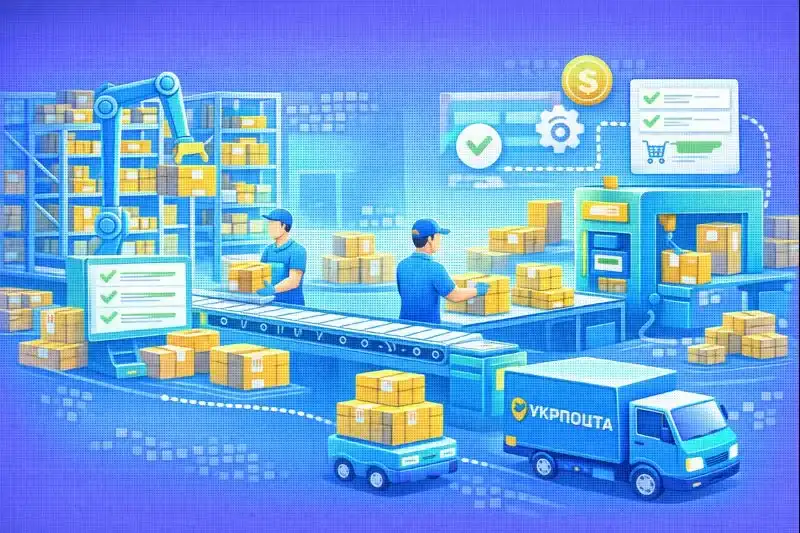
When Fulfillment Becomes Necessary:
- Order volume 300-500+ per month
- Warehouse space shortage
- Need for fast processing (same-day shipping)
- Seasonal sales peaks
- Scaling without hiring warehouse staff
Fulfillment Operators in Ukraine
Major Players:
- Nova Poshta Fulfillment – ecosystem integration
- Zammler Fulfillment – fashion and accessories focus
- Rozetka Fulfillment – for marketplace sellers
- Local providers – regional operators
Fulfillment Pricing Models
| Component | Cost Range | Notes |
|---|---|---|
| Storage | ₴150–300/m²/month | Depends on location |
| Receiving goods | ₴15–40/pallet | One-time upon delivery |
| Order processing | ₴25–60/order | Picking, packing |
| Packaging | ₴10–30 | Materials and labor |
| Additional services | ₴5–20 | Stickers, gift wrapping |
| Returns processing | ₴20–50 | Inspection, restocking |
Minimum Commitments:
- Most operators require minimum 100-200 orders/month
- 6-12 month contract
- Minimum storage area 5-10 m²
How to Choose a Fulfillment Partner
Evaluation Criteria:
- Warehouse location – proximity to main customers
- Integrations – API with your e-commerce platform
- SLA – guaranteed order processing time
- Scalability – ability to scale during peaks
- Reporting – real-time inventory and order data
- Pricing – transparent structure without hidden fees
- Reputation – other e-commerce client reviews
Questions for Provider:
- What's average time from order to shipment?
- How are returns processed?
- What integrations are available out-of-box?
- Are there minimum commitments and termination penalties?
- Who's responsible for losses/damages?
Fulfillment ROI for Different Volumes
Calculation Example for Store with 500 Orders/Month:
Own Warehouse:
- Rent 50 m²: ₴25,000/month
- 2 staff salaries: ₴40,000/month
- Packing materials: ₴10,000/month
- Equipment and utilities: ₴5,000/month
- Total: ₴80,000/month = ₴160/order
Fulfillment:
- Storage 10 m²: ₴2,500/month
- Processing 500 orders × ₴45: ₴22,500/month
- Packaging 500 × ₴20: ₴10,000/month
- Total: ₴35,000/month = ₴70/order
Savings: ₴45,000/month (56%)
Fulfillment reduces operational costs, speeds delivery (storage closer to customers), improves customer experience, directly impacting Customer Lifetime Value.
Delivery Service Comparative Analysis
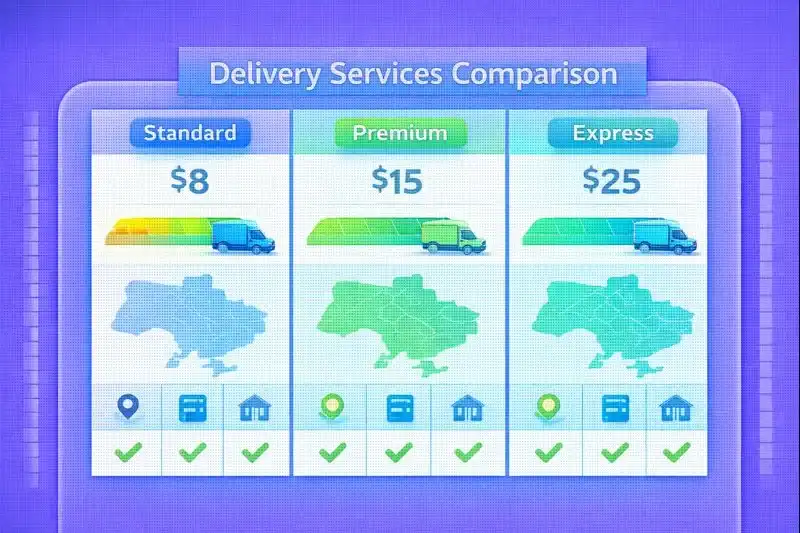
| Parameter | Nova Poshta | Ukrposhta | Meest | Justin |
|---|---|---|---|---|
| Speed | 1-2 days | 3-5 days | 2-3 days | 2-3 days |
| Coverage (branches) | 11,000+ | 24,000+ | 7,000+ | 3,500+ |
| Cost (2 kg) | ₴70 | ₴45 | ₴65 | ₴60 |
| API Integration | ⭐⭐⭐⭐⭐ | ⭐⭐⭐ | ⭐⭐⭐⭐ | ⭐⭐⭐ |
| COD | Yes (2% + ₴20) | Yes (1% + ₴10) | Yes (2.5%) | Yes (2%) |
| Parcel Lockers | 20,000+ | Limited | 500+ | 1,000+ |
| International | Limited | Yes | Strong | No |
| Customer Support | ⭐⭐⭐⭐⭐ | ⭐⭐⭐ | ⭐⭐⭐⭐ | ⭐⭐⭐⭐ |
| Address Delivery | Yes | Limited | Yes | Yes |
| Customer Trust | Highest | Medium | High | High |
Service Selection by Business Type
Startup E-commerce (< 100 orders/month):
- Primary: Nova Poshta (trust + speed)
- Alternative: Ukrposhta (regional savings)
Growing Business (100-500 orders/month):
- Multi-carrier: Nova Poshta + Ukrposhta + Justin
- Gives customers checkout choice
Scale-up (500+ orders/month):
- Fulfillment + contract rates with operators
- Own logistics for specific regions (optional)
E-commerce Platform Delivery Integration
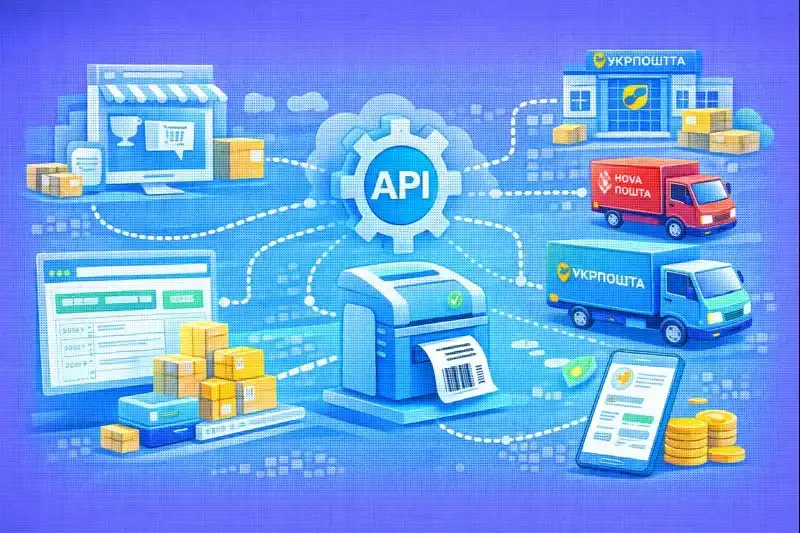
API vs Ready Plugins
API Integration:
Advantages:
- Maximum flexibility and customization
- Full delivery logic control
- Unique features possible (e.g., dynamic zoning)
Disadvantages:
- Requires development (10-40 hours)
- Technical support needed
- Development and maintenance costs
Ready Plugins:
Advantages:
- Quick launch (1-2 hour setup)
- Plugin developer support
- Affordable price (0-50 USD)
Disadvantages:
- Limited functionality
- CMS and plugin update dependency
- Sometimes conflicts with other modules
Recommendation: beginners – plugins, when scaling – custom API integration.
Waybill Creation Automation
Typical Workflow:
- Customer places order on site
- System automatically creates TTN via API
- TTN number added to order
- Customer receives email/SMS with tracking
- Statuses sync hourly
Best Practices:
- Create TTN after payment (for prepaid) or confirmation (for COD)
- Store PDF labels for quick printing
- Configure retry logic for API errors
Delivery Status Synchronization
Key Tracking Statuses:
- Created – TTN created, awaiting shipment
- Received at warehouse – parcel at sender branch
- In transit – transported to destination city
- Arrived at branch – ready for pickup
- Received – customer picked up parcel
- Return – refusal or delivery failure
Communication Automation:
- SMS when status "Arrived at branch"
- Email with tracking immediately after TTN creation
- Push notifications about delays
Detailed email automation scenarios described in E-commerce Email Marketing article.
Checkout Cost Calculation
Dynamic Cost Calculation:
API integration allows showing exact delivery cost at checkout based on:
- Cart weight
- Product dimensions
- Delivery address
- Selected delivery type (branch/address/locker)
Conversion Impact:
- Cost transparency reduces abandonment by 15-20%
- Ability to compare delivery options increases trust
Checkout delivery selection optimization detailed in Checkout Optimization material.
Label Printing and Shipment Organization
Efficient Process:
- Bulk TTN creation for daily orders
- Batch label printing (zebra printers or A4)
- Label application to parcels
- Courier call or branch delivery
- Shipment register closing
Tools:
- Zebra printers for high volumes (100+ orders/day)
- Regular A4 printers for small volumes
- Warehouse Management Systems for complex logistics
Delivery Cost Optimization
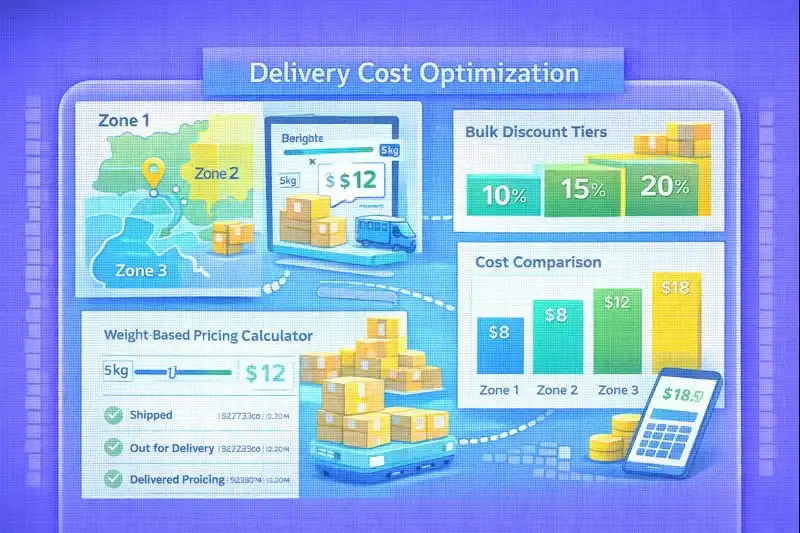
Efficiency Calculation Formulas
Free Delivery ROI:
ROI = (Conversion Increase × AOV × Order Count) - Delivery Costs
Example:
- Conversion increased from 2% to 2.8% (+40%)
- AOV = ₴1,200
- Traffic = 10,000 visitors/month
- Delivery cost = ₴70/order
Without Free Delivery:
- Orders: 10,000 × 2% = 200
- Revenue: 200 × ₴1,200 = ₴240,000
With Free Delivery:
- Orders: 10,000 × 2.8% = 280
- Revenue: 280 × ₴1,200 = ₴336,000
- Delivery costs: 280 × ₴70 = ₴19,600
- Net increase: (₴336,000 - ₴240,000) - ₴19,600 = ₴76,400
ROI = 390% (pays off in 1 month)
Free Delivery Break-even:
Break-even = Delivery Cost / (Conversion Rate Lift × Profit Margin)
Example:
- Delivery cost: ₴70
- Conversion Lift: 40% (from 2% to 2.8%)
- Profit Margin: 30%
Break-even = ₴70 / (0.4 × 0.3) = ₴583
If AOV > ₴583, free delivery is profitable.
Delivery Pricing Strategies
1. Completely Free Delivery
Advantages:
- Maximum marketing effect
- Communication simplicity
- Highest conversion lift
Disadvantages:
- High costs
- Encourages low-check orders
When to Apply:
- High margin (50%+)
- Average check above break-even
- Strong market competition
2. Conditional Free (Minimum Amount)
Model: Free delivery for orders from ₴X
Optimal X Calculation:
Optimal Minimum = Average Check × 1.3–1.5
Example:
- Average check: ₴800
- Optimal minimum: ₴1,000–1,200
Advantages:
- Increases average check (up-sell effect)
- Reduces delivery costs
- Filters small orders
Disadvantages:
- Some buyers don't reach threshold
- Clear terms communication needed
3. Paid Delivery with Transparent Rates
Model: Customer pays actual delivery cost
Advantages:
- Zero additional business costs
- Pricing transparency
- Multiple options possible (fast/economy)
Disadvantages:
- Lower conversion (by 10-25%)
- Psychological barrier for buyer
When to Apply:
- Low margin
- Unique product without direct competitors
- B2B segment
4. Partial Compensation
Model: Store pays part of delivery cost
Example:
- Actual cost: ₴70
- Customer pays: ₴30
- Store compensates: ₴40
Advantages:
- Balance between costs and conversion
- Psychologically more attractive than full cost
- Configuration flexibility
Rate Zoning
Geographic Zoning:
| Zone | Region | Rate |
|---|---|---|
| Zone 1 (city) | Your city | ₴0 |
| Zone 2 (region) | Oblast | ₴40 |
| Zone 3 (country) | Rest of Ukraine | ₴70 |
Zoning Advantages:
- Cost optimization
- Local sales stimulation
- Home region competitive advantage
Contract Rates with Carriers
At volumes 200+ shipments/month you can get:
- 10-25% discount from base rates
- COD commission reduction from 2% to 1.5%
- Free packaging
- Personal manager
- Priority order processing
How to Negotiate:
- Prepare 3-month shipment statistics
- Contact carrier's corporate department
- Discuss terms and commitments
- Sign contract with fixed rates
Customer Experience and Communication
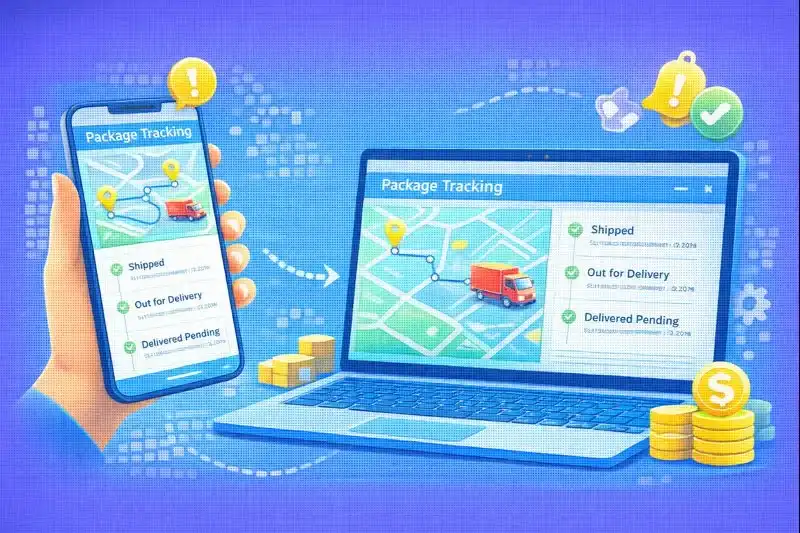
Delivery Timeline Transparency
On Product Page:
- "1-2 day delivery" for in-stock items
- "5-7 day delivery" for made-to-order items
- Timeline calculator based on buyer location
At Checkout:
- Expected delivery date for each option
- Different carrier timeline comparison
- Transparent terms (e.g., "next business day shipping")
In Email Confirmation:
- Expected delivery date
- Tracking instructions
- Support contacts
Order Tracking
Mandatory Elements:
-
Tracking Page on Site
- Order number or TTN entry
- Current status display
- Parcel movement history
-
Personal Account Integration
- All orders and statuses in one place
- Document download capability
-
Direct Carrier Tracking Link
- Link to official Nova Poshta/Ukrposhta site
- Information transparency
SMS and Email Notifications
Critical Notification Points:
-
After Order Placement
- Detail confirmation
- Expected timelines
-
After TTN Creation
- Tracking number
- Tracking link
-
Warehouse Shipment
- Parcel in transit
- Expected arrival date
-
Arrival at Destination Branch
- MOST IMPORTANT NOTIFICATION
- Branch address
- Working hours
- Free storage period
-
Delivery Delay (optional)
- Reason explanation
- New expected date
-
Parcel Receipt
- Purchase thank you
- Review invitation
- Next purchase promo code
Detailed email communication scenarios discussed in E-commerce Email Marketing.
Delivery Problem Handling
Typical Problems and Solutions:
1. Delivery Delay
- Proactive customer communication
- Compensation (next purchase discount)
- Carrier support tracking
2. Parcel Damage
- Customer damage photos
- Carrier claim (if declared value)
- New parcel shipment or refund
3. COD Refusal
- Refusal reason analysis
- Unreliable customer segmentation
- Prepayment for repeat offenders
4. Parcel Loss
- Carrier investigation (up to 30 days)
- Customer compensation without waiting for results
- Carrier claim for declared value
Problem Handling SLA:
- Complaint response: < 2 hours
- Problem resolution: < 24 hours
- Compensation: within 3 business days
Typical Delivery Organization Mistakes
Mistake 1: Single Carrier Limitation
Problem: Single operator dependency limits buyer choice, creates risks during carrier outages.
Solution: Offer minimum 2-3 delivery options (e.g., Nova Poshta + Ukrposhta + self-pickup).
Data: Stores with carrier choice have 8-12% higher conversion.
Mistake 2: Ignoring Regional Preferences
Problem: Delivery service popularity differs by region. Western Ukraine often chooses Meest, eastern regions – Nova Poshta.
Solution: Analyze order geography and offer relevant delivery options for each region.
Mistake 3: Missing Alternative Pickup Points
Problem: Only branches, without parcel lockers and address delivery, limits buyer convenience.
Solution: Integrate all delivery types: branches, lockers, courier, self-pickup.
Mistake 4: Non-optimized Rates
Problem: Buyer pays full delivery cost for high-margin product, reducing conversion.
Solution: Calculate break-even point and implement conditional free delivery.
Mistake 5: Lack of Automation
Problem: Manual TTN creation, label printing, notifications waste time and cause errors.
Solution: Integrate carrier APIs with e-commerce platform. Detailed automation approaches described in Marketing Automation article.
Mistake 6: Poor Delivery Status Communication
Problem: Customer doesn't know when to expect parcel, doesn't receive notifications, must search for information themselves.
Solution: Automatic SMS/email at each delivery stage, site tracking page, proactive problem communication.
Delivery Service Selection Checklist
Business Analysis:
- Identify main sales regions (cities vs villages)
- Calculate average order weight and dimensions
- Assess average check and margin
- Analyze order frequency (volumes)
Carrier Comparison:
- Collect rates for typical shipments (1kg, 3kg, 10kg)
- Assess coverage (branches in your regions)
- Check route delivery speed
- Review COD terms
- Compare commissions and additional fees
Technical Integration:
- Check API and documentation availability
- Assess ready plugin quality for your CMS
- Test test TTN creation
- Configure automatic notifications
- Integrate site tracking
Testing:
- Make 5-10 test shipments
- Assess actual delivery speed
- Check packaging quality and product preservation
- Collect first customer feedback
- Analyze problem and refusal count
Delivery Integration Setup Checklist
Preparation:
- Create carrier corporate account
- Obtain API keys and access
- Study API documentation
- Prepare test environment
TTN Creation Setup:
- Integrate waybill creation API
- Configure automatic sender data filling
- Add delivery type selection (branch/address/locker)
- Implement label printing
- Test on test orders
Status Synchronization:
- Configure webhooks or status polling
- Store status change history
- Display statuses in personal account
- Configure status change notifications
Cost Calculation:
- Integrate cost calculation API
- Show cost dynamically at checkout
- Configure free/discounted delivery rules
- Add delivery speed selection (if available)
Customer Communication:
- Email after order creation with delivery details
- SMS/Email with TTN number and tracking
- Branch arrival notification
- Storage period reminder (if not picked up)
Monitoring and Analytics:
- Dashboard with key delivery metrics
- Track % of receipt refusals
- Analyze regional delivery speed
- Logistics cost reports
FAQ
1. Which delivery service to choose for online store startup?
For startup, Nova Poshta is recommended as primary carrier due to high customer trust (85% of Ukrainians prefer NP), extensive infrastructure, and quality integration. Add Ukrposhta as alternative for regions and budget-conscious buyers. This gives customer choice without excessive complexity.
2. How much does Nova Poshta integration cost?
Ready Plugin: ₴0-1,500 (one-time), 1-2 hour setup.
Custom API Integration: ₴15,000-50,000 development + support. Profitable at 500+ orders/month or specific requirements.
LetsCommerce: Out-of-box integration, 30-minute setup, no additional costs.
3. Should you offer multiple delivery services simultaneously?
Yes, definitely. Data shows:
- Stores with carrier choice have 8-12% higher conversion
- 23% of buyers abandon purchase if convenient delivery option unavailable
- Different regions have different preferences (Western Ukraine – Meest, others – Nova Poshta)
Optimal: 2-3 main services + self-pickup.
4. How to properly calculate delivery cost for customer?
Strategy Options:
- Free delivery: if margin > 40% and AOV > break-even point
- Conditional free: set threshold at average check × 1.3-1.5
- Paid with transparent rates: show actual cost
- Partial compensation: store pays 50-70% of cost
Break-even Formula:
Break-even = Delivery Cost / (Conversion Lift × Profit Margin)
If your AOV exceeds this amount, free delivery pays off.
5. When does fulfillment make sense?
Fulfillment Transition Signals:
- Order volume 300-500+/month
- Warehouse space or staff shortage
- Seasonal peaks difficult to handle internally
- Fast delivery needed (same-day shipping)
- Assortment expansion requires more space
- Own logistics cost > ₴100/order
ROI Calculation: At 500 orders/month, savings can be 40-60% compared to own warehouse.
6. How to reduce COD receipt refusal percentage?
Effective Tactics:
- SMS order confirmation 1-2 hours after placement (reduces refusals by 15-20%)
- Calls for large orders (₴1,000+)
- Branch arrival notification with detailed information
- Quality product photos and description on site (reduces expectation mismatch)
- Customer reviews increase trust
- Prepayment with discount (e.g., -5% for card payment)
Analytics: Track customers with high refusal % and switch them to prepayment.
Normal Refusal %: 3-8% for quality e-commerce.
7. What to do with product returns?
Returns Processing:
-
Return Policy:
- Clear site terms (14 days, product condition, etc.)
- Simple return instructions
-
Logistics:
- Return TTN via carrier API
- Return payment: customer expense (if not defective) or store (defect/error)
-
Warehouse Processing:
- Product inspection
- Return to stock or write-off
- Refund within 3-5 days
-
Fulfillment:
- Most operators provide returns processing (₴20-50/pc)
- Inspection, photos, inventory return
Optimization: Quality photos and descriptions reduce returns by 30-40%.
8. How to automate delivery process to save time?
Key Automation Points:
- TTN Creation: automatic after payment or confirmation
- Label Printing: bulk printing for daily orders
- Notifications: email/SMS at each status change
- Synchronization: automatic status updates hourly
- Reporting: delivery metrics dashboards
Tools:
- API integrations with carriers
- Warehouse Management Systems for warehouses
- Email automation platforms
- LetsCommerce with built-in logistics automation
ROI: Automation saves 10-20 hours/week at 200+ order volumes.
More on process automation in Marketing Automation article.
Conclusion
Delivery is a strategic element of successful e-commerce, directly impacting conversion, average check, repeat purchases, and overall business Customer Lifetime Value.
Key Conclusions:
- Multi-carrier strategy provides maximum flexibility and coverage
- Nova Poshta – optimal startup choice for trust and speed
- Ukrposhta – economical alternative for regions and heavy goods
- Fulfillment pays off at 300-500+ orders/month
- Automation critical for scaling without operational chaos
- Conditional free delivery optimizes cost-conversion balance
Growth Stage Recommendations:
Startup (< 100 orders/month):
- Nova Poshta + Ukrposhta
- Ready integration plugins
- Conditional free delivery from average check × 1.5
Growing (100-500 orders/month):
- Add 1-2 alternative services
- Custom API integration
- Contract carrier rates
- Extended notification automation
Scale-up (500+ orders/month):
- Fulfillment for main assortment
- Corporate discounted rates
- WMS for warehouse management
- Own logistics for specific regions (optional)
LetsCommerce Platform provides ready integrations with all major Ukrainian delivery services, TTN creation automation, status synchronization, flexible rate settings, and customer communication. This enables professional logistics launch in 1 day and scaling without operational chaos.
Investments in quality logistics pay off through increased conversion, average check growth, reduced refusals, and loyal customer base formation with high LTV.
Related Articles
- Checkout Optimization – how to properly configure delivery selection at checkout for maximum conversion
- Customer Lifetime Value – how fast and quality delivery impacts long-term customer value
- E-commerce Email Marketing – delivery status communication automation through email scenarios
- Marketing Automation – comprehensive business process automation, including logistics

Ready to start selling?
Launch your online store today with LetsCommerce.