Introduction
Voice commerce is transforming how consumers shop online, with voice shopping sales reaching $40 billion in the US in 2024 and projected to hit $80 billion by 2027 (OC&C Strategy Consultants, 2024). More significantly, 50% of all online searches are now voice-based, and 55% of households own at least one smart speaker (NPR/Edison Research, 2024), creating unprecedented opportunities for e-commerce brands to meet customers in this emerging channel.
The shift toward voice is driven by convenience - 71% of consumers prefer voice search over typing for simple queries (Google, 2024), and voice commerce users spend 30% more on average than traditional shoppers due to the frictionless purchasing experience. Early adopters are capturing market share as 62% of smart speaker owners have made voice purchases, with replenishment items like groceries, household supplies, and consumables leading adoption.
This guide explores how to optimize your e-commerce store for voice commerce, from technical implementation and product optimization to creating voice-first customer experiences that drive sales.
Understanding Voice Commerce and Smart Assistants
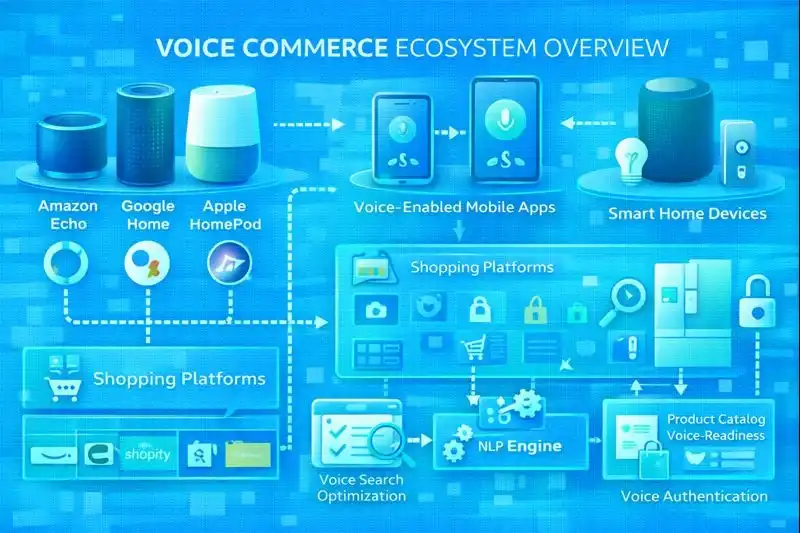
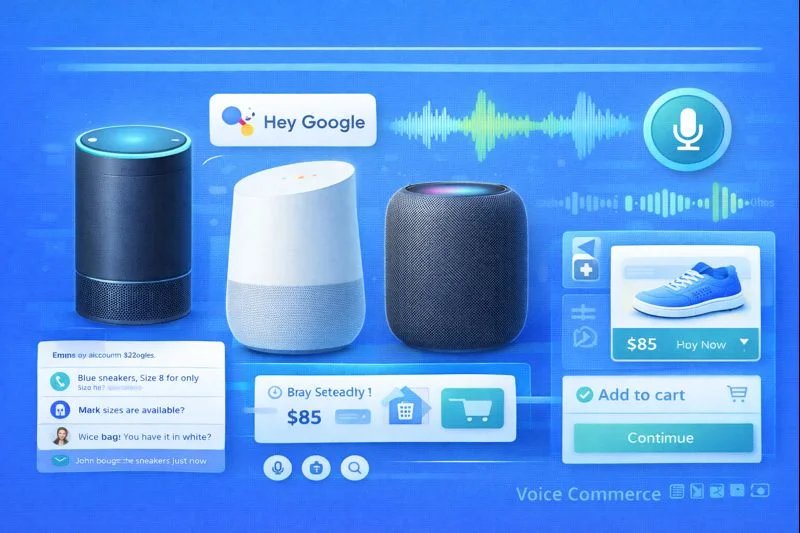
Voice commerce enables customers to search, browse, and purchase products using voice commands through smart speakers (Amazon Echo, Google Home) and voice assistants (Siri, Alexa, Google Assistant) on smartphones and other devices.
Major Voice Platforms
Amazon Alexa dominates with 70% of smart speaker market share and seamless integration with Amazon's e-commerce ecosystem. Users can reorder previous purchases, add items to cart, and complete checkouts entirely by voice. Amazon Prime members enjoy frictionless purchasing with "Alexa, buy batteries" triggering instant orders.
Google Assistant holds 25% market share and excels at discovery through superior search capabilities. Google Shopping integration allows product comparisons and price checks via voice. Strong Android ecosystem integration reaches billions of smartphone users.
Apple Siri captures premium demographic with iPhone/HomePod integration but limited commerce features compared to competitors. Best for brand discovery and store locator queries rather than direct purchasing.
How Consumers Use Voice Commerce
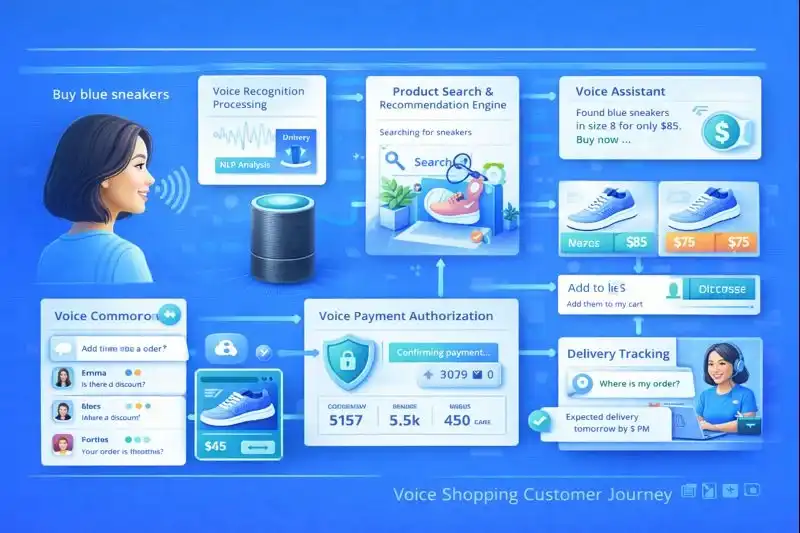
Voice shopping follows distinct patterns: Replenishment purchases (64% of voice commerce) - reordering frequently purchased items like coffee, paper towels, vitamins. Product research (48%) - asking questions about features, prices, reviews. Order tracking (41%) - checking delivery status hands-free. Deal discovery (32%) - finding sales and discounts through voice queries.
Purchase types skew toward low-consideration products under $50 where convenience outweighs need for visual research. However, voice increasingly influences higher-ticket purchases through research phase before completing transactions on screens.
Optimizing Product Listings for Voice Search
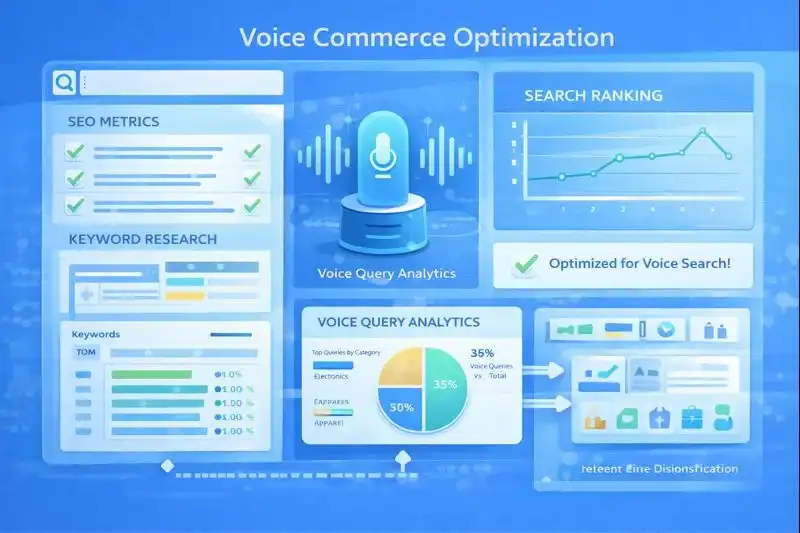
Voice search differs fundamentally from typed queries, requiring specific optimization strategies to ensure discoverability.
Voice Search Query Patterns
Voice queries are conversational and question-based versus keyword-focused text searches. Users ask "What's the best waterproof running shoe under $100?" rather than typing "waterproof running shoes." Voice queries average 29 words compared to text's 3-5 words (Backlinko, 2024).
Optimize for natural language: Include conversational phrases in product descriptions. Instead of just "Men's Running Shoes," add "best running shoes for men with flat feet" or "lightweight running shoes for marathon training."
Target question keywords: Incorporate who, what, where, when, why, how in content. Create FAQ sections answering common product questions: "How do I choose the right shoe size?" or "What's the difference between trail and road running shoes?"
Focus on long-tail keywords: Voice search favors specific, detailed phrases. "Organic fair-trade dark chocolate bars with sea salt" performs better than generic "chocolate bars" for voice discovery.
Product Name Clarity
Ensure product names are voice-friendly: Avoid special characters and complex spellings that voice assistants mispronounce. Use common, phonetically simple names. "Classic White T-Shirt" beats "Classique Blanc Tee (Limited Edition)."
Include brand, product type, and key attribute in titles: "Nike Air Max Running Shoes - Men's Size 10 Black" provides complete context for voice results.
Structured Data and Schema Markup
Implement Schema.org markup to help voice assistants understand product information:
- Product schema (name, price, availability, ratings)
- Offer schema (price, currency, conditions)
- Review schema (aggregate ratings, review counts)
- FAQ schema (common questions and answers)
Voice assistants prioritize structured data when generating responses, with marked-up content appearing in 65% more voice results than unmarked content (Moz, 2024).
Local SEO for Voice
Voice searches are 3x more likely to be local ("coffee shops near me" vs. "coffee shops"). Optimize Google Business Profile with accurate hours, location, and categories. Include location-specific keywords in product descriptions for local inventory queries.
Creating Voice Shopping Experiences
Beyond discovery, creating seamless voice purchasing experiences requires integration with voice platforms and optimized conversion flows.
Amazon Alexa Integration
Brands selling on Amazon automatically gain basic Alexa shopping capabilities - customers can reorder items by voice. For advanced integration:
Alexa Skills (custom voice apps) enable branded experiences. Build skills for product recommendations, virtual try-on consultations, or loyalty program integration. Development cost: $5,000-$25,000 depending on complexity.
Voice ordering optimization: Ensure product titles are concise and unambiguous. "Alexa, order coffee" should identify your brand if customer purchased previously. Include voice order shortcuts in packaging: "Reorder by saying 'Alexa, buy my usual coffee.'"
Google Shopping Actions
Integrate products into Google Shopping for voice discovery through Google Assistant. Users ask "Hey Google, find dishwasher detergent" and receive product recommendations with prices from your catalog.
Setup requires Google Merchant Center account, product feed submission, and Shopping Actions enrollment. Commission: 15-30% per sale depending on category.
Voice-Optimized Product Descriptions
Write descriptions that sound natural when read aloud by voice assistants. Test by having Alexa/Google read your descriptions - awkward phrasing becomes obvious.
Keep key information in first 50 words since voice assistants truncate longer descriptions. Lead with benefits before features: "Stay dry during intense workouts with our moisture-wicking fabric" before technical fabric specifications.
Subscription and Replenishment Programs
Voice commerce excels at repeat purchases. Implement subscription programs allowing customers to "Reorder monthly" via voice command. Amazon Subscribe & Save integration enables voice-activated subscription management.
Offer voice-exclusive subscription discounts (15-20% off) to incentivize voice channel adoption and build recurring revenue.
Voice Commerce Marketing Strategies
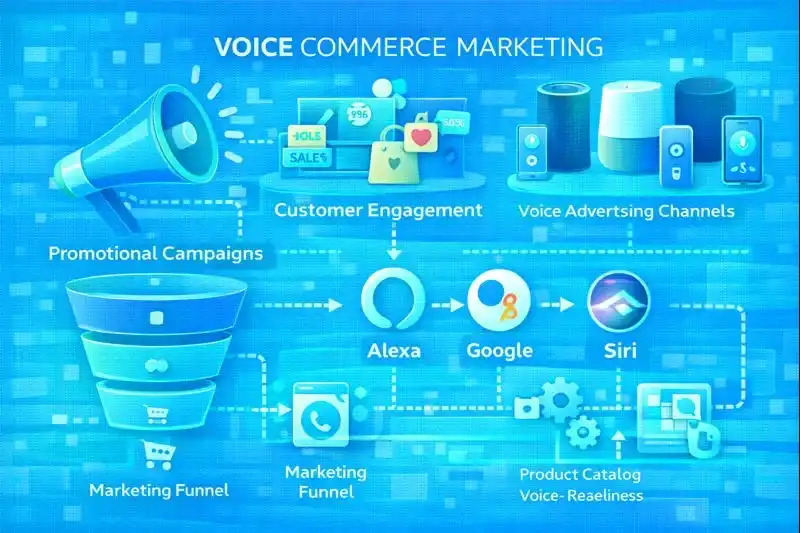
Driving voice commerce adoption requires education and strategic promotion to train customers on voice shopping capabilities.
Customer Education Campaigns
Most consumers don't realize they can shop by voice. Email campaigns teaching voice shopping: "Did you know? Reorder your favorites by asking Alexa!" Include voice command examples in product confirmation emails: "Loved this product? Say 'Alexa, reorder [Product Name].'"
Packaging inserts with voice reorder instructions capture customers at moment of product use. QR codes linking to voice setup tutorials improve adoption.
Voice-First Content Marketing
Create podcast sponsorships and audio ads reaching voice-forward audiences. Mention voice ordering capabilities in audio content: "Order now by asking your Google Assistant."
Develop audio-optimized content answering common questions in your niche. Position as voice search results through conversational, question-based formatting.
Incentivizing Voice Purchases
Offer voice-exclusive discounts (10-15% off first voice order) to overcome adoption hesitancy. Track with unique voice-only promo codes announced in Alexa Skills or voice responses.
Loyalty program bonuses for voice purchases (double points) encourage repeat voice behavior and data collection on voice customer preferences.
Voice Analytics and Attribution
Track voice commerce performance through platform-specific analytics (Alexa Skills metrics, Google Shopping Actions reports). Measure voice-attributed revenue, conversion rates, and average order values.
Implement survey touchpoints asking how customers discovered products. Many voice-influenced purchases complete on desktop/mobile, making pure voice attribution challenging without qualitative data.
Frequently Asked Questions
What products work best for voice commerce?
Replenishment and consumable products dominate voice commerce, representing 64% of voice purchases (OC&C Strategy, 2024). Top categories: Groceries and household supplies (paper towels, cleaning products, pantry staples), health and beauty (vitamins, shampoo, skincare with subscription models), pet supplies (food, treats customers reorder regularly), electronics accessories (batteries, cables, chargers). Success factors: Low price point ($10-$50), frequent repurchase cycle (weekly/monthly), simple product selection (limited variants - color/size), strong brand recognition (customers order by brand name). Products requiring extensive visual research (fashion, furniture) or high consideration (first-time electronics purchases) struggle in pure voice channels but benefit from voice-assisted research before screen completion.
How do I get my products to appear in voice search results?
Voice search optimization requires technical and content strategies. Implement structured data (Schema.org markup) for products, reviews, FAQs - voice assistants prioritize marked-up content appearing in 65% more results. Optimize for conversational keywords - include question-based phrases ("What's the best...?", "How do I choose...?") matching natural speech patterns. Earn featured snippets in Google - voice assistants read position zero results 40% of the time. Format content as concise answers (40-60 words), use lists and tables, target question keywords. Claim and optimize Google Business Profile for local voice queries (3x more likely to include "near me"). Build quality backlinks - domain authority influences voice result selection. Focus on mobile optimization - voice searches predominantly occur on mobile, requiring fast-loading, mobile-friendly sites. Create FAQ content addressing common questions in your niche. Test by asking smart speakers about your products to identify optimization gaps.
Is voice commerce worth investing in for small e-commerce businesses?
Voice commerce offers accessible entry points even for small businesses, with benefits beyond direct voice sales. Low-cost tactics: Optimize existing content for voice search (conversational keywords, FAQ sections) requires minimal investment. Structured data implementation ($500-$2,000 one-time via developer or Shopify apps). Amazon integration provides automatic Alexa capabilities for Amazon sellers. Higher investment options: Custom Alexa Skills ($5,000-$25,000) justified for brands with loyal customer base and high repurchase rates. ROI considerations: Direct voice sales may be modest (5-10% of total revenue) but voice influences larger purchase journey. 45% of consumers research via voice before buying on screens (Google, 2024). Strategic value: Early adoption builds expertise before competition intensifies. Voice-optimized content improves overall SEO through conversational keyword targeting. Recommendation: Start with content optimization and basic integration ($500-$2,000 investment), scale to custom experiences after proving voice-influenced revenue.
How do voice commerce conversion rates compare to traditional e-commerce?
Voice commerce conversion dynamics differ significantly from traditional e-commerce. Repurchase conversion rates: 40-60% for voice-initiated reorders of previous purchases - dramatically higher than 2-3% traditional e-commerce due to zero-friction. Discovery-to-purchase: 8-15% when customers find new products via voice - better than traditional but lower than repurchase. Abandoned cart rates: 25-35% lower for voice checkout when payment/shipping pre-configured (Amazon's 1-Click equivalent). However, average order values: 15-25% lower for pure voice purchases due to lack of visual upselling/cross-selling. Multi-touchpoint impact: Voice rarely exists in isolation - 45% voice product research leads to screen purchases within 24 hours. Total voice-influenced conversion (direct + assisted) reaches 15-25% for optimized brands. Optimization levers: Reduce friction through saved payment methods. Enable voice shopping lists ("Add to my list" for later review). Voice-exclusive bundles increase AOV. Subscription options capture recurring revenue.
What are the privacy concerns with voice commerce?
Privacy concerns represent significant barrier to voice commerce adoption, with 53% of consumers worried about smart speaker data collection (Pew Research, 2024). Main concerns: Always-listening devices - fear of passive surveillance and conversations being recorded. Purchase history tracking - detailed data on buying habits, preferences, and household needs. Cross-device data sharing - integration with broader advertising ecosystems. Addressing concerns: Transparency in data practices - clearly communicate what data is collected, how it's used, retention policies. Consent-based features - require explicit opt-in for purchase capabilities, loyalty program integration. Security measures - highlight voice recognition, purchase confirmation requirements (prevent accidental orders). Privacy controls - educate customers on mute buttons, deletion of voice history, privacy settings. Compliance: Follow GDPR, CCPA requirements for voice data. Provide clear opt-out mechanisms. Brand advantage: Small businesses building trust-based relationships can overcome privacy concerns more easily than large tech platforms by emphasizing limited data collection, local operations, customer-first policies.
Related Articles
- AI Chatbots for E-commerce: Complete Guide to Conversational Commerce - Combine voice commerce with AI chatbots for omnichannel customer service
- How to Make Shopping Convenient: The Role of Reviews and Ratings - Build trust through reviews that appear in voice search results
- TikTok Shop Integration Guide: How to Sell on Social Commerce Platforms - Create multi-channel strategy including voice, social, and traditional e-commerce
Conclusion
Voice commerce represents a $40 billion market in 2024 growing to $80 billion by 2027, driven by the 55% of households with smart speakers and 50% of searches now voice-based. While direct voice purchases currently focus on replenishment and low-consideration items, voice increasingly influences the entire customer journey, with 45% of consumers researching via voice before purchasing on screens.
Success in voice commerce requires a layered optimization strategy: implement structured data and conversational keywords for voice search discovery, integrate with Amazon and Google Shopping for native voice shopping capabilities, create educational campaigns teaching customers voice ordering, and measure both direct voice sales and voice-influenced conversions. Small businesses can start with low-cost content optimization ($500-$2,000) before scaling to custom Alexa Skills and advanced integrations.
The competitive advantage goes to early adopters who build voice expertise while the channel matures. Start optimizing today to capture the 62% of smart speaker owners already making voice purchases and position your brand for the voice-first future of e-commerce.