Introduction
Artificial intelligence is transforming e-commerce customer experience, with AI chatbots becoming essential infrastructure for competitive online retail. According to Juniper Research, chatbot-driven commerce transactions will reach $142 billion globally by 2024, up from $2.8 billion in 2019 - a 5,000% increase in just five years (Juniper Research, 2024). More impressively, 80% of businesses now use or plan to use chatbots for customer interactions (Oracle, 2024).
The business impact is substantial: AI chatbots reduce customer service costs by 30-70% while simultaneously increasing conversion rates by 20-35% through instant, personalized assistance (IBM, 2024). Modern AI chatbots handle 68% of customer conversations from start to finish without human intervention, freeing teams to focus on complex issues while maintaining 24/7 availability that consumers increasingly expect (Salesforce Research, 2024).
This comprehensive guide explores how to implement AI chatbots strategically in your e-commerce business - from selecting the right technology and designing conversational flows to measuring ROI and scaling automation for sustainable growth.
Understanding AI Chatbots vs. Traditional Customer Service
AI chatbots represent a fundamental evolution beyond rule-based automation, leveraging natural language processing (NLP) and machine learning to understand context, intent, and provide human-like interactions.
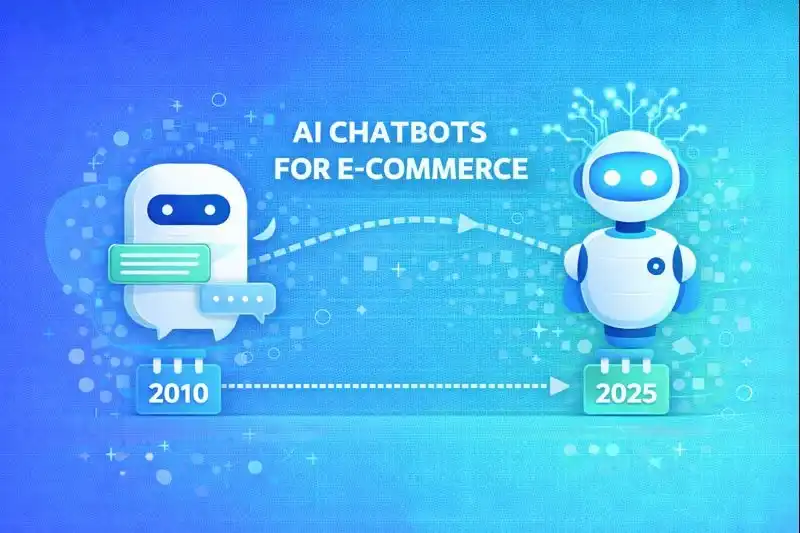
Three Generations of E-commerce Chat Technology
Generation 1: Rule-Based Chatbots (2010-2018) - Follow predetermined decision trees with keyword matching. Limited to simple FAQs. Break easily with unexpected inputs. Still used for basic functions but create frustration with 60% of users when they can't understand nuanced questions.
Generation 2: AI-Powered Chatbots (2018-2023) - Use NLP to understand intent beyond exact keywords. Learn from interactions to improve responses. Handle moderately complex queries. Successfully resolve 50-70% of customer inquiries without human escalation.
Generation 3: Generative AI Chatbots (2023-Present) - Leverage large language models (GPT-4, Claude, Gemini) for human-like conversations. Understand context across multiple messages. Generate personalized product recommendations. Achieve 85-90% resolution rates for common e-commerce scenarios while maintaining conversational quality that 70% of users find indistinguishable from human agents (Gartner, 2024).
Key Advantages Over Traditional Support
AI chatbots provide instant response times (under 1 second vs. 2-5 minutes for human agents), infinite scalability (handle 1,000+ simultaneous conversations without degradation), consistency (same quality answers every time regardless of agent mood or experience), 24/7 availability (crucial as 51% of consumers expect businesses to be available around the clock), and multilingual support (serve global customers without hiring language-specific teams).
Core Use Cases for E-commerce Chatbots
Strategic chatbot implementation targets high-frequency, high-impact customer touchpoints where automation delivers immediate value.
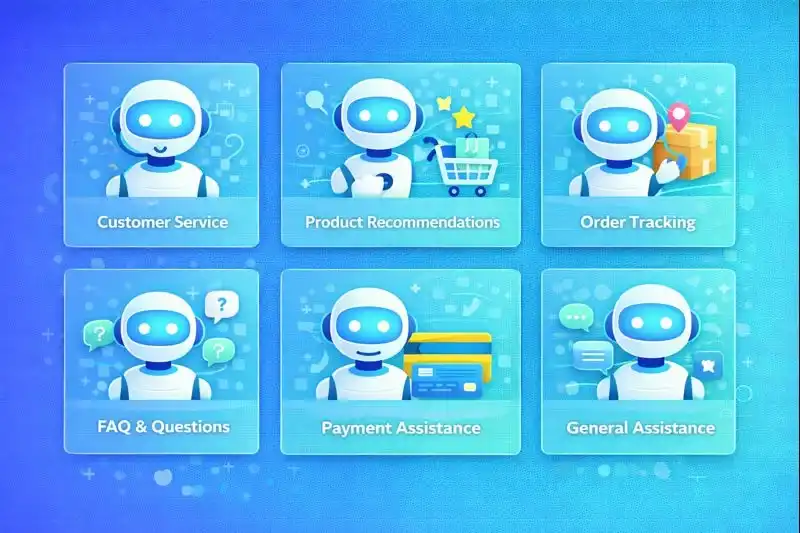
Product Discovery and Recommendations
AI chatbots act as virtual shopping assistants, asking qualifying questions to understand customer needs and preferences. Example: "I'm looking for a gift for my mother" triggers questions about age, interests, budget, and occasion, then surfaces personalized product suggestions. Conversational product discovery increases average order value by 15-25% compared to traditional search (Shopify, 2024).
Advanced implementations use collaborative filtering (analyzing purchase patterns from similar customers), visual search integration (customers upload photos, chatbot finds similar products), and seasonal awareness (recommending appropriate products based on time of year and location).
Order Tracking and Status Updates
40% of customer service inquiries are simple order status checks - perfect for automation. AI chatbots integrate with order management systems to provide real-time tracking information, proactive delay notifications, and estimated delivery windows. Customers simply ask "Where is my order?" and receive instant, accurate updates without waiting for agent availability.
Proactive chatbot notifications reduce "Where Is My Order" (WISMO) tickets by 60-70% by messaging customers at key milestones: order confirmed, shipped, out for delivery, delivered. This transforms customer service from reactive to proactive.
Returns and Exchanges Management
Returns processing is time-consuming and frustrating for both customers and support teams. AI chatbots streamline the process by verifying eligibility, generating return labels, offering exchanges as alternatives to refunds (preserving 30-40% of returns as exchanges), and processing refunds automatically once items are received.
Intelligent chatbots can reduce return rates by 10-15% by asking diagnostic questions ("What's wrong with the product?") and offering solutions (size guides, usage instructions, troubleshooting) that resolve issues without returns.
Customer Support Triage and Escalation
Even with 85-90% resolution rates, some inquiries require human expertise. Effective chatbots collect relevant information (order number, issue description, previous troubleshooting attempts) before escalating to human agents, reducing average handle time by 40% when handoff occurs.
Smart escalation logic prioritizes based on customer value (VIP customers get immediate human connection), issue complexity (legal/fraud matters route directly to specialists), and sentiment analysis (frustrated customers escalate faster to prevent churn).
Personalized Marketing and Upselling
AI chatbots analyze browsing history, purchase patterns, and cart contents to make contextual product suggestions. A customer adding a camera to cart might receive chatbot messages about compatible lenses, memory cards, and cases. Chatbot-driven upsells generate 10-20% incremental revenue without feeling pushy when recommendations are genuinely relevant.
Post-purchase chatbots re-engage customers with personalized replenishment reminders ("Your coffee order from 30 days ago - time to restock?"), complementary product suggestions based on previous purchases, and exclusive offers triggered by browsing behavior.
Selecting the Right AI Chatbot Platform
Platform choice determines capabilities, integration complexity, and long-term scalability. The market offers solutions ranging from no-code chatbot builders to enterprise AI platforms.
Platform Categories and Best Use Cases
Live Chat Platforms with AI (Intercom, Drift, LiveChat): Best for businesses prioritizing human-AI hybrid approach. Strong live chat functionality with AI handling initial interactions. Pricing: $39-$999/month. Strengths: Easy implementation, familiar interface. Limitations: AI capabilities less advanced than specialized platforms.
E-commerce Native Chatbots (Tidio, Gorgias, Zendesk for E-commerce): Purpose-built for online retail with Shopify/WooCommerce integrations. Pre-configured for common e-commerce scenarios. Pricing: $29-$749/month. Strengths: Quick setup, e-commerce templates. Limitations: Less flexible for unique business logic.
Enterprise AI Platforms (IBM Watson, Google Dialogflow, Microsoft Bot Framework): For large retailers with complex requirements and technical resources. Highly customizable with advanced NLP. Pricing: Custom (typically $10,000+/year). Strengths: Unlimited customization, scalability. Limitations: Requires development resources.
Generative AI Chatbots (ChatGPT integration, Claude, Custom LLM implementations): For forward-thinking brands wanting most advanced conversational AI. Human-like interactions with broad knowledge. Pricing: API-based ($0.002-0.12 per 1,000 tokens). Strengths: Best conversational quality, flexible. Limitations: Requires careful prompt engineering and guardrails.
Key Selection Criteria
Evaluate platforms on: Integration capabilities with your e-commerce platform, CRM, email marketing, and helpdesk tools; NLP accuracy for understanding customer intent (test with real customer queries); Multilingual support if serving global markets; Customization flexibility for unique business processes; Analytics and reporting for measuring performance and ROI; Scalability to handle traffic spikes during promotions; Compliance with data privacy regulations (GDPR, CCPA).
Cost Structure Considerations
Chatbot pricing models vary: Per-conversation ($0.05-0.50 per conversation), Monthly active users ($0.10-2.00 per MAU), Flat monthly fee (unlimited usage within plan limits), API-based (pay per AI request for generative models). Calculate total cost of ownership including platform fees, development resources, ongoing optimization, and integration maintenance.
Designing Effective Conversational Flows
Conversation design determines chatbot success or failure. Poorly designed flows frustrate users and damage brand perception, while thoughtful design creates delightful experiences that drive conversion.
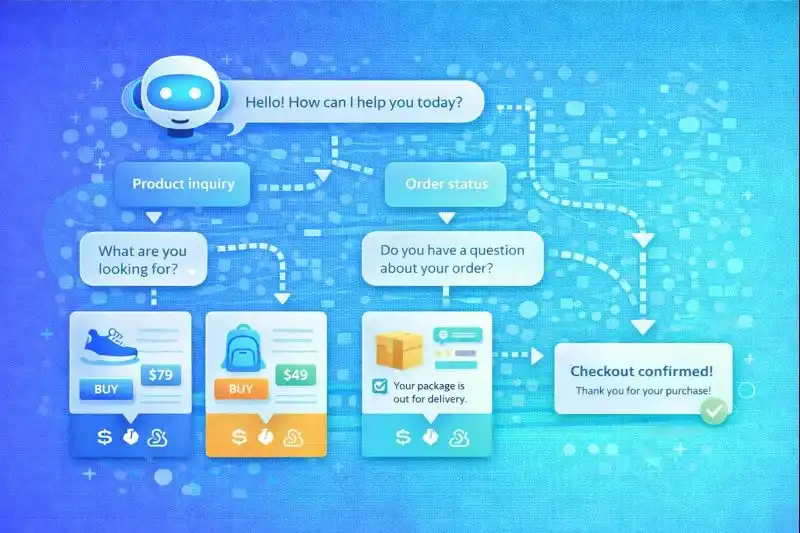
Principles of Effective Chatbot Conversations
Set Clear Expectations Immediately: First message should identify the chatbot as AI and explain its capabilities. Example: "Hi! I'm [Brand]'s AI assistant. I can help you find products, track orders, process returns, or connect you with a specialist. What can I help with today?" Transparency builds trust - 86% of consumers prefer knowing they're interacting with AI (PwC, 2024).
Use Natural, Brand-Aligned Language: Avoid robotic phrasing like "Please input your order number." Instead: "What's your order number? You can find it in your confirmation email." Match your brand voice - luxury brands might be more formal, while DTC brands can be casual and emoji-friendly.
Keep Responses Concise: Users scan rather than read chatbot messages. Use bullet points for multiple options, bold text for key information, and break long messages into multiple shorter bubbles. Optimal response length: 1-3 sentences or 20-60 words.
Offer Clear Next Steps: Every chatbot message should guide users toward resolution with specific action buttons ("Track My Order," "Start Return," "Talk to Human") rather than open-ended questions that leave users uncertain.
Handle Failure Gracefully: When chatbot doesn't understand, acknowledge confusion and offer alternatives. Bad: "I don't understand." Good: "I'm not quite sure what you mean. I can help with order tracking, returns, or product recommendations - which would be most helpful?"
Common Conversational Flow Patterns
Product Discovery Flow: Greeting → Understand need (gift/personal use) → Qualify preferences (price range, category, recipient) → Surface recommendations → Handle objections → Add to cart → Upsell related items → Checkout assistance.
Order Status Flow: Greeting → Request order number/email → Fetch status → Display tracking information → Proactive issue identification (delays) → Offer next actions (change address, cancel) → Resolution confirmation.
Return/Exchange Flow: Greeting → Verify eligibility → Understand reason → Offer alternatives (size exchange, troubleshooting) → If return proceeds: Generate label → Choose refund method → Confirm process → Follow-up timeline.
Testing and Iteration
Launch chatbot with limited scope (1-2 use cases) and gradual rollout (10% of traffic initially) to identify issues before full deployment. Monitor conversation transcripts to find confusion patterns. Track escalation rate, resolution rate, and user satisfaction to measure effectiveness. Iterate weekly based on real usage data rather than assumptions.
Integration with E-commerce Technology Stack
Chatbot effectiveness depends on seamless integration with existing systems to access customer data, inventory information, and order details in real-time.
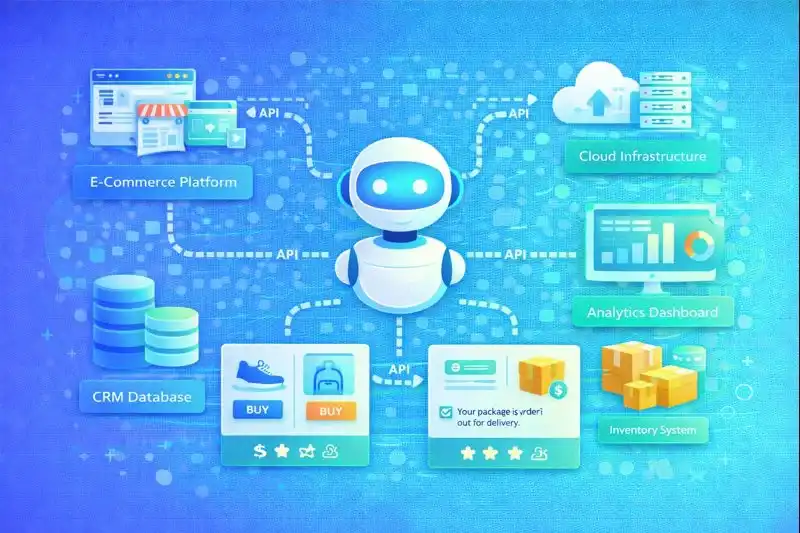
Critical Integrations for E-commerce Chatbots
E-commerce Platform (Shopify, WooCommerce, Magento, BigCommerce): Enables chatbot to access product catalog for recommendations, real-time inventory to avoid selling out-of-stock items, customer order history for personalization, cart contents for abandonment recovery, and checkout integration to complete purchases within chat.
Customer Relationship Management (Salesforce, HubSpot, Zoho CRM): Provides customer lifetime value for VIP prioritization, purchase history for personalized recommendations, support ticket history to avoid repetition, lead scoring for sales-focused chatbot interactions, and segmentation data for targeted messaging.
Helpdesk and Support Platforms (Zendesk, Gorgias, Freshdesk): Allows seamless handoff to human agents with context, ticket creation for complex issues, knowledge base integration for self-service, SLA tracking for high-priority customers, and unified conversation history across channels.
Email Marketing Platforms (Klaviyo, Mailchimp, SendGrid): Enables chatbot to trigger email sequences (abandoned cart, post-purchase), sync chat subscribers to email lists, coordinate messaging across channels, and use chatbot conversations to enrich customer profiles for segmentation.
Analytics and Business Intelligence: Integrate chatbot data with Google Analytics for attribution tracking, data warehouses (Snowflake, BigQuery) for deep analysis, BI tools (Tableau, Looker) for executive dashboards, enabling measurement of chatbot contribution to revenue, customer satisfaction, and operational efficiency.
Integration Best Practices
Use API-first architecture for maximum flexibility and future-proofing. Implement webhook-based real-time data sync rather than batch updates for live information. Establish data governance policies for customer privacy compliance. Create fallback mechanisms when integrated systems are unavailable (cached data, graceful degradation). Monitor API performance and rate limits to avoid service interruptions during traffic spikes.
Implementing AI-Powered Product Recommendations
Intelligent product suggestions transform chatbots from reactive support tools to proactive revenue drivers, increasing average order value and customer satisfaction simultaneously.
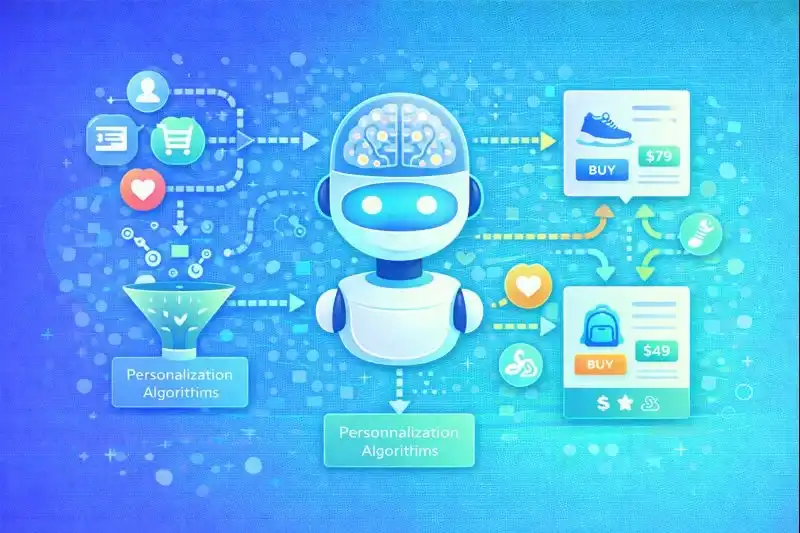
Recommendation Algorithm Approaches
Collaborative Filtering: Analyzes "customers who bought X also bought Y" patterns. Strengths: Discovers unexpected connections, improves with more data. Limitations: Cold-start problem for new products/customers. Best for: Mature catalogs with substantial transaction history.
Content-Based Filtering: Recommends products with similar attributes to customer's interests (brand, category, price range, style). Strengths: Works immediately for new items, transparent logic. Limitations: Limited discovery beyond obvious matches. Best for: Fashion, home decor with clear attribute data.
Hybrid Approaches: Combine collaborative + content-based + business rules (promote new arrivals, seasonal relevance, margin optimization). Modern recommendation engines use machine learning models trained on behavior data, achieving 25-40% higher click-through rates than single-method approaches.
Contextual Recommendations: Leverage real-time context including browsing session, cart contents, time of day, location, and device. Example: Mobile browser at lunch might receive "quick lunch delivery" suggestions, while desktop browser in evening sees "meal kit" recommendations.
Conversational Recommendation Strategies
Progressive Qualification: Start broad ("Looking for yourself or a gift?") and narrow with each question. 3-5 questions achieve 80%+ of recommendation accuracy - additional questions see diminishing returns and risk frustration.
Visual Presentation: Use product carousels with images rather than text-only lists. Include price, rating, and key differentiator for each recommendation. Limit initial suggestions to 3-5 products to avoid overwhelming - offer "Show me more" for additional options.
Explain Recommendations: Transparency builds trust. "I'm suggesting this because you viewed similar jackets" or "Customers with your budget loved these options" helps users understand logic and increases click-through by 15-20%.
Learn from Rejection: When users say "not quite right," ask why ("Too expensive? Wrong style?") and adjust subsequent recommendations accordingly. Adaptive chatbots that learn within conversations achieve significantly higher conversion than static recommendation lists.
Measuring Chatbot Performance and ROI
Data-driven optimization separates successful chatbot implementations from failed experiments. Track the right metrics and iterate based on performance insights.
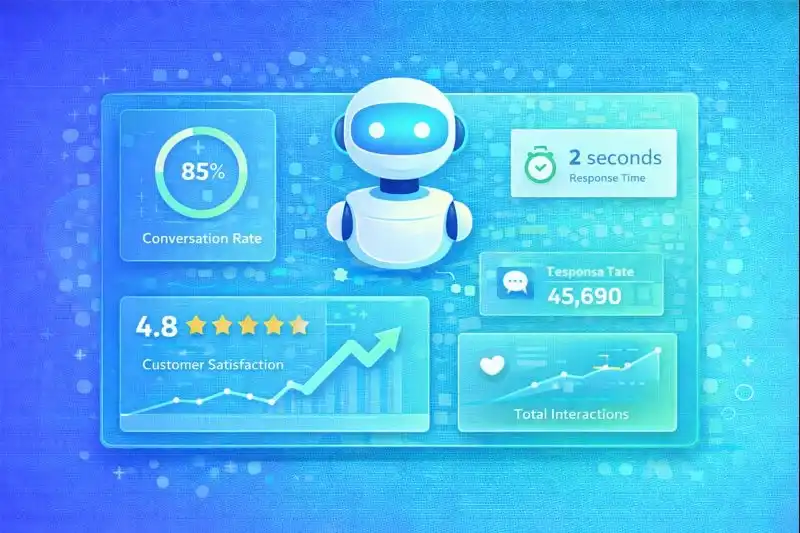
Key Performance Indicators
Conversation Metrics: Total conversations (volume trend), conversation completion rate (users who reach resolution vs. abandon mid-chat - target 65%+), average conversation length (messages exchanged - shorter often indicates efficiency), user satisfaction score (CSAT - target 4.0+/5.0).
Operational Efficiency: Containment rate (conversations resolved without human escalation - target 70-85%), escalation rate (when human help needed - lower is better but 0% unrealistic), average handle time savings (compare chatbot vs. human resolution times), cost per conversation (platform fees + operational overhead divided by conversation volume).
Business Impact: Conversion rate (chatbot interactions that result in purchases - track both direct attribution and assisted conversions), average order value (AOV of chatbot-influenced purchases vs. baseline), revenue attribution (total sales where chatbot played role in customer journey), customer lifetime value (do chatbot users have higher LTV?).
Quality Metrics: Intent recognition accuracy (does chatbot correctly understand user requests? - target 85%+), response relevance (are answers helpful? - measure through user feedback), error rate (technical failures, broken integrations), false positive escalations (unnecessary handoffs to humans).
ROI Calculation Framework
Cost Savings: (Human agent conversations avoided × average cost per conversation) - chatbot operational costs. Example: 10,000 monthly conversations × 70% containment = 7,000 avoided human conversations × $6 per conversation = $42,000 monthly savings vs. $5,000 chatbot platform cost = $37,000 net monthly savings.
Revenue Impact: (Chatbot-attributed sales × average order value) + (abandoned cart recovery conversions × cart value). Example: 500 monthly sales × $75 AOV = $37,500 + 200 cart recoveries × $60 = $12,000 = $49,500 monthly revenue attribution.
Total ROI: (Monthly savings + monthly revenue - chatbot costs) / chatbot costs × 100 = ROI percentage. Using examples above: ($37,000 + $49,500 - $5,000) / $5,000 × 100 = 1,630% ROI.
Benchmark Targets
Successful e-commerce chatbots achieve: 70-85% containment rate, 4.0+/5.0 customer satisfaction, 25-35% conversion rate improvement for chatbot-assisted sessions, $30,000-$100,000+ monthly net value (savings + revenue) for mid-market retailers, 6-12 month payback period on implementation investment.
Advanced Chatbot Strategies and Emerging Trends
As AI technology evolves, sophisticated chatbot implementations unlock competitive advantages through cutting-edge capabilities.
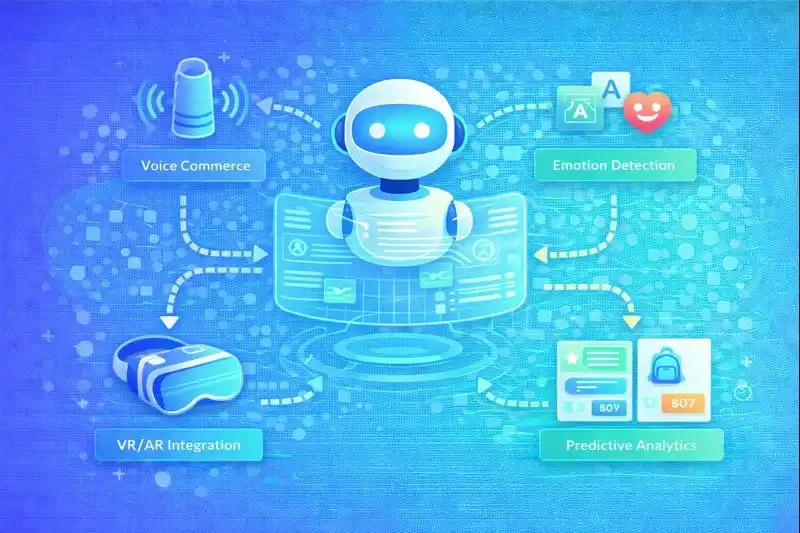
Voice Commerce Integration
Voice-activated shopping via smart speakers (Alexa, Google Assistant) represents the next frontier. 21% of US consumers have made voice purchases (eMarketer, 2024), with adoption accelerating. Integrate chatbots with voice platforms to enable "Alexa, reorder my usual coffee" or "Hey Google, ask [Brand] when my package arrives."
Voice UX considerations: Design for audio-first interactions (shorter responses, clear pronunciation), implement voice authentication for secure account access, optimize product naming for voice search (avoid confusing pronunciations), test with diverse accents and speech patterns.
Sentiment Analysis and Emotional Intelligence
Advanced chatbots detect customer emotion through text analysis - frustration, excitement, confusion - and adapt responses accordingly. A frustrated customer detected by short, negative messages might receive immediate escalation to human agent or empathetic language with proactive discount offers.
Sentiment-aware chatbots reduce churn by 15-25% by identifying at-risk customers and intervening before they leave. Implementation requires NLP models trained on customer service data to recognize e-commerce-specific emotional signals.
Proactive Engagement
Move beyond reactive (customer initiates) to proactive chatbot outreach based on behavior triggers: Cart abandonment (after 5 minutes of inactivity: "Still interested in those shoes?"), browse abandonment (viewed 10+ products without purchase: "Need help deciding?"), slow checkout (stuck on shipping page: "Questions about delivery options?"), VIP customer login (welcome back high-value customers with exclusive offers).
A/B test proactive timing - too soon feels intrusive, too late misses opportunity. 30-90 seconds after trigger event typically optimal. Proactive chatbots increase conversion by 10-20% when implemented thoughtfully.
Multilingual and Localization
Global e-commerce requires multilingual support without hiring language-specific teams. Modern AI chatbots support 90+ languages through automatic translation. However, true localization goes beyond translation to include currency display, local payment methods, culturally appropriate communication styles, and regional inventory availability.
Visual and Voice Search Integration
Let customers upload product photos to chatbot ("I saw this on Instagram, do you have something similar?") and use computer vision to identify visually similar items from your catalog. Visual search increases conversion by 30% for fashion and home décor categories where aesthetics drive purchases (Slyce, 2024).
Combine with voice search to enable "Show me dresses like this in blue" while uploading inspiration photos.
Chatbot-as-a-Service Marketplace
Emerging platforms offer pre-trained AI chatbots for specific industries and use cases, dramatically reducing implementation time. Vertical-specific chatbots (beauty, electronics, fashion) come with domain knowledge and templates, enabling launch in days rather than months.
Frequently Asked Questions
How much does it cost to implement an AI chatbot for an e-commerce store?
Total implementation cost ranges from $2,000-$100,000+ depending on complexity and approach. Entry-level (DIY no-code platforms): $500-$2,000 setup + $50-$300/month platform fees. Suitable for basic FAQ and order tracking. Requires minimal technical skills but limited customization. Mid-market (professional implementation): $10,000-$30,000 setup + $500-$2,000/month. Includes custom conversation design, advanced integrations, AI training. Best for growing businesses with moderate transaction volume (1,000-10,000 monthly orders). Enterprise (custom AI development): $50,000-$250,000+ setup + $5,000-$25,000/month. Fully customized generative AI, multilingual, omnichannel. Justified for large retailers ($10M+ annual revenue) where 1% conversion improvement = significant revenue. Calculate ROI based on cost savings (reduced human agent costs) + revenue impact (conversion improvement, cart recovery) - typical payback period 6-12 months.
Can AI chatbots fully replace human customer service agents?
No - optimal strategy combines AI and human strengths in hybrid approach. AI chatbots excel at high-volume, repetitive queries (order status, FAQs, product information) achieving 70-85% containment rates. However, 15-30% of conversations require human judgment for complex issues, emotional situations, or unique edge cases. Best practice: AI handles tier 1 support (simple, frequent questions) freeing humans for tier 2/3 complex issues, sales conversations, and high-value customers. This hybrid model achieves 30-70% cost reduction while maintaining or improving customer satisfaction through instant AI responses for simple queries + expert human help for complex needs. Leading retailers report 40% of support volume automated while maintaining or increasing CSAT scores from 4.0 to 4.3+ (Zendesk, 2024).
How long does it take to see ROI from a chatbot implementation?
Typical ROI timeline is 3-12 months depending on implementation quality and business metrics. Immediate impact (weeks 1-4): Cost savings from ticket deflection visible immediately - if chatbot handles 500 conversations monthly at $6 per human conversation saved, that's $3,000 monthly savings from day one. Early revenue impact (months 2-3): As conversation flows optimize, see conversion rate improvements and cart recovery beginning. Expect 5-15% conversion lift for chatbot-assisted sessions in this phase. Full maturity (months 6-12): After training on real conversations, A/B testing flows, and integrating advanced features, chatbots reach 70-85% containment rates and 25-35% conversion improvements. At this point, successful implementations generate $30,000-$100,000+ monthly net value for mid-market retailers. Accelerate ROI through focused initial scope (1-2 high-impact use cases vs. trying to do everything), rigorous testing before launch, and weekly iteration based on data.
What's the difference between rule-based and AI-powered chatbots?
Rule-based chatbots follow predetermined decision trees with "if user says X, respond with Y" logic. Strengths: Predictable, simple to build, low cost ($20-$100/month). Limitations: Break easily when users deviate from script, require manual updates for every new scenario, can't understand context or natural language variations. Resolution rate: 30-50%. AI-powered chatbots use NLP and machine learning to understand intent regardless of exact phrasing, learn from interactions to improve over time, handle complex, multi-turn conversations, and adapt responses based on context. Strengths: Higher resolution rates (70-85%), better user experience, require less manual maintenance. Limitations: Higher cost ($200-$2,000+/month), require training data, potential for unexpected responses without guardrails. Modern generative AI chatbots (GPT-4, Claude, Gemini) represent cutting edge with 85-90% resolution, human-like conversations, but require careful prompt engineering and safety controls. Recommendation: Start with AI-powered platforms (not rule-based) in 2025 - cost difference minimal vs. capability improvement. Reserve generative AI for advanced implementations after mastering traditional AI chatbots.
How do you ensure chatbots don't frustrate customers with wrong answers?
Multi-layered approach ensures chatbot quality and user satisfaction: 1. Confidence thresholds: Configure chatbot to only respond when intent confidence > 80% - below this, escalate to human or ask clarifying questions. Prevents guessing wrong answers. 2. Human-in-the-loop training: Review weekly conversation samples to identify confusion patterns and retrain chatbot. Monitor user feedback (thumbs up/down) and escalation reasons to find gaps. 3. Clear fallback handling: When chatbot doesn't understand, acknowledge limitation gracefully: "I'm not quite sure about that. Would you like to chat with our team or see our help center?" 4. Easy escalation: Always offer clear path to human agent - "Talk to a Person" button visible throughout conversation. 5. Gradual rollout: Launch to 10-20% of traffic initially, monitor quality, iterate, then scale. Avoid "big bang" full deployment. 6. Continuous testing: A/B test conversation flows, response phrasing, and escalation triggers. 7. Set accurate expectations: Be transparent about chatbot capabilities upfront - don't promise more than it can deliver. Result: Well-implemented chatbots achieve 4.0+ CSAT scores, matching or exceeding human agents for appropriate use cases.
Related Articles
- How to Keep Customers After the Promotion Ends - Use AI chatbots for post-purchase engagement and retention strategies
- Why Your Store Needs a Loyalty Program - Integrate chatbots with loyalty programs for automated point tracking and redemption
- How to Attract Customers Using Holiday Email Campaigns - Coordinate chatbot and email marketing for omnichannel customer journey
Conclusion
AI chatbots have evolved from experimental technology to essential e-commerce infrastructure, with chatbot-driven transactions reaching $142 billion globally in 2024 and 80% of businesses adopting the technology. The business case is compelling: 30-70% cost reduction in customer service combined with 20-35% conversion rate improvements deliver ROI that typically pays back in 6-12 months while providing 24/7 customer support that 51% of consumers now expect.
Success requires strategic implementation beyond simply installing chatbot software. Focus on high-impact use cases (product discovery, order tracking, returns management) before expanding scope. Select platforms with strong e-commerce integrations and NLP capabilities appropriate for your technical resources ($50-$2,000/month for most mid-market businesses). Design conversation flows that set clear expectations, use natural language, and escalate gracefully when needed. Measure containment rate (target 70-85%), customer satisfaction (4.0+), and revenue attribution to optimize continuously.
The competitive landscape is shifting rapidly as generative AI chatbots (GPT-4, Claude, Gemini) deliver human-like conversations at scale. Early adopters leveraging these advanced technologies gain significant advantages in customer experience, operational efficiency, and personalization. The question is no longer whether to implement AI chatbots, but how quickly you can deploy them strategically to meet rising customer expectations while capturing the substantial ROI that leaders in the space already enjoy - $30,000-$100,000+ monthly net value for optimized implementations.

Ready to start selling?
Launch your online store today with LetsCommerce.