Introduction
Discount campaigns are a powerful tool to attract new customers, boost sales, and quickly introduce new products to the market. However, the main challenge for many stores is ensuring that customers continue returning even after the promotion ends. Offering discounts is just the first step, but long-term success depends on how well you can retain customers.
The economics of retention are compelling: acquiring new customers costs 5-25 times more than retaining existing ones (Invesp). Even more striking, 65% of a company's business comes from repeat customers, and increasing customer retention rates by just 5% boosts profits by 25-95% (Bain & Company). Repeat customers also have 300% higher lifetime value than one-time buyers, and 43% of customers spend more on brands they're loyal to. These statistics underscore a critical truth—retention is where real profitability lives.
In this article, we'll explore proven methods to maintain customer loyalty after discount campaigns end, turning promotion-driven shoppers into long-term brand advocates.
Loyalty Programs
Loyalty programs are an effective way to keep customers interested even after a discount campaign has ended. These programs encourage customers to return for additional purchases by allowing them to collect points or receive personalized discounts.
How to Implement a Loyalty Program:
- Points Accumulation: Let customers earn points for every purchase, for example, one point per dollar spent.
- Personalized Discounts: Offer discounts based on previous purchases.
- Exclusive Promotions: Allow loyal customers to access sales before the official launch.
Loyalty programs help create a connection between the customer and the brand, turning them into repeat buyers.
Post-Purchase Email Sequence: 90-Day Retention Framework
Email is your most powerful retention tool—post-purchase sequences can increase repeat purchases by 40-60%:
Email 1 (Day 0 - Immediately After Purchase): Order Confirmation
- Subject: "Order Confirmed! Here's What Happens Next"
- Content: Order details, estimated delivery, tracking link, customer service contact
- Goal: Build confidence, reduce buyer's remorse
- Open Rate Benchmark: 60-70% (transactional emails have highest opens)
Email 2 (Day 3 - Shipping Notification)
- Subject: "Great News! Your Order Is On the Way 📦"
- Content: Tracking number, delivery date, product care tips or usage guide
- Goal: Maintain excitement, provide value beyond the transaction
- Include: Link to "While you wait, check out these related products"
Email 3 (Day 7 - Delivered, Educational Content)
- Subject: "Did Your [Product] Arrive? Here's How to Get the Most From It"
- Content: Product tips, tutorials, FAQ, customer service offer
- Goal: Increase product satisfaction, reduce returns
- CTA: "Need help? Reply to this email or visit our Help Center"
Email 4 (Day 14 - Review Request + Loyalty Introduction)
- Subject: "How's Your [Product]? Share Your Thoughts (+ Earn Rewards)"
- Content: Review request with incentive (10% off next purchase), introduce loyalty program
- Goal: Collect social proof, introduce non-discount retention mechanism
- Expected Response: 8-12% leave reviews when incentivized
Email 5 (Day 21 - Personalized Recommendations)
- Subject: "Based on Your Recent Purchase, You Might Love These"
- Content: 3-4 complementary products, customer testimonials, styling/usage ideas
- Goal: Drive second purchase (critical retention milestone)
- Benchmark: 2-4% conversion rate on targeted recommendations
Email 6 (Day 30 - Re-Engagement Value Offer)
- Subject: "It's Been a Month! Here's Something Special for You"
- Content: Value-add offer (free shipping, small gift with purchase, exclusive early access—NOT discount)
- Goal: Secure second purchase before 90-day window closes
- CTA: Clear, single-focused ("Shop New Arrivals with Free Shipping")
Email 7 (Day 45 - Community/Content Marketing)
- Subject: "Join [X] Customers in the [Brand] Community"
- Content: User-generated content, customer stories, invite to social media, behind-the-scenes
- Goal: Build emotional connection beyond products
- Include: "Share your [Product] photo with #BrandName for a chance to be featured"
Email 8 (Day 60 - VIP Early Access)
- Subject: "As a Valued Customer, You Get First Access to [New Collection/Sale]"
- Content: Exclusive 24-48 hour early access to new products or sale
- Goal: Reward loyalty without training discount behavior
- Benchmark: 5-8% conversion (higher than standard promotions)
Email 9 (Day 75 - Feedback Survey + Incentive)
- Subject: "We Value Your Opinion: Quick 2-Minute Survey (Reward Inside)"
- Content: 3-5 question survey about product satisfaction, shopping experience
- Goal: Identify issues early, gather insights, show you care
- Incentive: Enter to win $100 gift card or guaranteed 15% discount code
Email 10 (Day 90 - Win-Back or Loyalty Tier Upgrade)
- If No Second Purchase: Win-back campaign (see next section)
- If Already Purchased Again: "You're now a Silver Member! Here's What You've Unlocked"
- Goal: Either recover at-risk customer or celebrate loyalty milestone
Automation Best Practices:
- Pause sequence if customer makes another purchase (restart from Email 1)
- Segment by product category (different tips for apparel vs electronics)
- A/B test subject lines and offers monthly
- Track revenue per email (identify which emails drive sales)
Personalized Email Campaigns
Personalized email campaigns are another tool that can help retain customers. Use email newsletters to remind customers about new arrivals, special discounts, or promotions tailored specifically for them.
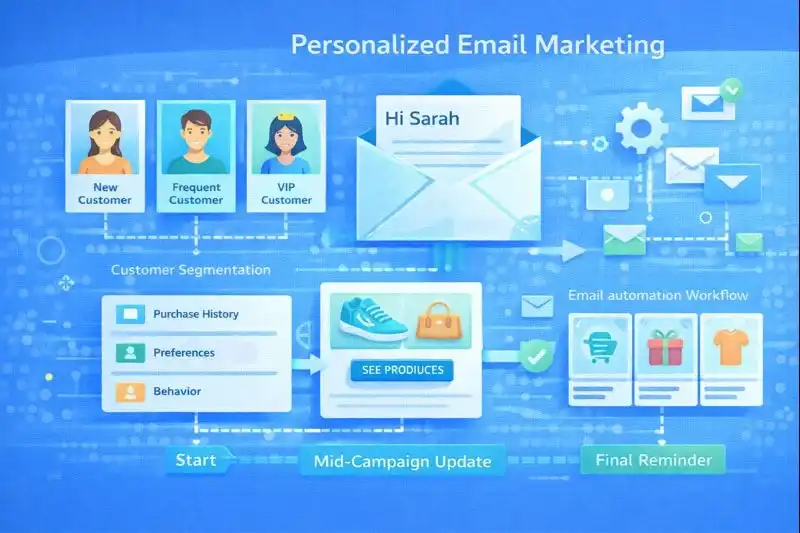
Tips for Effective Newsletters:
- Segmentation: Group customers based on their interests and habits.
- Personal Greetings: Use customer names in greetings to create a more personal approach.
- Product Recommendations: Include recommendations based on previous purchases.
Personalized newsletters make customers feel valued and encourage them to return to your store.
Engagement on Social Media
Social media plays a key role in building customer loyalty, especially after a discount campaign ends. Consistent interaction with your audience and sharing valuable content helps retain customers and increase interest in your brand.
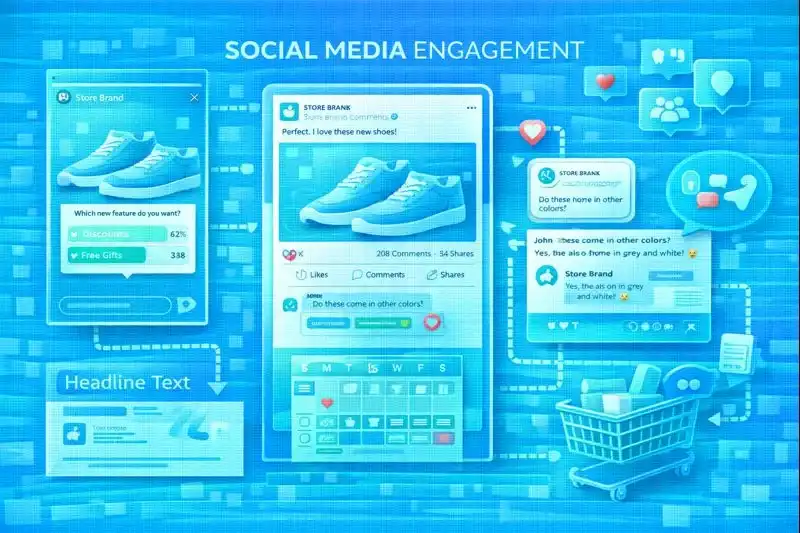
How to Engage with Your Audience After Promotions:
- Respond to Comments: Reply to customer comments and reviews.
- Conduct Polls: Create polls to learn about customer preferences.
- Share News and Tips: Post useful information and talk about new arrivals or interesting trends.
These activities help strengthen the connection with customers and maintain their interest in your brand.
Collecting Feedback
Collecting feedback is an essential tool for improving service and retaining customers. After a discount campaign ends, ask customers about their shopping experience. This allows you to identify strengths and weaknesses in your service and improve future campaigns.
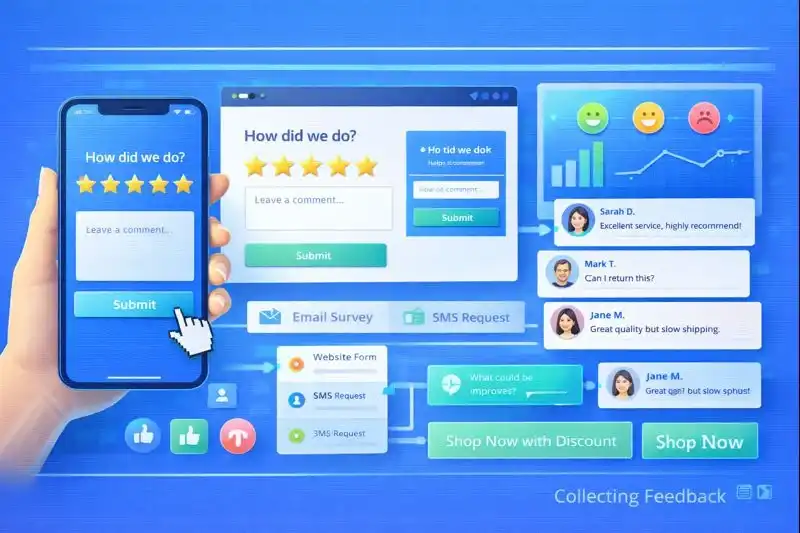
How to Collect Valuable Feedback:
- Surveys: Send short surveys after purchase to learn about customer satisfaction.
- Social Media Polls: Ask customers about their experiences through Instagram Stories or Facebook.
- Review System on Website: Allow customers to leave comments and ratings on product pages.
Feedback not only improves service but also shows customers that their opinions matter.
Offers for Regular Customers
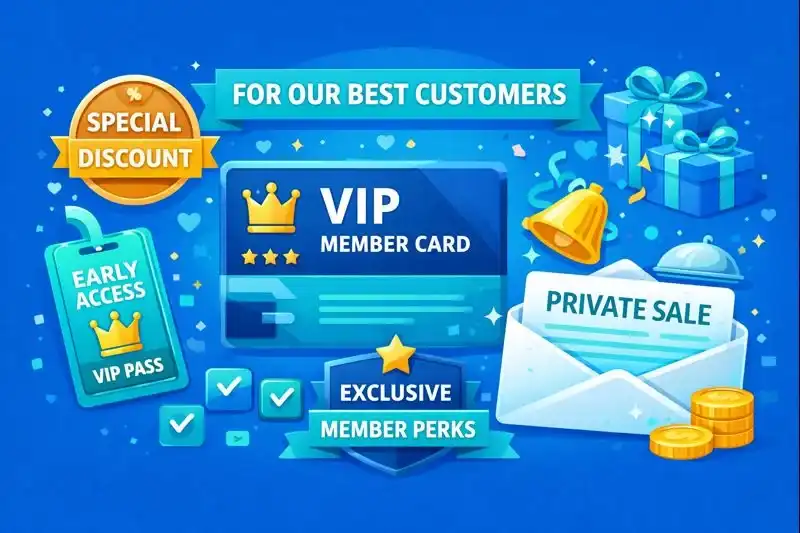
Offer special discounts or bonuses for customers who frequently shop at your store. These can include individual discounts, invitations to private sales, or early access to new collections.
How to Implement It:
- Special Promotions for Regular Customers: Create exclusive promotions for customers who have made a certain number of purchases.
- Early Access: Let regular customers preview new items first.
- Exclusive Discounts: Offer additional discounts on select products.
These simple steps help maintain the interest of regular customers and encourage them to make new purchases.
Analyzing and Improving Campaigns
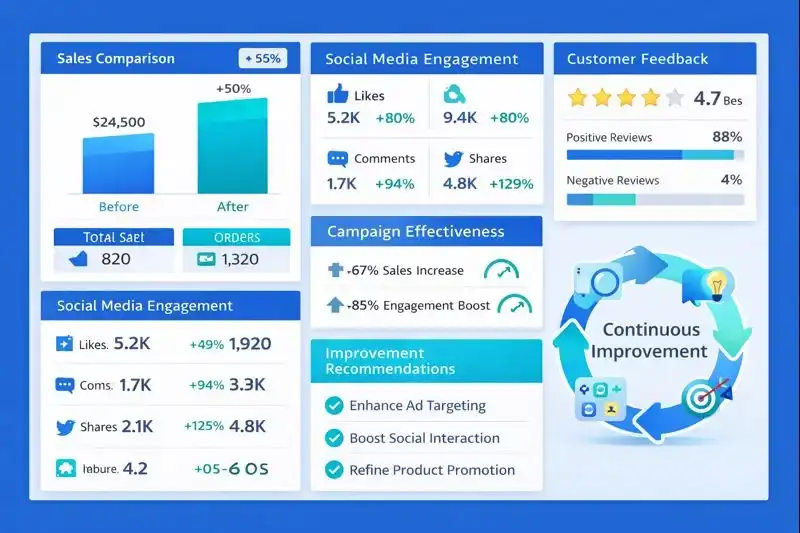
After a discount campaign ends, it’s important to analyze its effectiveness. This will help you understand which campaign elements were most successful and which areas need improvement. Use data on engagement, sales, and customer feedback to plan future campaigns.
Tips for Analysis:
- Sales Study: Analyze which products sold best during the promotion.
- Social Media Engagement: Track views, likes, and comments on posts related to the promotion.
- Feedback Assessment: Review collected feedback to understand overall customer sentiment.
Analysis not only helps improve future promotions but also reveals the most effective methods for engaging customers.
Win-Back Campaigns: Re-Engaging Churned Customers
Customers who haven't purchased in 90+ days are at risk of permanent churn. Win-back campaigns can recover 10-20% of lost customers:
Segmentation by Inactivity Period:
90-180 Days Inactive (Warm Leads):
- Subject: "We Miss You! Here's 20% Off to Come Back"
- Offer: Moderate discount (15-20%) or free shipping
- Success Rate: 15-20% recovery
- Approach: Acknowledge absence, offer incentive, highlight what's new
180-365 Days Inactive (Cold Leads):
- Subject: "It's Been a While... Let's Catch Up (Big Offer Inside)"
- Offer: Aggressive discount (25-30%) or significant value-add
- Success Rate: 8-12% recovery
- Approach: Stronger incentive, showcase product improvements/new arrivals
365+ Days Inactive (Very Cold):
- Subject: "Final Goodbye or Welcome Back? You Decide"
- Offer: Best possible deal (30-40% off) or exclusive product access
- Success Rate: 3-5% recovery
- Approach: "We'd love to have you back, but we understand if you've moved on"
Multi-Touch Win-Back Sequence:
Email 1 (Day 90): Soft Re-Engagement
- "We noticed you haven't shopped in a while—what can we do better?"
- Include survey link, no aggressive selling
- 8-10% open rate
Email 2 (Day 100): Value Reminder
- "Remember Why You Loved [Brand]? Here's What You've Been Missing"
- Showcase new products, customer testimonials, recent awards
- 6-8% open rate
Email 3 (Day 110): Incentive Offer)
- "Come Back and Save: 20% Off Your Next Order"
- Clear CTA, limited-time offer (7 days)
- 10-15% open rate (subject line drives curiosity)
Email 4 (Day 120): Final Push)
- "Last Chance: Your 20% Discount Expires Tonight"
- Urgency-focused, one last attempt
- 12-18% open rate (urgency works)
Email 5 (Day 130 - If Still No Purchase): Breakup Email)
- "We're Saying Goodbye (Unless You Want to Stay?)"
- Acknowledge they may have moved on, offer final incentive or unsubscribe option
- 5-8% open rate, but those who engage are highly motivated
Alternative Win-Back Tactics:
- Direct Mail: Physical postcard with QR code to exclusive offer (3-5% response rate, premium feel)
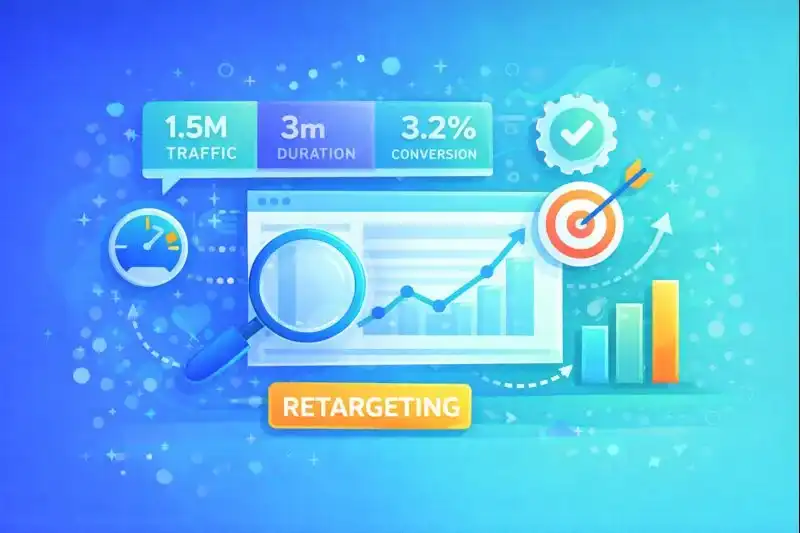
- Retargeting Ads: Show personalized "We miss you" ads on Facebook/Instagram
- SMS (If Opted In): Text with limited-time offer (25-30% open rate, use sparingly)
- Phone Call: For high-value churned customers (>$1,000 LTV), personal call from founder/CEO
Retention Metrics Dashboard: What to Track Weekly
Customer Lifetime Value (CLV):
- Formula: Average Order Value × Purchase Frequency × Customer Lifespan
- Example: $75 AOV × 4 purchases/year × 3 years = $900 CLV
- Benchmark: Should be 3-5x your CAC
Repeat Purchase Rate:
- Formula: Customers Who Bought 2+ Times ÷ Total Customers × 100
- Benchmark: 20-40% good, 40%+ excellent
- Track by Cohort: How many from January's customers bought again in Feb, Mar, etc.?
Average Time Between Purchases:
- Formula: Total Days Between Orders ÷ Number of Orders
- Benchmark: Varies by category (fashion: 60-90 days, consumables: 20-40 days)
- Use: Trigger win-back campaigns when customers exceed average by 50%
Churn Rate:
- Formula: Customers Lost / Total Customers at Start × 100
- Benchmark: <10% monthly is healthy, >15% is problematic
- Calculate: If you start with 1,000 customers and lose 80 in a month, churn is 8%
Net Promoter Score (NPS):
- Question: "On a scale of 0-10, how likely are you to recommend us?"
- Formula: % Promoters (9-10) - % Detractors (0-6)
- Benchmark: 30-50 is good, 50+ is excellent for e-commerce
Customer Satisfaction Score (CSAT):
- Question: "How satisfied were you with your purchase?"
- Scale: 1-5 stars
- Benchmark: 4.2+ average is healthy
Dashboard Template (Track Monthly):
| Metric | This Month | Last Month | Change | Benchmark |
|---|---|---|---|---|
| Repeat Purchase Rate | 28% | 25% | +3% ↑ | 20-40% |
| Churn Rate | 7% | 9% | -2% ↓ | <10% |
| CLV | $820 | $790 | +$30 ↑ | 3-5x CAC |
| Avg Days Between Orders | 68 | 65 | +3 ↑ | 60-90 |
| NPS | 42 | 38 | +4 ↑ | 30-50 |
| CAC | $45 | $48 | -$3 ↓ | <$50 |
Case Studies: Retention Strategies That Worked
Case Study 1: Fashion Brand Increased Retention 180% with Post-Purchase Sequence
Mid-sized apparel brand ($5M revenue) struggled with one-time buyers:
-
Challenge: 12% repeat purchase rate, most customers only bought during sales
-
Solution: Implemented comprehensive 90-day email sequence with educational content, styling tips, early access perks
-
Results in 6 Months:
- Repeat purchase rate increased from 12% to 34% (+180%)
- Average days to second purchase decreased from 120 to 45 days
- Customer lifetime value increased from $95 to $280
- Revenue from repeat customers grew from 25% to 58% of total
-
Key Tactic: Stopped leading with discounts—focused on styling education and community building
Case Study 2: Beauty Brand Cut Churn 60% with Predictive Win-Backs
Skincare company used data to identify at-risk customers early:
-
Challenge: 18% monthly churn rate, most customers didn't reorder after first purchase
-
Solution: Built model predicting churn based on engagement (email opens, site visits) + purchase history, triggered win-back at 60 days instead of waiting for 90
-
Results in 3 Months:
- Churn rate dropped from 18% to 7% (-60%)
- Win-back campaign recovered 22% of at-risk customers (vs 12% at 90 days)
- Subscription conversion increased 35% (auto-replenish prevented churn)
-
Key Tactic: Early intervention—contacted customers before they mentally churned
Case Study 3: Home Goods Store Built $3M from Repeat Customers
Furniture/decor brand with high AOV but low repeat rates:
-
Challenge: $450 AOV but only 8% repeat purchase rate (furniture is infrequent purchase)
-
Solution: Created "Room Refresh" quarterly campaign targeting past customers with complementary products, launched referral program incentivizing past buyers to recommend friends
-
Results in 12 Months:
- Repeat purchase rate increased to 24% (+200%)
- 42% of revenue came from past customers (was 15%)
- Referral program generated $800K in new customer revenue
- CLV increased from $480 to $1,350
-
Key Tactic: Acknowledged purchase infrequency, focused on cross-category sales and referrals instead
Frequently Asked Questions
What's a good customer retention rate for e-commerce?
For e-commerce, a "good" customer retention rate is 20-40%, while above 40% is excellent. This means 20-40% of customers who purchased once will buy again within a year. However, benchmarks vary significantly by industry: Fashion/Apparel: 25-35%, Beauty/Cosmetics: 30-40%, Food & Beverage subscriptions: 70-80%. To calculate your retention rate: [(Customers at End of Period - New Customers) / Customers at Start] × 100. For example, if you start with 1,000 customers, gain 200 new ones, and end with 900 total, your retention is (900-200)/1,000 = 70%. Focus on cohort retention—track how many customers from a specific month/campaign buy again in months 2, 3, 6, and 12. Strong stores see Month 2: 15-25%, Month 6: 30-40%, Month 12: 35-50%. If retention falls below 15%, urgently review post-purchase experience and retention strategies.
How do I calculate customer retention rate?
The standard formula is: [(Customers at End - New Customers) / Customers at Start] × 100. Here's a practical example: January 1: You have 500 customers. During January: You acquire 100 new customers. January 31: You have 480 total customers. Calculation: (480 - 100) / 500 × 100 = 76% retention rate. For e-commerce, track retention over 30, 60, and 90-day periods separately, as behavior differs. Use this enhanced formula for post-promotion analysis: Track customers who bought during the promotion, then measure how many purchase again within 90 days. If 1,000 bought during Black Friday and 250 returned within 90 days, your post-promotion retention is 25%. Tools like Shopify, Google Analytics 4, and Klaviyo automate these calculations. Benchmark against yourself monthly—5% improvement compounds to 60%+ profit increases annually.
What's the difference between customer retention and loyalty?
Retention is behavioral; loyalty is emotional. Retention measures whether customers come back (objective metric: repeat purchase rate). Loyalty measures whether customers want to come back and recommend you (subjective: Net Promoter Score, brand affinity). You can have high retention with low loyalty—customers rebuy out of habit, lack of alternatives, or switching costs, but they're not advocates. Conversely, high loyalty with low retention suggests barriers to purchase (price, availability, poor UX). The goal is both: loyal customers who actively repurchase. Retention strategies: Email automation, loyalty points, retargeting ads (transactional). Loyalty strategies: Exceptional service, brand community, values alignment (emotional). Retention gets the second purchase; loyalty gets purchases 3-10+. Measure retention with repeat purchase rate, loyalty with NPS surveys and referral rates. The sweet spot: 40%+ retention rate with 50+ NPS score.
How long does it take to build customer loyalty?
Customer loyalty typically develops over 3-6 months and 3-5 purchases. Research shows loyalty milestones: Purchase 1: Transaction (no loyalty yet). Purchase 2 (within 30-60 days): Habit formation begins. Purchase 3 (within 90 days): Pattern established—customer is "retained." Purchases 4-5 (months 4-6): Loyalty emerges—emotional attachment forms. Purchase 6+: Advocacy—customers recommend you actively. The critical window is first 90 days post-purchase—if a customer doesn't rebuy within 90 days, likelihood of ever returning drops to <5%. To accelerate loyalty: Week 1: Thank-you email with care instructions. Week 2: Educational content about the product category. Week 3-4: Personalized recommendations. Day 30: Re-engagement offer (small, not discount-heavy). Day 60: Loyalty program invitation. Day 90: Customer feedback survey. Post-promotion customers need extra nurturing—they're discount-trained. Offer exclusive early access (not discounts) to shift from transactional to emotional loyalty.
What causes customers to stop buying after promotions?
The #1 reason is discount addiction—customers only bought because of the deal and wait for the next one. Other causes: Price shock (58% of customers abandon when they see full price after discount), Poor post-purchase experience (slow shipping, bad customer service), Lack of perceived value (product didn't meet expectations set by marketing), No follow-up communication (72% of customers forget brands without email contact), Better competitor offers (customers are comparison shopping), and One-time need fulfilled (seasonal/gift purchases). To prevent this: Immediately after purchase: Send quality confirmation and shipping emails (builds confidence). Week 1: Educational content about the product (increases satisfaction). Week 2-3: Introduce loyalty program (shifts from discount to rewards mindset). Week 4: Personalized recommendations at full price but with added value (free shipping, gift with purchase, bundle deals). Never: Send discount codes immediately—this trains discount-only behavior. If retention is low, survey churned customers: "What would bring you back?" The answer guides your strategy.
Related Articles
Build a comprehensive customer retention strategy with these proven tactics:
- Why Your Store Needs a Loyalty Program - Deep dive into loyalty program strategies that increase repeat purchases by 30%+ and boost lifetime value
- Holiday Email Campaigns That Work - Use post-purchase email sequences to re-engage promotion shoppers year-round
- How to Make Shopping Convenient - Reduce friction in the buying process to increase repeat purchase likelihood by 35%
Conclusion
Customer retention is where e-commerce profitability lives. Remember the economics: acquiring new customers costs 5-25x more than retention, yet 65% of business comes from repeat customers. A mere 5% increase in retention boosts profits by 25-95%, and repeat customers have 300% higher lifetime value. These aren't marginal gains—they're transformational.
The post-promotion challenge is real: discount-driven shoppers often vanish when prices normalize. Combat this with a structured 90-day nurturing sequence: Week 1 confirmation and education, Week 2-3 loyalty program introduction, Week 4 value-added offers (not discounts), Day 60 exclusive early access, Day 90 feedback surveys. Focus on emotional loyalty, not just transactional retention—build community, exceptional service, and brand values that resonate.
Start implementing today: audit your post-purchase email sequence, launch or optimize your loyalty program, and calculate your current retention rate. Track cohort retention monthly and aim for 20-40% baseline, scaling to 40%+ for excellent performance. The stores that win long-term don't chase endless new customers—they build relationships that turn one-time buyers into lifetime advocates.

Ready to start selling?
Launch your online store today with LetsCommerce.