

Introduction
Reviews and ratings have become an essential part of customers' decision-making process. For stores, they are a valuable tool that helps build trust and create a positive impression. By allowing customers to read other users' feedback, they feel more confident in their choices, while stores gain valuable insights that enable them to improve services and product offerings.
The data proves the power of social proof: 93% of consumers read online reviews before making a purchase, and displaying reviews can increase conversion rates by 270%. Products with reviews have 63% higher purchase likelihood than those without, and stores with customer reviews see 18% higher revenue on average. Even more striking, 72% of customers won't take action until they've read reviews, and 88% trust online reviews as much as personal recommendations. This isn't just about building trust—it's about removing the final barrier between browsing and buying.
This article explores how to leverage reviews and ratings strategically: collecting them systematically, displaying them for maximum impact, handling negative feedback professionally, and turning social proof into a conversion engine that drives sustainable revenue growth.
How to Encourage Customers to Leave Reviews
To make reviews truly useful, it’s essential to motivate customers to share their experiences. Studies show that satisfied customers are less likely to leave a review than those who had issues. Therefore, it’s important to actively encourage customers to leave reviews by providing convenient and rewarding options.

Tips for Encouraging Customers:
- Discounts and Bonuses: Offer customers a small discount on their next purchase or reward points for leaving a review.
- Simple and Convenient Forms: Minimize the steps required to leave a review by creating a straightforward, user-friendly interface.
- Automatic Reminders: Send follow-up emails or messages a few days after purchase, kindly requesting a review.
These methods help increase the number of reviews, allowing other shoppers to gain valuable insights about products.
Review Platform Comparison: Choosing the Right Tool
Selecting the right review platform impacts collection rates, display flexibility, and SEO benefits:
| Platform | Best For | Monthly Cost | Key Features | Integrations | SEO Benefits | Rating |
|---|---|---|---|---|---|---|
| Yotpo | Growing brands | $29-$299 | Reviews, photos, Q&A, loyalty | Shopify, WooCommerce, Magento | Rich snippets, strong | 4.7/5 |
| Judge.me | Shopify stores | $15-$99 | Reviews, photos, video, carousel | Shopify only | Automatic schema markup | 4.9/5 |
| Trustpilot | Enterprise/credibility | $199-$999 | Third-party verification, trust badge | All platforms, API | Highest trust signal | 4.6/5 |
| Stamped.io | Budget-conscious | $23-$149 | Reviews, photos, NPS, checkout | Shopify, BigCommerce | Good schema support | 4.8/5 |
| Loox | Visual products | $9.99-$299 | Photo reviews focus, referral | Shopify only | Basic schema markup | 4.9/5 |
| Fera.ai | Multi-platform | $9-$99 | Reviews, social proof widgets | Shopify, WooCommerce, custom | Automatic rich snippets | 4.7/5 |
Platform Selection Criteria:
- Budget (<$50/month): Stamped.io ($23) or Loox ($9.99) provide core functionality
- Shopify Exclusive: Judge.me offers best value and features for Shopify
- Enterprise/Credibility: Trustpilot ($199+) delivers highest trust signal but costs more
- Photo/Video Focus: Loox specializes in visual reviews (critical for fashion/beauty)
- Loyalty Integration: Yotpo combines reviews + loyalty program in one platform
- Multi-Store: Fera.ai works across platforms with unified review management
Must-Have Features:
- ✅ Automated review request emails
- ✅ Photo/video review capability
- ✅ Google Shopping integration
- ✅ Rich snippets/schema markup (for search visibility)
- ✅ Review moderation dashboard
- ✅ Import reviews from other platforms
- ✅ Widget customization (match your branding)
Implementing Reviews for Maximum SEO Impact
Reviews don't just build trust—they significantly boost search rankings when implemented correctly.
Schema Markup (Rich Snippets) Implementation:
Rich snippets display star ratings directly in Google search results, increasing click-through rates by 35%:
-
Automatic Schema (Easiest):
- Most review platforms (Judge.me, Yotpo, Stamped.io) automatically inject schema markup
- Verify implementation using Google's Rich Results Test: https://search.google.com/test/rich-results
- Check that AggregateRating and Review schemas are present
-
Manual Schema (For Custom Builds):
<script type="application/ld+json">
  {
    "@context": "https://schema.org/",
    "@type": "Product",
    "name": "Your Product Name",
    "aggregateRating": {
      "@type": "AggregateRating",
      "ratingValue": "4.5",
      "reviewCount": "127"
    }
  }
</script>
- SEO Benefits of Reviews:
- Fresh Content: Each review adds unique content to product pages (search engines love this)
- Long-Tail Keywords: Customers mention specific use cases and features
- User-Generated Content: Google values authentic customer language over marketing copy
- Lower Bounce Rate: Visitors spend more time reading reviews, signaling quality to search algorithms
Strategic Review Display Placement:
- Product Pages: Display average rating + review count prominently near product title (above the fold)
- Homepage: Showcase "Top Rated Products" or "Customer Favorites" carousel
- Category Pages: Show star ratings on product thumbnails in grid/list views
- Checkout: Display recent reviews in sidebar to reinforce purchase decision
- Thank You Page: Showcase 5-star reviews to validate customer's purchase choice
Benefits of Reviews for Your Store
Reviews are beneficial for both customers and the store itself. They not only help build trust but also improve SEO, reduce the risk of returns, and make it easier for customers to select the right products.
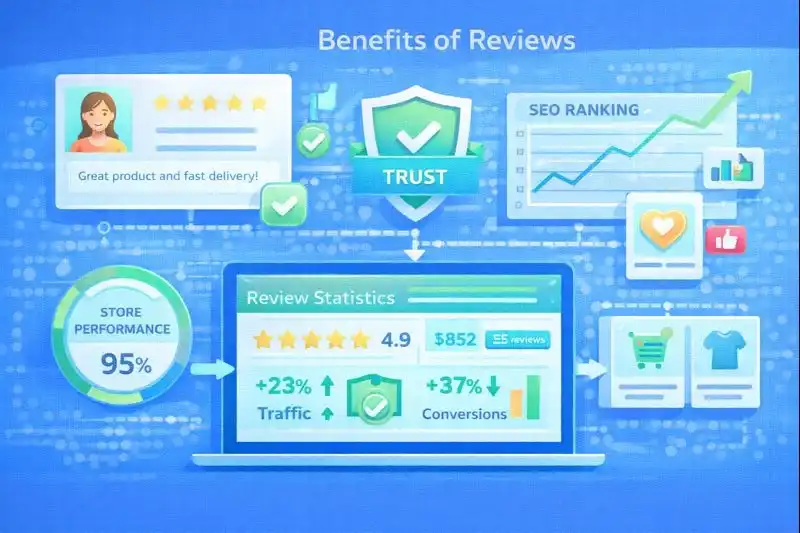
How Reviews Improve Your Store’s Performance:
- Boosting Trust: The more real reviews customers leave, the more trust new shoppers have in your store.
- Improving SEO: Search engines respond positively to reviews on the website, boosting the store’s search rankings.
- Reducing Returns: With more information available, customers make more informed decisions, reducing the likelihood of returns.
Thus, reviews create a positive effect that enhances brand reputation and recognition.
Handling Negative Reviews
Negative reviews can be challenging, but they present an opportunity for improvement. By responding correctly to criticism, you can turn an unhappy customer into a loyal one, demonstrating that their opinion matters.
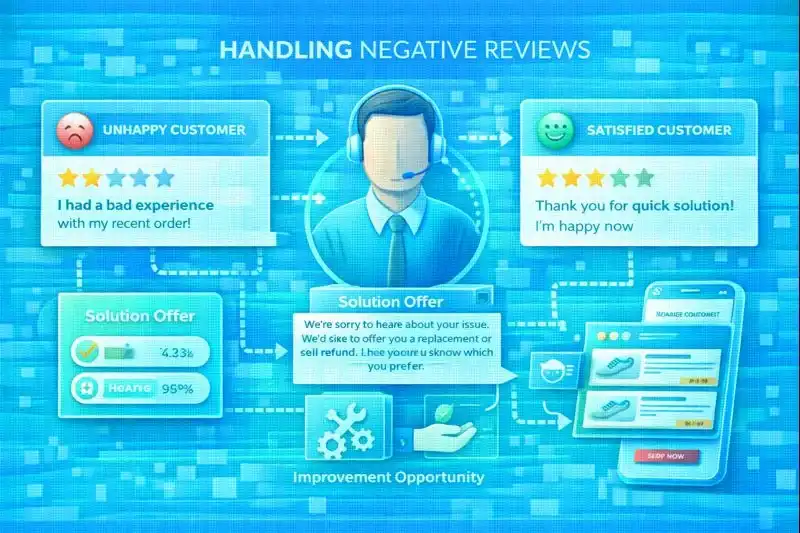
Tips for Responding to Negative Reviews:
- Politeness and Professionalism: Even if the review seems unfair, respond with respect and a willingness to help.
- Offer a Solution: Suggest options for compensation or ways to resolve the issue.
- Thank Customers for Feedback: Show appreciation for their opinion and a commitment to improvement.
Handling negative reviews well helps build a positive image and shows other customers that you care about their experience.
The Impact of Ratings on Purchases
Ratings, such as star ratings, provide customers with a quick way to compare products. They indicate a product’s popularity, simplifying the decision-making process. Most shoppers look at average ratings, aiming to choose products that have high popularity.
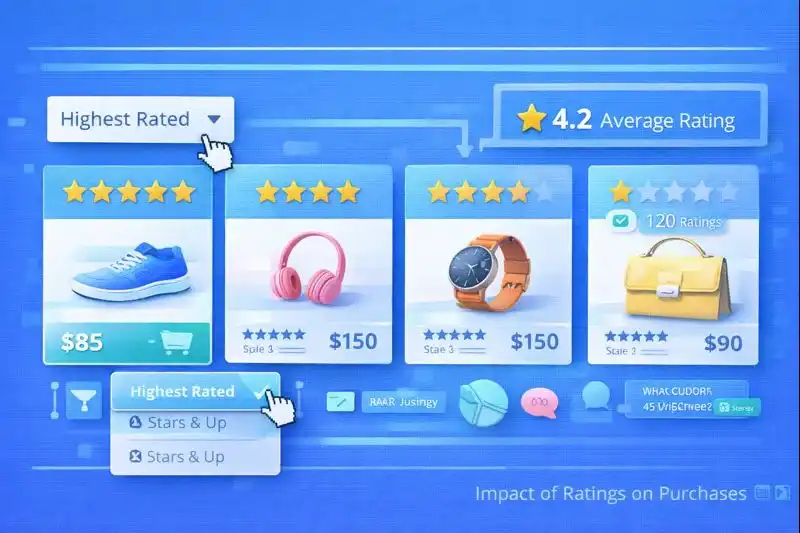
How Ratings Help Customers:
- Quick Comparison: Shoppers can instantly see a product’s average rating and make a faster choice.
- Trust in High Ratings: Products with high ratings earn greater customer trust.
- Filter by Rating: Add a rating filter on the site so customers can easily find top-rated products.
A rating system simplifies product selection and makes the shopping experience more enjoyable.
How Reviews and Ratings Enhance Transparency
Reviews and ratings increase your store's transparency, giving customers a realistic view of products and services. When shoppers see real reviews, they feel more confident that the store is open and honest.
Benefits of Transparency for the Store:
- Building Trust: Customers feel that the store is transparent and provides all necessary information.
- Increasing Sales: Confidence in the store encourages more purchases.
- Attracting New Customers: Honesty and transparency boost the store's reputation.
An honest approach to reviews and ratings helps strengthen your brand’s position in the market and attract more customers.
How Reviews and Ratings Increase Customer Loyalty
When customers see that the store values their reviews and actively engages with them, loyalty is enhanced. Many shoppers return to stores that demonstrate honesty and care about their experience. Reviews and ratings on the site become part of the store's culture and help create a community of loyal customers.
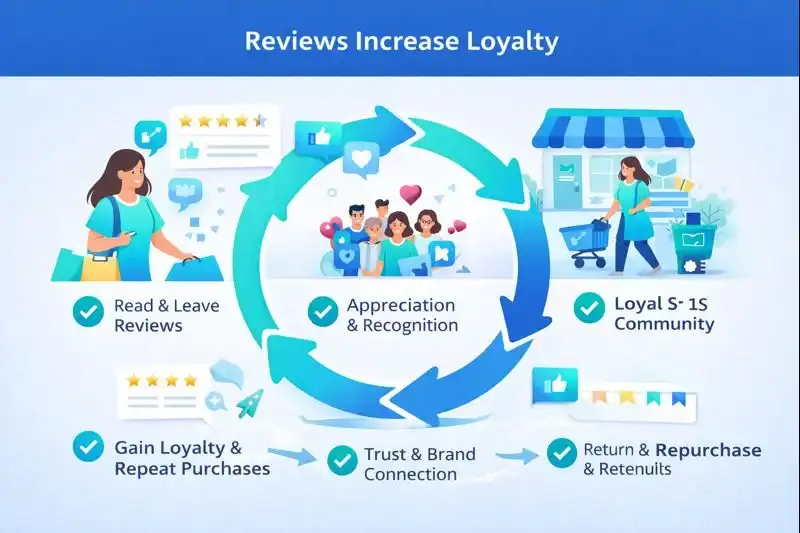
How Reviews Foster Loyalty:
- Supporting Feedback: Customers see that their opinions matter.
- Positive Image: Openness to reviews improves the brand's image.
- Encouraging Repeat Purchases: Loyal customers are more likely to return and stay with the store long-term.
Reviews and ratings create a foundation for customer loyalty, which is key to long-term success.
Advanced Review Request Automation
Multi-Touch Review Request Strategy:
Single email requests achieve 5-10% response rates; multi-touch campaigns reach 15-25%:
Touch 1 (Day 5-7 Post-Delivery): Primary Request
- Subject: "How's your [Product Name]? We'd love to hear from you 😊"
- Content: Personal tone, product image reminder, one-click review link, 10% discount incentive
- Expected Response: 8-12%
Touch 2 (Day 14: Non-Responder Follow-Up)
- Subject: "Quick favor: 30 seconds for your feedback on [Product]?"
- Content: Shorter email, emphasize helping future customers, same incentive
- Expected Response: 3-5%
Touch 3 (Day 30: Final Request)
- Subject: "Last chance to share your thoughts (+ bonus inside)"
- Content: Final reminder, increased incentive (15% discount or enter prize draw), urgency
- Expected Response: 2-4%
SMS Review Requests (If Customer Opted In):
Text messages achieve 20-25% response rates (4x higher than email alone):
- Send 3 days post-delivery
- Keep under 160 characters
- Include direct link
- Example: "Hey [Name]! How's your [Product]? Drop a quick review here [link] and get 10% off your next order 🎁"
In-App Review Prompts (Mobile App Stores):
If you have a mobile app:
- Trigger review prompt after 3+ successful orders
- Use native iOS/Android review prompts (better conversion than external links)
- Time requests after positive interactions (order delivered, loyalty reward claimed)
Post-Purchase Page Review Capture:
On order confirmation/thank you pages:
- "Love it already? Leave a review now!" (captures excited early reviews)
- 5-10% of customers will review immediately if prompted
- These early reviews are often the most enthusiastic
Leveraging User-Generated Content (UGC) Beyond Reviews
Reviews are just one form of customer-created content—expand social proof across channels:
Photo/Video Review Incentives:
Visual reviews convert 73% better than text-only reviews:
- Offer higher incentives for photo/video reviews: 15% discount vs 10% for text-only
- Display photo reviews prominently on product pages with carousel galleries
- Feature customer photos in Instagram posts/Stories (with permission and credit)
- Create "Customer Spotlight" weekly series showcasing best user photos
Instagram/TikTok UGC Collection:
- Create branded hashtag (#MyBrandStyle, #BrandCommunity)
- Encourage customers to tag your account in posts
- Repost best customer content to your main feed (drives more submissions)
- Run monthly contests: "Best product photo wins $100 gift card"
- Aggregate UGC feeds on product pages using tools like Foursixty, Pixlee, Taggbox
Unboxing Video Campaigns:
- Seed products to micro-influencers for unboxing content
- Request unboxing videos from first 100 customers (offer gift/discount)
- Compile clips into launch highlight reel
- Post to TikTok, Instagram Reels, YouTube Shorts (unboxing videos drive discovery)
Review Syndication Across Platforms:
Share reviews beyond your website to maximize reach:
- Google Seller Ratings: Reviews display in Google Ads (requires 150+ reviews via Google Customer Reviews program)
- Facebook Page Reviews: Import website reviews to Facebook business page
- Social Media Graphics: Create quote graphics from 5-star reviews for Instagram/Facebook posts
- Email Marketing: Include recent review snippet in weekly newsletters
- Retargeting Ads: Feature customer testimonials in retargeting ad creative
Measuring Review Program ROI
Track these metrics to prove review impact on revenue:
Collection Metrics:
- Review Request Send Rate: % of orders that receive review request email
- Review Response Rate: % of requests that result in submitted reviews (target: 10-15%)
- Photo/Video Review Rate: % of reviews that include visual content (target: 20-30%)
- Average Days to First Review: Time from product launch to 10th review (target: <30 days)
Display & Engagement Metrics:
- Review Widget Views: How many visitors see reviews on product pages
- Review Read Rate: % of product page visitors who scroll to/click reviews section
- Reviews Per Product: Distribution (identify products needing more reviews)
- Average Star Rating by Product: Track trends (declining ratings = quality issue)
Business Impact Metrics:
- Conversion Rate by Review Count: Compare products with 0, 1-10, 10-25, 25+ reviews
- Revenue Attributed to Reviews: Calculate incremental revenue from improved conversion rates
- CAC Reduction: Reviews reduce paid acquisition costs by improving organic conversion
- Return Rate by Review Count: Products with more reviews typically see lower returns (informed buyers)
Example ROI Calculation:
- Baseline: Product with 0 reviews converts at 2% (200 visitors → 4 sales)
- With 15 Reviews: Same product converts at 3% (200 visitors → 6 sales)
- Incremental Revenue: 2 extra sales × $50 AOV = $100 additional revenue per 200 visitors
- Monthly Impact: 10,000 visitors × 50% view reviewed products = 5,000 visitors seeing reviews × 3% lift = 150 extra sales = $7,500/month
- Review Program Cost: $50/month (platform) + $200/month (discount incentives) = $250/month
- ROI: ($7,500 - $250) / $250 × 100 = 2,900% ROI
Case Studies: Review Programs That Drive Results
Case Study 1: Fashion Brand Increased Conversion 47% with Photo Reviews
A mid-sized apparel brand with $2M annual revenue implemented Loox for visual review collection:
-
Challenge: 1.8% conversion rate, customers uncertain about fit/quality
-
Solution: Automated photo review requests with 15% discount incentive, displayed photo galleries on product pages
-
Results in 90 Days:
- Collected 847 photo reviews (28% of orders)
- Conversion rate increased from 1.8% to 2.65% (+47%)
- Return rate decreased from 18% to 12% (better expectations set by customer photos)
- Revenue increased $420K annually from conversion lift alone
-
Key Tactic: Segmented review requests by product type—sent separate emails for tops, bottoms, dresses asking specific questions ("How's the fit? True to size?")
Case Study 2: Electronics Store Leveraged SEO Power of Reviews
Small electronics retailer competing against Amazon used reviews for SEO advantage:
-
Challenge: Invisible in Google search, Amazon dominated all product keywords
-
Solution: Implemented Judge.me with schema markup, focused on collecting detailed reviews mentioning specific features
-
Results in 6 Months:
- Collected 1,200+ reviews averaging 250 words each (detailed)
- 30 products achieved rich snippets in Google search
- Organic traffic increased 127% (review content created long-tail keyword rankings)
- Google Shopping clicks increased 83% (star ratings displayed in ads)
- Overall revenue from organic search: +156%
-
Key Tactic: Asked specific questions in review forms ("What problem did this solve?" "How are you using it?") to generate keyword-rich content
Case Study 3: Beauty Brand Scaled to $10M with UGC Strategy
Direct-to-consumer skincare brand used customer content as primary marketing:
-
Challenge: Small ad budget ($50K/year), competing against established brands with millions in marketing spend
-
Solution: Invested in comprehensive UGC program—photo reviews, Instagram hashtag campaign, influencer seeding
-
Results in 12 Months:
- 3,400 photo/video reviews collected
- Instagram hashtag (#MySkinGlow) generated 8,200 posts from customers
- Repurposed UGC for all paid ads (replacing expensive photo shoots)
- ROAS on ads featuring UGC: 8.2x vs 3.1x for studio photography
- Scaled from $2M to $10M annual revenue with same ad budget (improved efficiency)
-
Key Tactic: Made sharing content EASY—QR code in product packaging linked directly to Instagram camera with branded hashtag pre-populated
Frequently Asked Questions
How many reviews do I need to increase conversions?
The conversion impact scales with review volume, but you'll see measurable results with as few as 5-10 reviews per product. Research shows: 0 reviews: Baseline conversion rate. 5-10 reviews: 18% conversion increase. 10-25 reviews: 35-50% conversion increase. 25-50 reviews: 60-80% conversion increase. 50+ reviews: 85-100% conversion increase (diminishing returns beyond this). The biggest jump happens between 0 and 10 reviews—this removes the "unproven product" barrier. For new products, prioritize getting your first 10 reviews within 30 days of launch using follow-up emails, incentives (discounts for reviews), and early customer programs. Track conversion rate by review count bracket—if products with 20+ reviews convert at 4% while 0-5 review products convert at 1.5%, you know where to focus review collection efforts. Remember: quality over quantity—ten detailed, authentic reviews outperform fifty generic "great product" comments.
Should I display negative reviews or filter them out?
Always display negative reviews—filtering creates distrust and violates FTC guidelines. Here's why: 100% 5-star ratings look fake (95% of consumers are suspicious), 67% of shoppers specifically look for negative reviews to understand risks, 82% seek negative reviews to make informed decisions, and stores displaying all reviews (including negatives) see 15% higher trust scores. The key is how you handle negatives: Respond professionally within 24-48 hours, offer solutions publicly, show you're actively improving based on feedback. Optimal rating distribution: 60-70% 5-star, 20-25% 4-star, 8-12% 3-star, 2-5% 1-2 star. This looks authentic. If you have legitimate fake/spam reviews, remove those only—but real customer dissatisfaction should be visible and addressed. Negative reviews actually increase conversion when combined with positive ones because they signal authenticity and help customers understand product limitations before purchase.
What's a good average star rating for e-commerce products?
The optimal average rating is 4.2-4.7 stars out of 5. Counterintuitively, perfect 5.0 ratings perform worse than 4.2-4.7 because they appear fake. Breakdown: 4.7-5.0 stars: Excellent, but verify authenticity signals (some negatives visible). 4.2-4.6 stars: Ideal range—high trust + authenticity. 3.5-4.1 stars: Acceptable, but investigate common complaints. Below 3.5 stars: Red flag—address product/service issues urgently. Industry benchmarks: Fashion/Apparel: 4.3-4.5, Electronics: 4.2-4.4, Home Goods: 4.4-4.6, Beauty: 4.5-4.7. If your rating falls below 4.0, prioritize these fixes: Identify recurring complaints and fix root issues, reach out to unhappy customers for resolution, improve product descriptions to set accurate expectations, implement quality control improvements. Track rating trend over time—improving ratings (3.8 → 4.2) signal positive changes; declining ratings (4.6 → 4.0) demand immediate investigation.
How do I get customers to leave reviews if they're not doing it organically?
Only 5-10% of customers leave reviews organically, so you need proactive collection systems. Most effective strategies: Email automation (75% of review sources): Send review request 5-7 days post-delivery (when product is in use), use simple one-click review links, include product image to jog memory, A/B test subject lines ("How's your new [product]?" performs best). Incentivized reviews (legal when disclosed): Offer 10-15% discount on next purchase (don't require positive reviews—violates FTC), enter reviewers into monthly prize drawings, or provide loyalty points (100 points = $5 value). In-package inserts: QR code card that links directly to review page, handwritten-style "We'd love your feedback!" notes. SMS follow-up (if opted in): Text 3 days after delivery with direct review link (20% higher response than email). On-site pop-ups: Trigger after 2+ purchases: "You're a valued customer—share your experience?" Timing is critical: Ask too early (immediately after purchase) = low completion. Ask too late (30+ days) = forgotten. Sweet spot: 5-10 days post-delivery for most products, 14-21 days for complex products (furniture, electronics).
Can fake reviews hurt my store?
Yes—massively. Fake positive reviews can result in: Platform bans (Amazon, Google Shopping remove sellers), FTC fines up to $43,792 per violation, Permanent reputation damage (media exposure of fake reviews destroys trust), Legal liability (customers can sue for deceptive practices), SEO penalties (Google devalues sites with detected fake reviews). Spotting fake reviews: Overly generic ("Great product!"), Posted in bursts (20 reviews in one day), Reviewer history (account created same day, multiple products same store), Similar phrasing across reviews (copy-paste). What to do instead: Implement verified purchase badges (only buyers can review), use third-party review platforms (Trustpilot, Yotpo—harder to game), display reviewer purchase history ("Verified Buyer"), moderate reviews for spam but NOT sentiment, report competitors using fake reviews to platforms. One authentic negative review is worth more than 100 fake positives—it signals transparency and builds lasting trust. Focus on earning real reviews through excellent products/service, not manufacturing fake social proof that will eventually backfire.
Related Articles
Build a comprehensive trust and conversion optimization strategy:
- Customer Retention Strategies - Turn satisfied reviewers into repeat customers with post-purchase nurturing sequences
- Why Your Store Needs a Loyalty Program - Incentivize reviews through loyalty points systems that reward customer engagement
- Social Media Marketing Guide - Share positive reviews on social media to amplify social proof across channels
Conclusion
Social proof through reviews and ratings isn't optional—it's conversion infrastructure. With 93% of consumers reading reviews before purchasing and reviews increasing conversion by 270%, the math is simple: no reviews = no sales. Products with reviews have 63% higher purchase likelihood, and stores leveraging social proof see 18% higher revenue on average. The barrier isn't trust in your brand—it's trust in the product itself, and reviews remove that final objection.
The winning strategy prioritizes getting your first 10 reviews per product within 30 days (this unlocks the 18% conversion boost), maintains an authentic 4.2-4.7 star average (perfect 5.0 looks fake to 95% of consumers), displays all reviews including negatives (67% actively seek negative reviews for authentic ity), responds to criticism within 24-48 hours professionally, and automates review requests 5-7 days post-delivery when satisfaction is high.
Start implementing today: set up automated review request emails, incentivize reviews with 10-15% discount codes (disclose this clearly to comply with FTC), respond to every review (positive and negative) to show engagement, display star ratings prominently on product pages and in search results, and track conversion rate by review count to prove ROI. The stores dominating e-commerce don't just collect reviews—they systematically engineer social proof into every customer touchpoint, turning satisfied buyers into your most persuasive salespeople.