Introduction
Subscription commerce has evolved from niche experiment to mainstream e-commerce strategy, with subscription e-commerce sales reaching $38 billion in the US in 2024, growing at 17% annually (McKinsey & Company, 2024). More significantly, 75% of direct-to-consumer brands now offer subscription options, recognizing the strategic value of predictable recurring revenue and increased customer lifetime value.
The business model advantages are compelling: subscription customers have 3-5x higher lifetime value than one-time purchasers, monthly recurring revenue provides cash flow predictability for inventory and growth planning, and subscriber retention rates of 70-90% create stable revenue
foundations. Leading subscription brands achieve customer retention costs 5-7x lower than acquisition costs, enabling profitable scaling (Recurly Research, 2024).
This guide explores how to implement subscription commerce successfully - from selecting the right model and pricing strategy to optimizing retention and scaling operations for sustainable growth.
Understanding Subscription Commerce Models
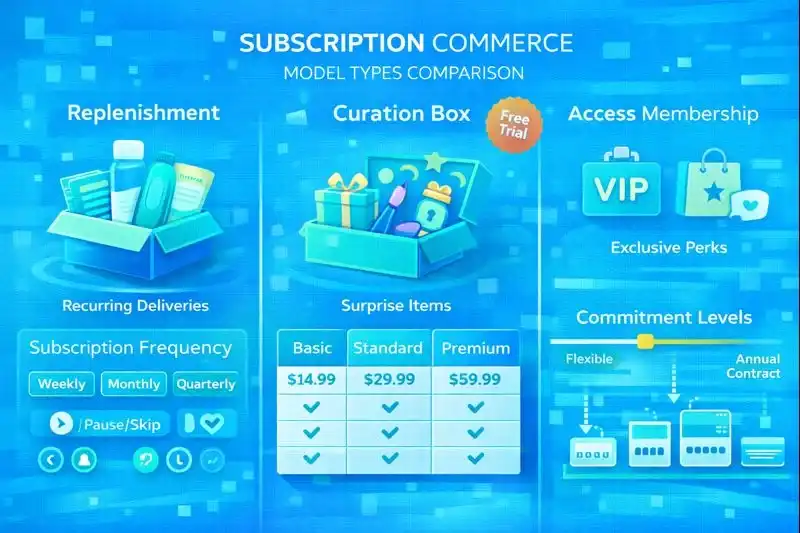
Subscription commerce encompasses several distinct models, each with unique economics, operational requirements, and ideal use cases.
Replenishment Subscriptions
Customers receive regular deliveries of consumable products they use consistently - razors, vitamins, pet food, coffee. Dollar Shave Club pioneered this model, disrupting traditional retail with convenience-driven subscriptions.
Best for: Products with predictable consumption patterns, clear replenishment cycles (weekly/monthly), and high repeat purchase rates. Average retention: 6-12 months depending on product category. AOV: $20-$60 typically.
Curation Subscriptions
Customers receive curated selections of products chosen by experts or algorithms based on preferences - beauty boxes, book clubs, clothing styling services. Birchbox and Stitch Fix exemplify this model.
Best for: Discovery-focused categories (beauty, fashion, books), customers seeking personalized recommendations, and products where variety drives engagement. Average retention: 3-6 months due to novelty factor decline. AOV: $35-$100+.
Access Subscriptions
Customers pay recurring fees for exclusive benefits - free shipping, member pricing, early access to sales. Amazon Prime dominates with 200+ million subscribers globally.
Best for: High-frequency shoppers where shipping costs/convenience justify subscription, brands with deep product catalogs, and businesses offering exclusive member experiences. Average retention: 12-24+ months with strong value proposition. AOV: Varies but drives 2-3x purchase frequency.
Hybrid Models
Combining subscription types creates differentiated value. Example: Core replenishment subscription + optional add-ons + membership benefits. Customers subscribe to monthly coffee delivery, can add snacks as one-time purchases, and receive free shipping on all orders.
Best for: Mature brands with diverse product lines, customers with varied needs, and businesses seeking revenue optimization through multiple monetization layers.
Designing Your Subscription Offer
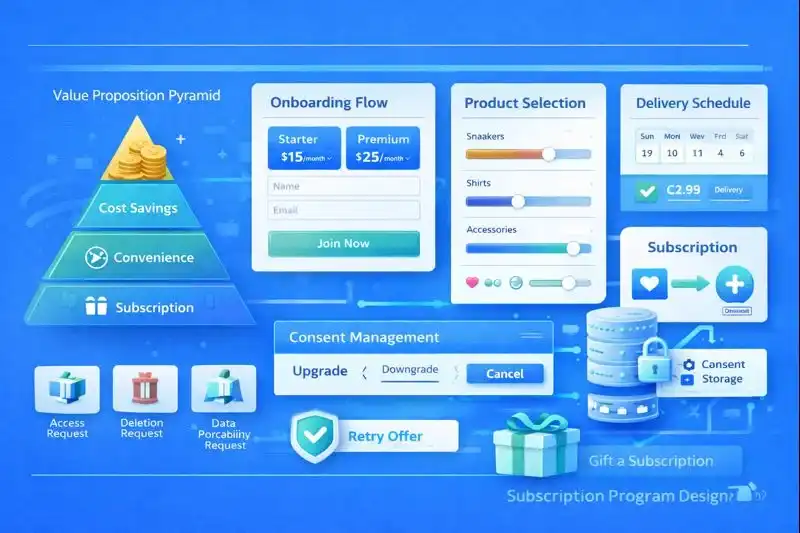
Successful subscription programs balance customer value proposition with business unit economics, requiring strategic decisions across pricing, frequency, and benefits.
Pricing Strategy
Subscription discount vs. one-time purchase: Typical discounts range 10-25% off retail to incentivize subscriptions while maintaining margins. Test price sensitivity - 15% discount proves sweet spot for many categories, driving subscriptions without excessive margin erosion.
Tiered pricing: Offer multiple subscription levels with increasing value - Basic ($25/month), Premium ($45/month + exclusive items), VIP ($75/month + concierge service). 35% of subscribers upgrade to higher tiers when presented with clear value differentiation (Subscription Trade Association, 2024).
Prepay discounts: Annual subscriptions paid upfront receive additional 15-25% discount vs. monthly billing. Improves cash flow and increases retention (sunk cost psychology). However, 70-80% of subscribers prefer monthly billing despite savings, so offer both.
Delivery Frequency Options
Allow flexible cadences (every 2 weeks, monthly, every 2 months) rather than fixed schedules. 68% of subscription cancellations cite "too much product" as reason - flexibility prevents oversupply cancellations (Yotpo, 2024).
Implement skip functionality - customers can pause next delivery without canceling. Skip rates of 15-25% are healthy, preventing churn while maintaining subscriber relationship.
Use consumption-based recommendations - "Based on your usage, we recommend every 6 weeks" educates customers on optimal frequency.
Subscription Benefits Package
Beyond product discounts, offer membership perks: Free shipping (standard and expedited), early access to new products and sales (24-48 hours before public), exclusive products available only to subscribers, birthday gifts or anniversary rewards, priority customer support (faster response times, dedicated channels).
Perceived value should exceed subscription cost by 2-3x to justify commitment. Calculate total annual value of benefits vs. subscription fees.
Trial and Onboarding
Free trials (7-30 days) reduce signup friction but convert at 25-40% vs. paid trials (discounted first month) converting at 55-70% - paid trials attract higher intent customers (Chargebee, 2024).
Onboarding sequences dramatically improve retention: Welcome email explaining how subscription works, product education content maximizing value, early check-ins (week 2, week 4) ensuring satisfaction, feedback requests gathering improvement insights.
Building Subscription Technology Infrastructure
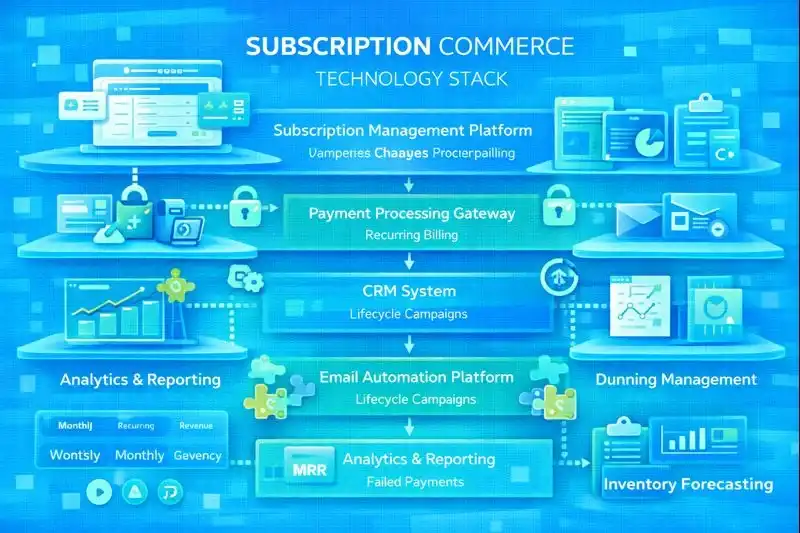
Effective subscription management requires specialized platforms handling recurring billing, customer self-service, and retention automation.
Subscription Management Platforms
Shopify Subscriptions (free for Shopify stores): Basic subscription functionality, simple setup, limited customization. Best for: Small businesses testing subscriptions with < 500 subscribers.
Recharge ($99-$999/month): Industry-leading Shopify subscription app, advanced customization, robust analytics. Best for: Growing DTC brands with 500-10,000+ subscribers needing flexibility.
Bold Subscriptions ($49.99-$499/month): Strong customization, subscription boxes focus. Best for: Curation-heavy models requiring complex product selections.
Chargebee ($249-$599+/month): Platform-agnostic, enterprise-grade, advanced dunning. Best for: Multi-platform businesses or custom e-commerce platforms.
Key Platform Capabilities
Flexible billing: Support multiple payment cadences (weekly, monthly, quarterly, annual), trial periods, tiered pricing, add-on products. Automated billing retry: Failed payments represent 20-40% of monthly churn - dunning management automatically retries failed cards over 7-14 days, recovering 30-50% of failed payments.
Customer self-service portal: Subscribers manage subscriptions independently - skip deliveries, change frequency, update payment methods, swap products. Reduces support burden by 40-60% while improving satisfaction.
Analytics and reporting: Track MRR (Monthly Recurring Revenue), churn rate, LTV, cohort retention, subscription conversion rates. Data-driven optimization requires granular visibility.
Integration Requirements
Connect subscription platform with: E-commerce platform (Shopify, WooCommerce, custom), email marketing (Klaviyo for automated flows), customer service (Zendesk, Gorgias for support ticket context), inventory management (real-time stock levels prevent overselling), accounting (QuickBooks, Xero for revenue recognition).
API access enables custom integrations as business scales beyond standard platform features.
Maximizing Subscription Retention
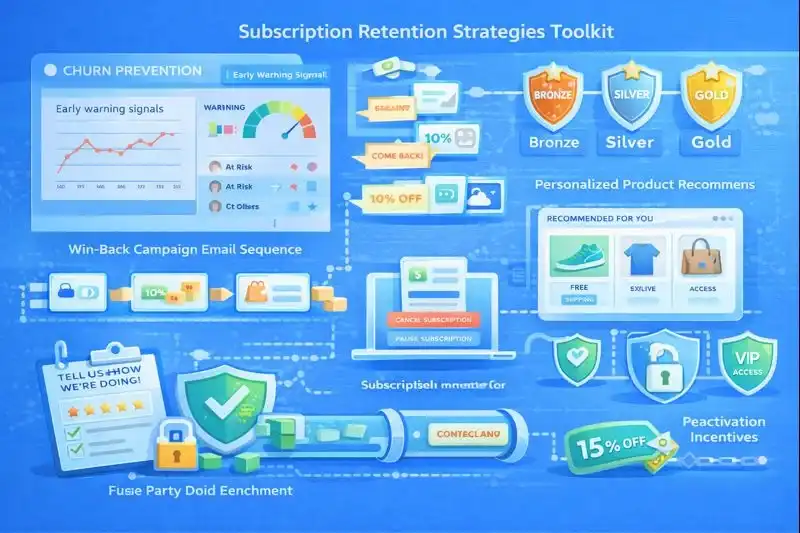
Retention determines subscription business success - improving retention from 80% to 90% increases LTV by 2-3x. Strategic retention programs combat natural subscriber attrition.
Proactive Communication
Pre-renewal reminders (3-5 days before billing) reduce involuntary churn from failed payments by allowing payment method updates. Include order contents, billing amount, delivery date for transparency.
Post-shipment engagement: Delivery confirmations, product usage tips, recipe ideas (food subscriptions), tutorials - drive product value realization preventing "is this worth it?" doubts.
Regular value reminders: Monthly "Your Subscription Savings" emails quantifying discount value, free shipping savings, exclusive perks used. Reinforce ROI.
Churn Prevention Tactics
At-risk subscriber identification: Monitor skip patterns (2+ consecutive skips), customer service contacts, login frequency decline. Trigger retention campaigns before cancellation.
Cancellation flows with alternatives: When customers attempt cancellation, offer frequency adjustments ("Too much product? Try every 8 weeks"), product swaps ("Don't like this flavor? Switch free"), pause options ("Take a break, resume anytime"), win-back discounts ("25% off next 3 months if you stay").
Save rates of 15-40% possible through thoughtful intervention versus immediate cancellation.
Surprise and Delight
Random rewards create positive associations: Bonus products in occasional shipments, upgrade surprises (premium version substituted), early access to limited products, handwritten thank-you notes in anniversary shipments.
Gamification: Subscription milestones (3-month, 6-month, 1-year) unlock badges, discounts, exclusive products. Creates progress psychology encouraging retention.
Community Building
Private Facebook Groups or Discord channels for subscribers create belonging. 67% of subscription box users cite community as retention factor (SUBTA, 2024).
User-generated content campaigns: Encourage subscribers sharing unboxing videos, product reviews, usage photos. Recognition and social proof strengthen commitment.
Feedback Integration
Regular surveys (quarterly) asking satisfaction, product preferences, improvement ideas demonstrate customer-centricity. Importantly, communicate changes implemented from feedback - "You asked for decaf options, now available!"
Close feedback loops build trust and reduce churn from addressable pain points.
Frequently Asked Questions
What subscription retention rate should I target?
Healthy subscription retention varies by model and product category. Replenishment subscriptions: Target 70-85% monthly retention (15-30% monthly churn). Annual retention of 40-60% is strong for consumables. Curation subscriptions: Expect 65-75% monthly retention (novelty factor creates higher churn). 30-45% annual retention typical. Access subscriptions: Can achieve 85-95% monthly retention with strong value proposition. 70-80% annual retention possible. Benchmark calculations: Monthly churn rate = (Cancellations in month / subscribers at month start) × 100. Annual retention = (Subscribers at year-end / subscribers at year-start) × 100. Improvement timeline: Expect 3-6 months to optimize retention through onboarding, communication, and product-market fit refinement. 5-10% retention improvement yields significant LTV gains. Warning signs: Monthly churn > 10% indicates fundamental issues requiring investigation.
How do I price my subscription to be profitable?
Subscription unit economics require careful calculation. Cost components: Product COGS (40-60% of subscription price for physical products), shipping costs (20-30% if free shipping offered), packaging (5-10% for subscription-specific packaging), payment processing (2.9% + $0.30), platform fees (subscription software 3-8% of revenue), customer acquisition (amortize over projected LTV). Profitability formula: Subscription price should be 2.5-3x product COGS minimum to cover all costs and maintain margins. Example: $30/month subscription should have < $12 COGS. LTV-based pricing: Calculate Customer Lifetime Value = (Avg subscription price × gross margin) × (1 / monthly churn rate). Ensure LTV > 3x CAC for sustainable growth. Testing approach: Launch with 15-20% discount vs. retail as starting point. Test price elasticity after 3-6 months with 500+ subscribers. Monitor retention by price cohort - higher churn at lower prices indicates need for adjustment.
Should I offer subscriptions if I'm a new e-commerce brand?
Subscriptions work best with established customer trust and product-market fit. Wait if: Brand is < 3 months old with minimal reviews/social proof. Haven't achieved consistent repeat purchase rates (30%+) through regular sales. Lack operational infrastructure for reliable fulfillment. Start immediately if: Selling replenishment/consumable products (coffee, skincare, supplements). Have loyal customer base from other channels (retail, wholesale) transitioning to DTC. Possess unique value proposition making subscription compelling from launch. Hybrid approach: Launch without subscriptions initially, gather first-time customer data, introduce subscriptions after 6-12 months using retention data to inform design. Quick test: Email existing customers offering subscription option - if 15%+ opt-in, validates demand before full development. Resource requirements: Plan $2,000-$10,000 for platform setup, onboarding automation, and initial inventory investment. Recommendation: Focus on acquisition and single-purchase optimization first, add subscriptions as scaling mechanism once fundamentals proven.
How do I reduce subscription churn?
Multi-layered churn reduction strategy addresses voluntary and involuntary attrition. Combat involuntary churn (40% of total): Dunning management - automatically retry failed payments 3-4 times over 7-14 days with customer email reminders. Recovers 30-50% of failed payments. Payment method diversification - enable multiple backup payment methods reducing single-card failure impact. Pre-billing verification - validate card works 3 days before billing allowing customer updates. Reduce voluntary churn (60% of total): Exceptional onboarding - first 30 days determine long-term retention. Welcome series, usage guides, satisfaction check-ins. Flexible management - enable skip, pause, frequency adjustments preventing "too much product" cancellations. Proactive intervention - identify at-risk subscribers (skip patterns, support contacts) and offer retention incentives before they cancel. Continuous value delivery - regular communication highlighting savings, exclusive benefits, new products. Win-back campaigns - for churned subscribers, 30-60 day win-back offers (25% discount to return) recover 10-15% of cancellations. Benchmark: 5% monthly churn reduction = 20-30% LTV improvement.
Can subscriptions work for non-consumable products?
Yes, through access/membership models rather than replenishment. Successful non-consumable subscription approaches: Rental/rotation - fashion, accessories, toys rotate through subscription (Rent the Runway). Customers receive new items monthly, return previous. Loyalty/access programs - pay monthly fee for free shipping, member pricing, early sale access across all purchases (not recurring products). Works for any catalog. Subscription credits - monthly subscription provides credits toward marketplace purchases. Example: $50/month = $60 in credits toward any products. Drives regular engagement. Educational content + products - monthly learning kits, craft projects, book clubs combining consumable elements (materials) with collectible outcomes. Success factors: Focus on experience and access rather than product replenishment. Create compelling reason to maintain membership monthly. Ensure perceived value 2-3x subscription cost. Challenges: Higher churn than consumables (10-15% monthly typical) as novelty fades. Requires continuous new product development or curated selection maintaining interest. Best for: Brands with deep catalogs, strong community elements, or rotating inventory justifying ongoing subscriptions.
Related Articles
- Why Your Store Needs a Loyalty Program - Combine subscriptions with loyalty rewards for maximum customer lifetime value
- How to Keep Customers After the Promotion Ends - Apply retention strategies from promotions to subscription programs
- How to Attract Customers Using Holiday Email Campaigns - Use email marketing to promote subscription offers during peak shopping seasons
Conclusion
Subscription commerce has evolved into a $38 billion market growing at 17% annually, with 75% of DTC brands now offering subscriptions. The strategic advantages are clear: 3-5x higher customer lifetime value, predictable monthly recurring revenue for cash flow planning, and 5-7x lower retention costs compared to acquisition enabling profitable scaling.
Success requires strategic model selection aligned with product category (replenishment for consumables, curation for discovery, access for catalog businesses), value-driven pricing (15-20% discount plus membership perks creating 2-3x perceived value), specialized technology infrastructure (platforms like Recharge, Chargebee handling billing complexity), and obsessive retention focus (targeting 70-85% monthly retention through proactive communication, flexible management, and continuous value delivery).
Start with solid product-market fit (30%+ repeat purchase rates), invest $2,000-$10,000 in platform and automation setup, and prepare for 3-6 month optimization period before achieving sustainable economics. The recurring revenue foundation subscriptions provide enables long-term growth - early implementation positions your brand for the subscription economy future.

Ready to start selling?
Launch your online store today with LetsCommerce.