Introduction
The marketing landscape is undergoing its most significant transformation in two decades as third-party cookies phase out and privacy regulations proliferate globally. With Google Chrome eliminating third-party cookies in 2024 (affecting 63% of browser market share), iOS limiting tracking since iOS 14.5, and privacy laws covering 75% of global internet users (IAPP, 2024), e-commerce brands must fundamentally rethink marketing strategies.
The shift creates both challenge and opportunity: 86% of consumers concerned about data privacy (Cisco, 2024), yet 83% willing to share data for personalized experiences when brands demonstrate trustworthiness. Brands embracing privacy-first marketing report 20-30% improvement in customer trust and 15-25% increase in customer lifetime value as authentic data relationships replace invasive tracking (Boston Consulting Group, 2024).
This guide explores how to build effective marketing in the privacy-first era through first-party data strategies, compliant tracking alternatives, and customer consent frameworks that drive performance while respecting privacy.
Understanding the Privacy-First Marketing Landscape
Privacy-first marketing prioritizes customer consent and data protection while maintaining marketing effectiveness through strategic first-party data collection.
The End of Third-Party Cookies
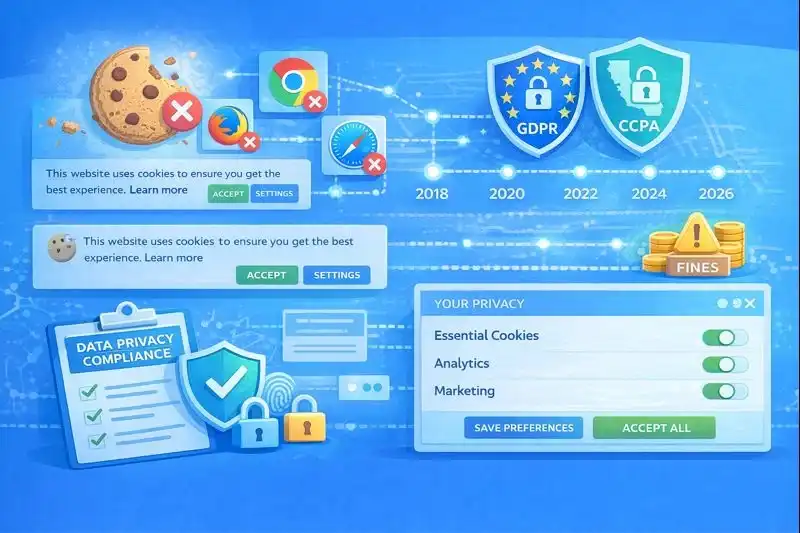
Third-party cookies enabled cross-site tracking, retargeting, and attribution across the web for 25+ years. Chrome's deprecation (following Safari, Firefox) eliminates this capability for 95% of browsers.
Impact on e-commerce marketing: Retargeting effectiveness drops 50-70% without third-party cookies. Attribution complexity increases - difficult tracking customer journey across sites. Lookalike audiences weaken - Facebook/Google rely on third-party data for targeting. Conversion tracking requires new approaches - server-side and first-party solutions.
Global Privacy Regulations
GDPR (European Union) - requires explicit consent for data processing, $20M or 4% revenue fines for violations. CCPA/CPRA (California) - consumer rights to know, delete, opt-out of data sales. Expanding to 13+ US states in 2024-2025. LGPD (Brazil), PIPEDA (Canada), PDPA (Singapore) - global privacy requirements. Cumulative effect: 75% of consumers protected by comprehensive privacy laws.
Compliance requirements: Clear consent mechanisms (no pre-checked boxes), data minimization (collect only necessary data), transparency (privacy policies explaining data use), user rights (access, deletion, portability), breach notification (72 hours under GDPR).
Consumer Privacy Expectations
86% concerned about data privacy but only 30% trust companies with data (Cisco, 2024). 90% want control over data collection. Transparency builds trust - clear explanation of data use increases willingness to share by 40%.
Privacy paradox: Consumers demand privacy but expect personalization. Solution: value exchange - demonstrate tangible benefits for data sharing (better recommendations, exclusive offers, faster checkout).
Building First-Party Data Strategy
First-party data (information customers share directly) becomes primary marketing asset in privacy-first era.
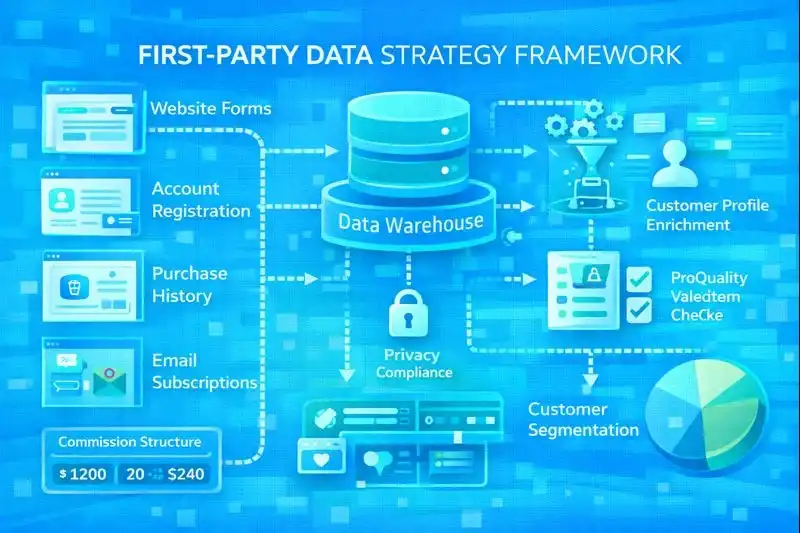
First-Party Data Sources
Website behavior - browsing patterns, product views, cart additions, search queries collected via own analytics.
Purchase history - transaction data, product preferences, frequency, average order value from commerce platform.
Email engagement - open rates, click behavior, content preferences from email marketing platform.
Account profile data - explicitly provided information during registration - preferences, birthday, interests.
Customer service interactions - support tickets, chat transcripts, product questions revealing needs and pain points.
Survey responses - direct feedback through post-purchase surveys, preference centers, NPS questionnaires.
Data Collection Strategies
Progressive profiling - gradually collect information over time rather than overwhelming forms. First visit: email only. Second purchase: birthday for discount. Third visit: product preferences for recommendations.
Value exchange - incentivize data sharing: 10% discount for email signup, free shipping for account creation, birthday gift for birthdate, early sale access for preference updates.
Zero-party data - information customers intentionally share (preferences, intent). Quiz tools ("Find your perfect product") collect preferences while providing value. Preference centers let customers control communication.
Behavioral tracking (first-party) - track behavior on your domain using privacy-compliant tools. Google Analytics 4, Plausible, Matomo respect privacy while providing insights.
First-Party Data Activation
Segmentation - create audiences based on behavior, purchase history, engagement: VIP customers (high LTV), at-risk (declining engagement), product affinity (category preferences), lifecycle stage (new, active, dormant).
Personalization - use first-party data for product recommendations (based on purchase/browse history), dynamic content (homepage varying by customer segment), email customization (product suggestions, content tailored to interests).
Predictive analytics - machine learning models predict churn, next purchase, lifetime value using first-party data. No third-party data required - your data more predictive for your customers than generic web data.
Implementing Privacy-Compliant Tracking
Accurate measurement remains possible through privacy-respecting alternatives to third-party cookie tracking.
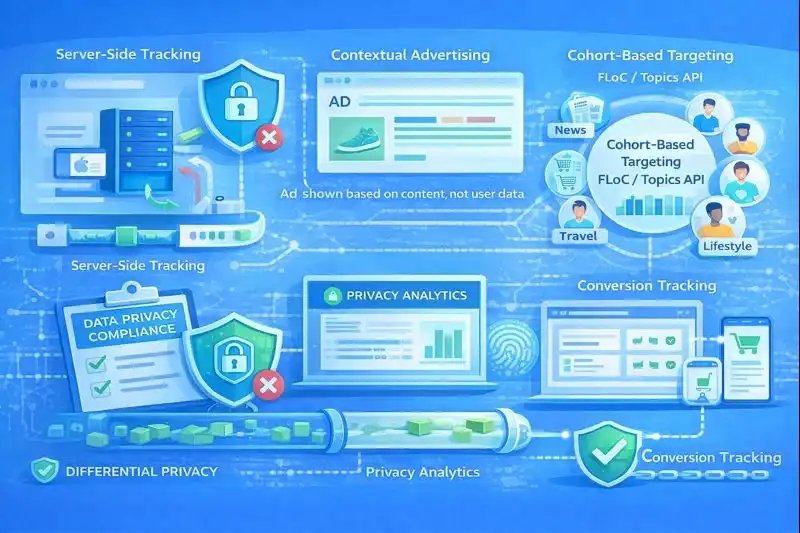
Server-Side Tracking
Server-side GTM (Google Tag Manager) moves tracking from browser to your server. Benefits: Bypasses ad blockers, more accurate data (no browser blocking), first-party context (data sent from your domain), privacy-friendly (controls what data shares with third parties).
Implementation: Google Tag Manager Server ($100-$500/month hosting), configure server container, update client tags to send data server-side. Complexity: Requires technical setup but 20-30% improvement in data accuracy vs. client-side tracking.
Conversion APIs
Facebook Conversion API - send conversion events directly from server to Facebook, bypassing iOS/browser restrictions. 30-40% more conversions tracked vs. pixel-only tracking.
Google Ads Enhanced Conversions - similar server-side conversion sharing for Google. Hashed customer data (email, phone) enables attribution while respecting privacy.
Implementation: Integrate with commerce platform (Shopify, WooCommerce have apps), hash PII before sending, validate tracking against platform reports.
First-Party Analytics
Google Analytics 4 - designed for privacy-first era with cookieless measurement options, consent mode (adjusts tracking based on user consent), predictive metrics using first-party machine learning.
Privacy-focused alternatives: Plausible Analytics ($9-$69/month) - no cookies, GDPR-compliant, simple dashboard. Matomo (open-source) - self-hosted, complete data ownership. Fathom Analytics ($14-$54/month) - privacy-first, simple interface.
Why consider alternatives: No cookie consent required (doesn't track individuals), faster page load (lighter scripts), EU-compliant by default, simpler for teams (focused metrics).
Attribution Modeling
Multi-touch attribution challenging without third-party cookies. Alternatives: First-click attribution - credit first interaction (conservative approach), last-click - credit final touchpoint before conversion, linear - equal credit to all touchpoints in customer journey, time decay - more recent interactions weighted higher.
Marketing mix modeling (MMM) - statistical analysis of marketing impact at aggregate level. Doesn't require individual tracking - uses overall spend vs. revenue patterns. Incrementality testing - A/B test marketing channels to measure true impact.
Building Consent Management Infrastructure
Legal compliance and customer trust require transparent, compliant consent collection.
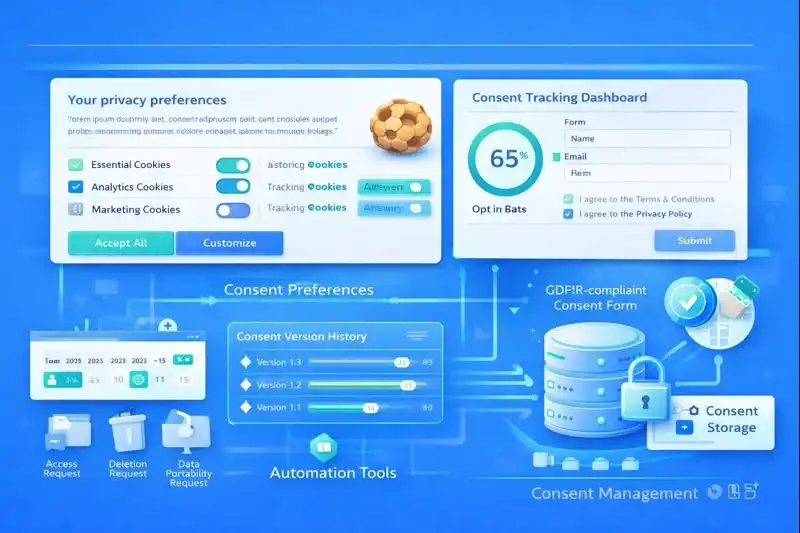
Consent Management Platforms (CMP)
OneTrust ($5,000-$100,000+/year) - enterprise consent management, cookie scanning, preference management, GDPR/CCPA compliance. Best for: Large enterprises, complex requirements.
Cookiebot ($9-$399/month) - affordable CMP for SMBs, automatic cookie detection, consent banners, GDPR-compliant. Best for: Small-medium businesses.
Osano ($199-$2,999/month) - mid-market CMP with cookie consent, data mapping, vendor management. Best for: Growing businesses with compliance needs.
Termly (free-$200/month) - basic consent banners, privacy policies. Best for: Startups, minimal budgets.
Consent Banner Best Practices
Clear language - "We use cookies to improve your experience" vs. confusing legal text. Specific categories - separate necessary (always on) vs. analytics, marketing, personalization (opt-in).
Easy opt-out - don't hide reject option. GDPR requires reject as easy as accept. Pre-checked boxes violate consent laws.
Granular control - let users accept some categories, reject others. All-or-nothing reduces consent rates by 30-40%.
Visual design - prominent but not deceptive. Dark patterns (tricking users into accepting) damage trust and risk legal penalties.
Consent Rate Optimization
Value proposition - explain benefits of consenting: "Accept marketing cookies for personalized product recommendations" vs. generic "improve experience."
Social proof - "Join 500,000 customers enjoying personalized shopping." Timing - don't show consent banner immediately on landing. Wait 3-5 seconds or trigger after engagement signal.
A/B testing - test banner designs, copy, positioning. 10-20% consent rate improvement possible through optimization.
Privacy Policy Clarity
Plain language privacy policies increase trust. Avoid legal jargon - "We collect your email to send order confirmations and marketing (you can unsubscribe)" vs. "Personal data processed for commercial communications."
Visual formatting - bullet points, tables, icons vs. dense paragraphs. Searchable - table of contents for long policies.
Regular updates - review annually, update when practices change. Notify users of material changes (GDPR requirement).
Frequently Asked Questions
How do I retarget customers without third-party cookies?
Retargeting remains possible through first-party and platform-native approaches. Email retargeting: Capture emails early (pop-up offers, account creation incentives), segment abandoned cart emails (30-50% open rates), browse abandonment flows for non-purchase visitors, post-purchase cross-sell campaigns. SMS retargeting: Collect phone numbers via checkout, text abandoned carts (45% click-through rates), flash sale alerts for engaged customers. On-site retargeting: Dynamic content showing recently viewed products on return visits, exit-intent popups offering discounts, persistent cart across devices via account login. Platform retargeting (first-party data): Facebook Custom Audiences - upload customer emails (hashed), Google Customer Match - similar email list targeting. 60-80% match rates typical. App-based retargeting: Push notifications for mobile app users, in-app messaging based on behavior. Limitations: Smaller reach than third-party cookie retargeting (only captured emails/phones vs. all visitors), delayed activation (need to collect data first). Mitigation: Aggressive email capture (aim for 30-50% of visitors through popups, incentives, account creation), multi-channel approach (email + SMS + on-site), creative alternatives (contextual advertising on relevant sites).
Can I still measure marketing ROI without cookies?
Yes, through first-party tracking, platform analytics, and incremental testing. Server-side tracking: Facebook Conversion API, Google Enhanced Conversions bypass cookie restrictions, track 30-40% more conversions than pixel/tag alone. Platform-native attribution: Facebook Ads Manager, Google Ads provide conversion reporting within their systems (though attribution windows shorter - 7-day vs. 28-day previously). First-party analytics: GA4 with server-side GTM, Matomo, Plausible track on-site behavior accurately. Incrementality testing: Geo-experiments - run ads in some regions not others, compare results. Holdout groups - exclude segment from marketing, measure difference. Unified measurement: Marketing mix modeling - statistical analysis of aggregate data (channel spend vs. revenue) doesn't require individual tracking. Challenges: Cross-device tracking harder (users browsing mobile, buying desktop not connected), attribution windows shorter (iOS limits to 7 days), reporting less granular (aggregate vs. individual user paths). Solutions: Focus on last-click or first-click attribution (simpler models), invest in server-side infrastructure, use platform conversions APIs, emphasize first-party data collection for retargeting. ROI measurement possible but requires new infrastructure.
What's the difference between GDPR and CCPA compliance?
Both regulate data privacy but differ in scope, rights, and enforcement. GDPR (EU General Data Protection Regulation): Scope: Applies to any business processing EU residents' data (regardless of company location). Consent requirements: Explicit opt-in required for non-essential data processing. Pre-checked boxes invalid. Rights: Access, deletion, portability, restriction of processing, object to profiling. Penalties: Up to €20M or 4% global revenue (whichever higher). CCPA/CPRA (California Consumer Privacy Act): Scope: Businesses meeting criteria ($25M+ revenue OR 100,000+ CA residents OR 50%+ revenue from selling data) serving California residents. Consent: Opt-out model (assume consent unless consumer opts out) vs. GDPR's opt-in. More lenient than GDPR. Rights: Know what data collected, delete data, opt-out of "sales" (broad definition includes sharing for advertising). Penalties: $2,500-$7,500 per violation (lower than GDPR). Practical differences: GDPR stricter on consent - require active opt-in. CCPA allows opt-out - can process unless requested otherwise. GDPR covers more businesses globally. Both require privacy policies, data minimization, user rights infrastructure. E-commerce compliance: Most brands serving global customers should comply with GDPR (strictest standard) automatically meeting CCPA and most other regulations.
Should I use Google Analytics 4 or privacy-focused alternative?
Depends on needs, technical resources, and privacy priorities. Google Analytics 4 advantages: Free (no cost for SMBs), robust features (goals, funnels, audiences, ecommerce tracking), Google Ads integration (seamless conversion tracking), familiar (most marketers know GA). Disadvantages: GDPR concerns (data processed by Google in US - requires consent), complex interface (steep learning curve), privacy settings (requires careful configuration). Privacy-focused alternatives (Plausible, Fathom, Matomo): Advantages: No cookies required (visitor-level tracking optional), GDPR-compliant by default, data ownership (especially Matomo self-hosted), faster page load (lighter scripts), simpler dashboards (focus on key metrics). Disadvantages: Cost ($9-$69/month typically), fewer features (basic metrics vs. GA4's depth), no integration with Google Ads/social platforms. Recommendation: Use GA4 if: Need advanced analytics features, Google Ads conversion tracking, no budget for paid tool, have technical resources for privacy configuration. Use privacy-focused alternative if: EU/privacy-sensitive audience, want cookie consent-free tracking, prefer simplicity over depth, willing pay for peace of mind. Hybrid approach: GA4 + privacy alternative - use GA4 with consent for marketing analysis, privacy tool for basic stats without consent.
How do I build email list without buying data?
Organic email list building through value exchange and optimization. On-site capture: Pop-up offers - "10-15% first purchase discount" (20-30% conversion rate typical), exit-intent popups - trigger when user abandoning site (5-15% conversion), embedded signup forms - footer, sidebar, dedicated page (1-3% conversion). Content upgrades: Lead magnets - free guides, checklists, templates in exchange for email. Example: "Ultimate Gift Guide - Free PDF." Quizzes - "Find your perfect product" collects email for results (30-50% conversion). Contests/giveaways - enter contest with email (high volume but lower quality leads). Checkout optimization: Account creation - incentivize account vs. guest checkout (5-10% conversion boost + email capture), post-purchase offers - "Get 20% off next order" signup during order confirmation. In-person/offline: QR codes in stores, at events linking to signup page, receipt messaging - "Text receipts + exclusive offers: text JOIN to..." Progressive disclosure: Don't ask everything upfront - capture email first, gather preferences later through preference center, surveys. Social media: Instagram/Facebook lead forms - built-in signup without leaving platform, link in bio to landing page with compelling offer. Avoid: Buying email lists (violates GDPR/CAN-SPAM, low quality, damages sender reputation), auto-enrolling customers (requires opt-in for marketing). Best performers: Popup with discount (20-30% conversion), quiz funnels (30-50%), checkout account creation (5-10% incremental). Target 3-5% of site visitors converting to email subscribers through multi-touch approach.
Related Articles
- AI Chatbots for E-commerce: Conversational Commerce Guide - Collect first-party data through AI chat interactions while providing customer value
- How to Attract Customers Using Holiday Email Campaigns - Leverage first-party email data for compliant, effective campaigns
- Why Your Store Needs a Loyalty Program - Loyalty programs generate rich first-party data while building customer relationships
Conclusion
Privacy-first marketing is not a constraint but an opportunity to build more valuable customer relationships through trust and first-party data strategies. With Google Chrome eliminating third-party cookies, iOS limiting tracking, and 75% of global users protected by privacy regulations, brands must adapt or face declining marketing effectiveness and potential legal penalties.
The path forward combines aggressive first-party data collection (email capture targeting 30-50% of visitors through popups, incentives, accounts), privacy-compliant tracking infrastructure (server-side GTM, Conversion APIs, cookieless analytics), transparent consent management (clear value propositions, easy opt-out, GDPR/CCPA compliance), and creative retargeting alternatives (email/SMS flows, on-site personalization, platform Custom Audiences).
Brands embracing privacy-first strategies report 20-30% improvement in customer trust and 15-25% increase in LTV as authentic data relationships replace invasive tracking. Start with consent management platform ($0-$400/month), implement server-side tracking ($100-$500/month infrastructure), optimize email capture (10-15% discount incentives), and measure results through platform-native analytics and incremental testing. The future belongs to marketers who respect privacy while delivering personalized experiences - the two are not mutually exclusive.

Ready to start selling?
Launch your online store today with LetsCommerce.