Introduction
Headless commerce is revolutionizing e-commerce architecture, with the headless commerce market reaching $1.6 billion in 2024 and projected to grow at 22.5% CAGR through 2030 (Grand View Research, 2024). This architectural approach decouples the front-end presentation layer from back-end commerce functionality, enabling unprecedented flexibility, performance, and omnichannel capabilities that traditional monolithic platforms struggle to deliver.
The business advantages are compelling: headless sites load 30-40% faster than traditional e-commerce platforms, directly correlating to 10-15% conversion rate improvements (Google, 2024). Brands implementing headless architecture report 60% reduction in development time for new features and 3-5x faster time-to-market for campaigns. Perhaps most significantly, headless enables true omnichannel experiences - one back-end powering website, mobile apps, IoT devices, in-store kiosks, and future channels simultaneously.
This guide explores when headless commerce makes sense, how to implement it strategically, and what results to expect from transitioning to this modern architecture.
Understanding Headless Commerce Architecture
Headless commerce separates the customer-facing "head" (front-end) from commerce engine "body" (back-end) through APIs, enabling independent development and optimization of each layer.
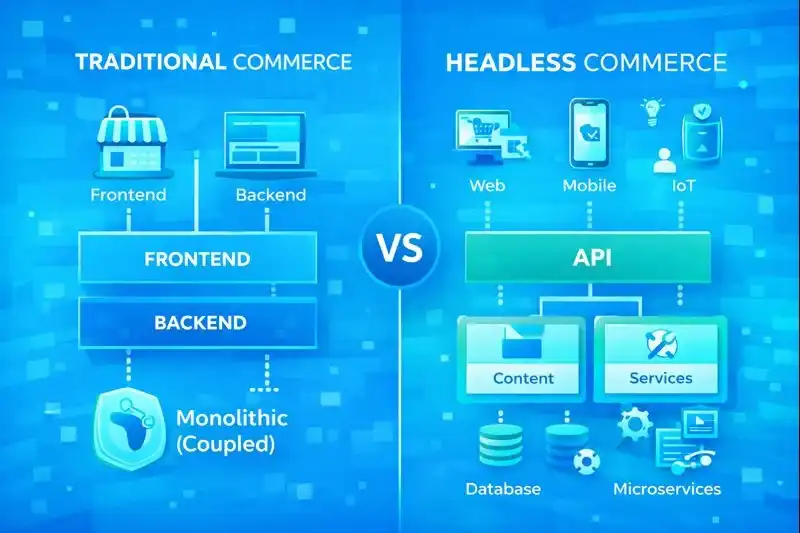
Traditional Monolithic E-commerce
Platforms like traditional Shopify, Magento, WooCommerce tightly couple front-end and back-end. Advantages: Simpler setup (everything integrated), lower initial cost ($29-$299/month), extensive plugins (app ecosystems), no developers required for basic stores.
Limitations: Customization constraints (template-bound designs), performance overhead (platform bloat), omnichannel challenges (separate systems for web/mobile/IoT), vendor lock-in (difficult migration).
Headless Commerce Architecture
Back-end commerce engine (Shopify Plus API, BigCommerce Headless, Commercetools) handles product catalog, inventory, orders, payments, customer data. Exposes functionality via RESTful or GraphQL APIs.
Front-end presentation layer (custom React/Next.js, Vue/Nuxt, Gatsby) built independently using modern JavaScript frameworks. Fetches data from back-end APIs, renders customer-facing experience.
Advantages: Complete design freedom, optimized performance (eliminate platform bloat), omnichannel ready (one back-end, multiple front-ends), best-of-breed integrations (choose perfect tool for each function), future-proof (swap front-end without touching commerce logic).
Limitations: Higher complexity (requires developers), increased cost ($2,000+/month total), longer initial build (3-6 months vs. 1-2 weeks), ongoing maintenance (updates, security, hosting).
When Headless Makes Sense
Choose headless if: Unique brand experience required (custom UX impossible in templates), omnichannel strategy (web + mobile app + IoT + in-store), performance critical (luxury brands, high AOV where speed = revenue), complex integrations (ERP, PIM, custom systems), $5M+ annual revenue justifying development investment.
Stick with traditional if: Starting new store (prove concept before architecture investment), limited technical resources, standard B2C retail (monolithic platforms serve 90% of needs), budget under $100K/year for technology.
Headless Commerce Technology Stack
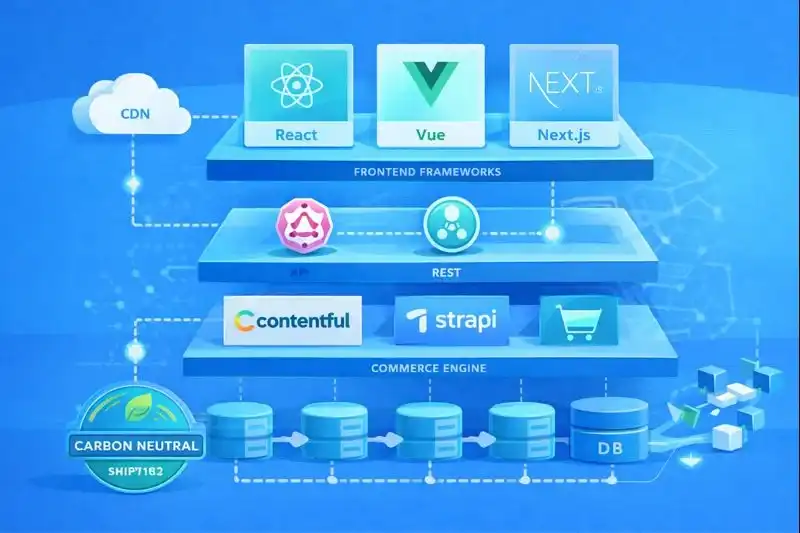
Implementing headless requires strategic selection of back-end commerce engine, front-end framework, and supporting infrastructure.
Back-End Commerce Platforms
Shopify Plus Headless ($2,000+/month) - Storefront API enables headless while retaining Shopify's commerce functionality. Best for: Brands comfortable with Shopify ecosystem wanting front-end flexibility. Pros: Mature platform, extensive integrations. Cons: Some limitations vs. true headless platforms.
BigCommerce Headless ($1,000-$4,000/month) - Purpose-built for headless with robust APIs. Best for: Mid-market brands prioritizing flexibility and scalability. Pros: Strong API, no transaction fees. Cons: Smaller app ecosystem than Shopify.
Commercetools (custom pricing, typically $50,000+/year) - Enterprise-grade, API-first, cloud-native commerce platform. Best for: Large enterprises, complex international operations. Pros: Ultimate flexibility, microservices architecture. Cons: Requires significant development resources.
Elastic Path - Similar to Commercetools, composable commerce platform. Best for: B2B and complex B2C scenarios.
Medusa (open-source, self-hosted) - Free headless commerce engine built on Node.js. Best for: Developer-heavy teams wanting complete control. Pros: Free, fully customizable. Cons: Requires hosting, security, maintenance.
Front-End Frameworks
Next.js (React) - Most popular headless front-end framework. Server-side rendering, static generation, optimized performance. Vercel hosting provides seamless deployment. Best for: Most headless implementations.
Nuxt.js (Vue) - Vue.js equivalent of Next.js. Excellent performance, developer experience. Best for: Teams preferring Vue over React.
Gatsby - Static site generator with CMS integration focus. Blazing fast performance through pre-built pages. Best for: Content-heavy stores, blogs with commerce.
Svelte/SvelteKit - Emerging framework with minimal JavaScript bundle sizes. Best for: Performance-obsessed implementations.
Hosting and Infrastructure
Vercel - Optimized for Next.js, global CDN, automatic scaling. Cost: $20-$2,000+/month. Best for: Next.js headless sites.
Netlify - Similar to Vercel, framework-agnostic. Cost: Free-$500+/month. Best for: Gatsby, general static sites.
AWS/Google Cloud/Azure - Enterprise infrastructure for large-scale operations. Cost: Variable, $200-$10,000+/month. Best for: High-traffic, complex requirements.
CDN: Cloudflare, Fastly for global content delivery ensuring fast load times worldwide.
Total Technology Cost
Typical headless stack: Commerce platform ($1,000-$5,000/month) + hosting ($100-$1,000/month) + CDN ($50-$500/month) + development tools ($100-$300/month) = $2,000-$7,000/month ongoing costs. Initial build: $50,000-$300,000 depending on complexity.
Building a Headless E-commerce Experience
Strategic development process ensures headless implementation delivers expected benefits without cost/timeline overruns.
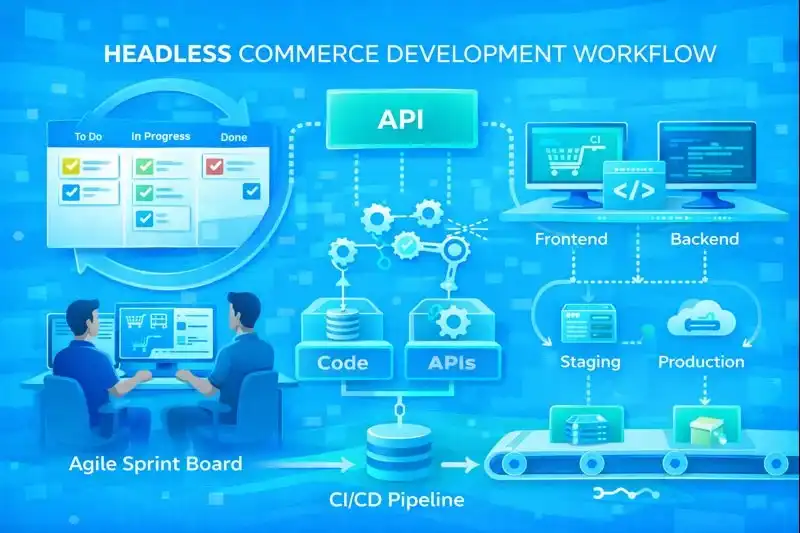
Phase 1: Planning and Architecture (2-4 weeks)
Define requirements - catalog features, personalization needs, omnichannel touchpoints, integration systems (ERP, CRM, PIM).
Select technology stack - commerce platform, front-end framework, hosting, APIs/integrations.
Create information architecture - site map, user flows, data models, API schema.
Budget and timeline - realistic expectations based on scope. Minimum 3 months for basic headless, 6-12 months for complex implementations.
Phase 2: Back-End Setup (4-8 weeks)
Configure commerce platform - product catalog migration, payment gateway integration, shipping logic, tax configuration.
API development - custom endpoints for unique business logic, webhooks for real-time data sync, authentication and security.
Data migration - products, customers, order history from existing platform. Test thoroughly - data integrity critical.
Integration - connect ERP, CRM, email marketing, analytics, customer service platforms via APIs.
Phase 3: Front-End Development (8-16 weeks)
Design system - component library ensuring consistency across pages and future development.
Page templates - homepage, product listing, product detail, cart, checkout, account pages. Checkout optimization critical - headless checkout requires careful UX to avoid cart abandonment.
Performance optimization - lazy loading, image optimization, code splitting, caching strategies. Target Lighthouse scores: 90+ across all metrics.
SEO implementation - server-side rendering for search visibility, meta tags, structured data, XML sitemap.
Mobile responsiveness - mobile-first development ensuring perfect mobile experience (60%+ of traffic).
Phase 4: Testing and Launch (4-6 weeks)
Functional testing - every user flow, edge cases, error handling.
Performance testing - load testing for traffic spikes (Black Friday), stress testing APIs.
Security testing - penetration testing, PCI compliance verification, data protection.
User acceptance testing - internal stakeholders validate against requirements.
Soft launch - beta testing with limited audience, gather feedback, fix issues before full launch.
Full launch - gradual rollout, monitoring for issues, rapid response team ready.
Post-Launch Optimization
Continuous improvement - A/B testing, conversion rate optimization, performance tuning. Headless enables faster iteration - update front-end without touching back-end.
Analytics - comprehensive tracking of user behavior, conversion funnels, performance metrics.
Headless Commerce for Omnichannel Strategy
The true power of headless emerges in omnichannel scenarios where multiple front-ends share one commerce back-end.
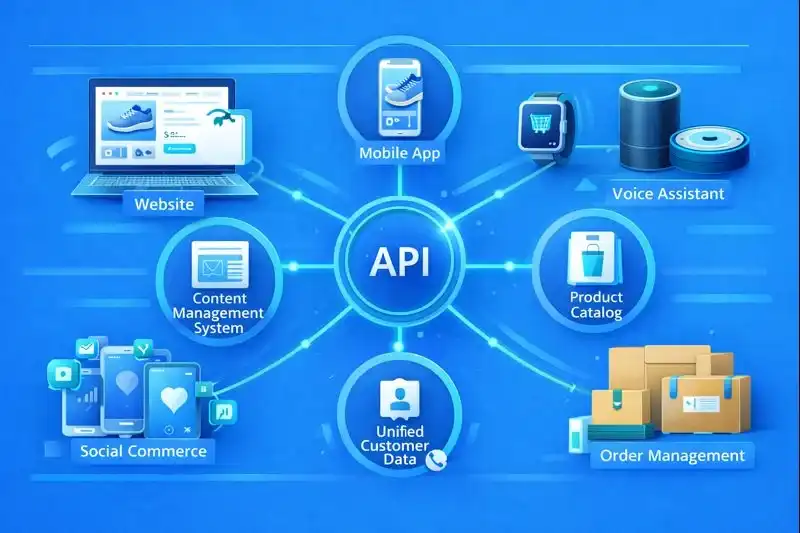
Multi-Touchpoint Architecture
Single commerce API powers: Responsive website (primary channel), native mobile apps (iOS/Android with React Native or Flutter consuming same APIs), progressive web app (app-like mobile web experience), voice commerce (Alexa/Google Assistant integration), in-store kiosks (endless aisle, product lookup), IoT devices (smart refrigerators, connected products).
Benefits: Consistent inventory across channels, unified customer data (single view regardless of touchpoint), centralized promotions (one system managing all offers), streamlined operations (manage once, deploy everywhere).
Progressive Web Apps (PWA)
App-like experiences without app store deployment. Push notifications, offline functionality, home screen installation. Twitter Lite, Starbucks PWA demonstrate potential.
Headless architecture ideal for PWA - front-end optimized for performance, back-end APIs provide data. Conversion rates 30-50% higher than responsive web for mobile users.
Native Mobile Apps
React Native or Flutter enable code sharing between iOS/Android. Connected to headless commerce APIs same as website.
80% of mobile shopping time spent in apps vs. browsers. Native apps drive 3x conversion vs. mobile web for many categories.
Investment: $50,000-$200,000 for professional app development. Justified for brands with 30%+ mobile revenue and loyal customer base.
In-Store Integration
Clienteling apps for sales associates - access full product catalog, customer purchase history, create orders on behalf of customers. Unified inventory shows warehouse + store stock.
Self-service kiosks - customers browse extended catalog beyond store inventory, place orders for delivery.
BOPIS (Buy Online, Pick Up In Store) - headless architecture enables real-time inventory visibility across channels.
International and Localization
Multi-currency, multi-language capabilities from single back-end. Different front-ends for regional needs while sharing commerce logic.
Edge computing - deploy front-end to CDN nodes closest to customers globally for optimal performance.
Frequently Asked Questions
How much does headless commerce really cost?
Headless commerce investment breaks into initial build and ongoing costs. Initial implementation: Small-medium business ($50,000-$150,000) - basic headless storefront using Shopify Plus or BigCommerce back-end, Next.js front-end, standard features. Timeline: 3-4 months. Enterprise ($150,000-$500,000+) - custom commerce platform, complex integrations, multiple front-ends (web + mobile app), advanced personalization. Timeline: 6-12 months. Ongoing costs: Commerce platform ($1,000-$5,000/month), hosting/infrastructure ($200-$2,000/month), CDN ($50-$500/month), maintenance ($2,000-$10,000/month for ongoing development/updates). Total: $3,000-$20,000/month for established headless operations. Hidden costs: Developer dependency - cannot DIY updates like Shopify themes. Slower feature delivery initially - building from scratch vs. plugin installation. Migration risk - complex transition from existing platform. ROI factors: Performance gains (30-40% faster = 10-15% conversion lift), development efficiency (60% faster feature delivery after initial build), omnichannel revenue (unified back-end enables mobile app, kiosks). Break-even typically 18-36 months for $5M+ revenue businesses.
Is headless commerce only for large enterprises?
Historically yes, but increasingly accessible to mid-market brands. Traditional barrier: Development cost ($50,000-$500,000) excluded businesses under $10M revenue. Changing landscape: Shopify Hydrogen (free React framework for Shopify Plus) lowers entry barrier. BigCommerce Headless plans start at $1,000/month vs. enterprise-only previously. Composable commerce platforms (Builder.io, Uniform) provide visual development reducing custom coding. Agency expertise - specialized headless agencies offer packages for $30,000-$75,000 vs. custom builds. Realistic minimum: $2M-$5M annual revenue to justify headless investment. Below this, traditional platforms serve needs at fraction of cost. Sweet spot: $5M-$50M revenue brands wanting competitive differentiation through unique UX, performance, omnichannel but lacking enterprise budgets. When to consider: Unique brand experience impossible in templates, omnichannel strategy (web + app + other), performance directly impacts revenue (luxury goods, high AOV). When to avoid: Early-stage startups (prove business model first), limited technical resources (headless requires ongoing development), commodity products where experience differentiation minimal.
Can I migrate from Shopify/WooCommerce to headless gradually?
Yes - progressive decoupling enables gradual headless migration. Phase 1: API-first approach: Keep existing platform (Shopify, WooCommerce) but start using headless principles for new features. Example: build custom mobile app consuming Shopify APIs while keeping Shopify website. Phase 2: Hybrid implementation: Headless for specific sections - custom homepage/product pages in Next.js while keeping Shopify checkout. Reduces risk - maintain working checkout while upgrading experience gradually. Phase 3: Full headless: Custom front-end for entire site once hybrid proven successful. Migration path varies by platform: Shopify to headless Shopify Plus: Simplest - keep same back-end (products, inventory, orders), replace front-end only. Migration: 2-4 months. Cost: $50,000-$150,000. WooCommerce to headless: More complex - migrate to headless platform (BigCommerce, Commercetools) OR use WooCommerce as headless back-end (requires API development). Migration: 4-8 months. Cost: $75,000-$250,000. Risk mitigation: Run parallel - new headless site on subdomain while keeping old site live. A/B test with percentage of traffic. Full cutover only when confident. Expect 3-6 month transition for careful migration vs. risky "big bang" approach.
How does headless commerce affect SEO?
Headless can improve SEO through performance but requires technical implementation care. SEO advantages: Faster page speed (30-40% improvement) - Core Web Vitals directly impact rankings. Headless sites loading under 2 seconds see significant SEO benefit. Cleaner code - no platform bloat means search crawlers parse pages efficiently. Flexibility - custom meta tags, structured data, schema markup without platform constraints. SEO challenges: JavaScript rendering - search engines must execute JavaScript to see content. Requires server-side rendering (SSR) or static generation to ensure crawlability. Next.js automatic SSR handles this well. Dynamic content - headless sites fetching data client-side risk content invisibility to crawlers. Solution: Pre-render critical content server-side. URL structure - complete control means must architect SEO-friendly URLs from start. Redirects - migrating to headless requires comprehensive redirect mapping preserving link equity. Best practices: Next.js or Nuxt.js with SSR enabled, pre-render product/category pages, XML sitemap generation, robots.txt configuration, canonical URLs properly set, schema markup for products/reviews/breadcrumbs. Results: Properly implemented headless improves SEO through speed + flexibility. Poorly implemented headless damages SEO through rendering issues.
What are the biggest headless commerce mistakes to avoid?
Common pitfalls derailing headless implementations. 1. Underestimating complexity: Headless requires ongoing development - not "set and forget" like Shopify. Budget for 20-30% of build cost annually for maintenance, updates, new features. Hire developers or agency on retainer. 2. Choosing wrong tech stack: Overengineering - enterprise platforms for SMB needs. Underengineering - open-source solutions without team to support. Match stack to resources. 3. Ignoring performance: Headless enables speed but doesn't guarantee it. Poorly coded React site slower than optimized Shopify theme. Invest in performance optimization - lazy loading, CDN, caching, image optimization. Target 90+ Lighthouse scores. 4. Weak checkout experience: Headless checkout requires thoughtful UX - cannot copy Shopify's optimized flow. Test extensively - any friction kills conversion. Consider Shopify Buy SDK for headless front-end with Shopify checkout. 5. Inadequate testing: Rushing launch causes bugs, broken user flows, security vulnerabilities. Allow 4-6 weeks testing - functional, performance, security, UAT. 6. No analytics strategy: Cannot improve what you don't measure. Implement comprehensive tracking - Google Analytics 4, heatmaps, session recording, conversion funnels. 7. Vendor lock-in despite headless: Choosing proprietary front-end framework defeats headless flexibility. Use open standards - React/Vue, not platform-specific frameworks. Prevention: Hire experienced headless agency for first build. Start small - basic site before complex features. Plan for ongoing development from day one.
Related Articles
- AI Chatbots for E-commerce: Conversational Commerce Guide - Integrate AI chatbots seamlessly across headless architecture's multiple front-ends
- AR/VR Shopping Experiences Guide - Headless architecture enables custom AR/VR implementations impossible on traditional platforms
- TikTok Shop Integration Guide - Headless back-end can power both traditional e-commerce and social commerce channels simultaneously
Conclusion
Headless commerce represents the future of flexible, performant e-commerce, with the market growing at 22.5% CAGR as brands recognize limitations of monolithic platforms. The benefits are measurable: 30-40% faster load times, 10-15% conversion improvements, 60% reduction in feature development time, and true omnichannel capability powering web, mobile apps, IoT, and in-store from one back-end.
However, headless demands realistic expectations around investment ($50,000-$300,000 initial build, $3,000-$20,000/month ongoing), timeline (3-12 months implementation), and technical resources (ongoing development required). It's not for every business - brands under $2M revenue typically better served by traditional platforms, while $5M+ revenue businesses with unique experience requirements find headless transformational.
Success requires strategic technology selection (matching stack to resources), experienced development partners (avoid first-time headless mistakes), performance obsession (speed advantages aren't automatic), and long-term commitment (headless is ongoing development, not one-time project). For businesses meeting these criteria, headless commerce enables competitive differentiation impossible on template-based platforms.

Ready to start selling?
Launch your online store today with LetsCommerce.