Introduction
Augmented and virtual reality are transforming online shopping from flat product images to immersive experiences, with AR/VR e-commerce market reaching $12 billion in 2024 and projected to hit $61 billion by 2028 (Statista, 2024). More critically for retailers, AR shopping experiences increase conversion rates by 94% while reducing returns by 40% by helping customers visualize products accurately before purchasing (Shopify, 2024).
Consumer adoption is accelerating: 120 million Americans used AR shopping features in 2024, with 75% of consumers expecting retailers to offer AR experiences (Deloitte, 2024). The technology has matured beyond novelty - web-based AR works on 3+ billion smartphones without app downloads, making implementation accessible to businesses of all sizes. Leading brands report ROI of 3-10x on AR investments within 12-18 months through improved conversion, reduced returns, and decreased customer acquisition costs.
This guide explores how to implement AR and VR shopping experiences strategically - from selecting appropriate use cases and technology platforms to measuring impact and scaling immersive commerce initiatives.
Understanding AR vs. VR for E-commerce
Augmented reality and virtual reality serve different shopping needs, requiring distinct technical approaches and investment levels.
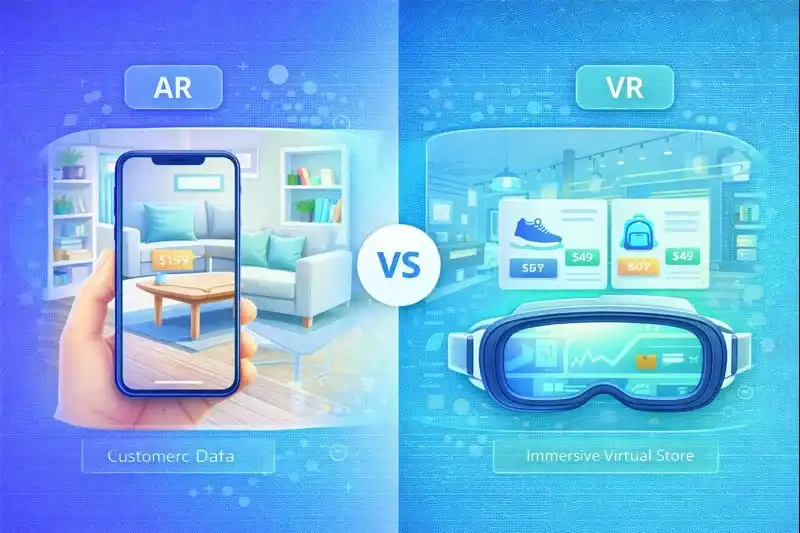
Augmented Reality (AR) Shopping
AR overlays digital content onto real-world environment through smartphone cameras or AR glasses. Customers see products in their actual spaces before buying.
Common AR shopping applications: Virtual try-on (eyeglasses, makeup, jewelry on customer's face), room visualization (furniture, decor in actual room), size comparison (viewing products at true scale), product customization (seeing different colors/configurations in real-time).
Technical requirements: 3D product models, web AR platform (8thWall, ARKit, ARCore), optimization for mobile performance. Works on iOS and Android devices without app downloads.
Investment: $5,000-$50,000 per product category for 3D modeling and integration. Scales down significantly per additional product once infrastructure built.
Virtual Reality (VR) Shopping
VR creates fully immersive digital environments through headsets (Meta Quest, Apple Vision Pro). Customers explore virtual showrooms and interact with products in simulated spaces.
Common VR shopping applications: Virtual showrooms (car dealerships, furniture stores), immersive product demos (complex products requiring spatial understanding), virtual events (product launches, exclusive shopping experiences), brand storytelling (immersive brand worlds).
Technical requirements: VR headset ownership (consumer barrier), 3D environment creation, VR platform (Unity, Unreal Engine). Higher development complexity than AR.
Investment: $50,000-$500,000+ for comprehensive VR commerce experiences. Currently niche application vs. mainstream AR.
Strategic Selection
Choose AR for: Mass market reach (billions of smartphone users), product visualization needs (furniture, home decor, fashion), immediate ROI potential (conversion and return reduction). Choose VR for: high-ticket products (cars, real estate, luxury goods), complex spatial products, brand experience differentiation (premium positioning).
For most e-commerce businesses, AR delivers better ROI with lower barriers to consumer adoption.
Implementing AR Product Visualization
AR product visualization helps customers see items in their environment, dramatically reducing uncertainty and purchase friction.
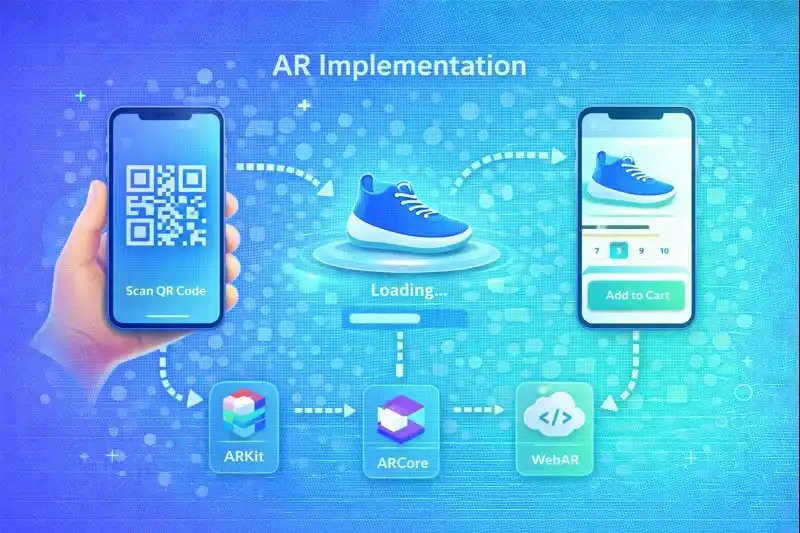
3D Model Creation
High-quality 3D models are foundation of AR experiences. Three approaches:
Photogrammetry - photographing products from multiple angles and generating 3D models via software. Cost: $50-$200 per product using services like Threedy.ai, CGTrader. Best for: Products with simple geometry.
3D scanning - using specialized scanners for precise models. Cost: $10,000-$50,000 for scanner, $20-$100 per product for processing. Best for: Complex shapes, large product catalogs justifying equipment investment.
Manual 3D modeling - designers create models in software (Blender, Maya). Cost: $500-$5,000+ per product for professional modeling. Best for: Products not yet manufactured, custom designs, highest quality requirements.
Model specifications: Polygon count < 100,000 for mobile performance, texture resolution 2048x2048 or lower, file formats GLB/GLTF for web AR compatibility.
AR Platform Selection
Shopify AR - built-in AR viewing for Shopify stores. Upload 3D models, automatically creates AR experiences. Cost: Included with Shopify. Best for: Simple AR needs, Shopify merchants.
Google Model Viewer - free web component for AR on product pages. Works across iOS/Android. Cost: Free. Best for: Basic AR without advanced features.
8th Wall - advanced web AR platform with custom interactions, analytics, brand customization. Cost: $99-$499/month. Best for: Professional AR experiences, custom features.
Threekit - enterprise AR/3D visualization with real-time customization. Cost: Custom pricing (typically $20,000+/year). Best for: Configurable products (furniture, vehicles) with many options.
Implementation Best Practices
Clear AR activation - prominent "View in Your Space" button on product pages. 71% of consumers would shop more if AR available (Retail Perceptions, 2024).
User guidance - first-time AR users need instructions: "Point camera at floor, tap to place product." Tutorial overlays improve success rates.
Lighting and shadows - realistic shadows and environmental lighting make products believable. Poor lighting reduces trust in AR accuracy.
Scale accuracy - products must appear at true size. Inaccurate sizing undermines AR value and increases returns despite visualization.
Furniture and Home Decor AR
IKEA Place pioneered furniture AR visualization. Key features to emulate: Room scanning for spatial awareness, product library with hundreds/thousands of SKUs, measurement tools showing dimensions, save and share - customers share AR previews for family feedback.
Conversion lift: Furniture AR drives 22% higher conversion and 35% reduction in returns (Shopify AR case studies, 2024).
Virtual Try-On for Fashion and Beauty
Virtual try-on addresses "fit and appearance" concerns, the primary purchase barriers for apparel and beauty products.
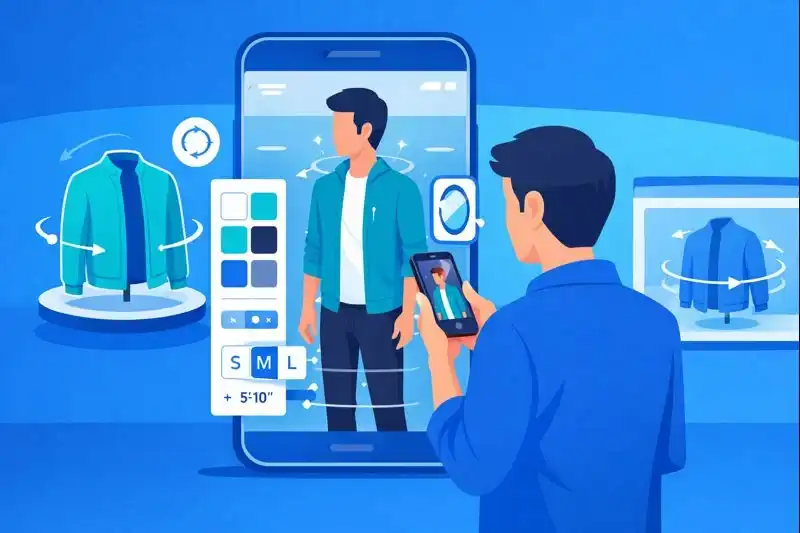
Fashion Virtual Try-On
Technology approaches: Body mapping - customers upload photo or create 3D avatar with measurements, see clothing on their body type. AR live try-on - real-time clothing overlay on camera feed. Wearable tracking - scanning body dimensions for accurate fit predictions.
Leading platforms: Zeekit (Walmart) - realistic clothing try-on with 99% accuracy claims. Vue.ai - AI-powered virtual try-on for fashion. Wannaby - specializes in footwear AR try-on.
Implementation complexity: Higher than product placement AR due to fabric simulation, realistic draping, and body tracking. Investment: $15,000-$100,000 for custom implementation.
Results: Fashion AR reduces returns by 36% on average and increases conversion 19-32% (Shopify, 2024).
Beauty Virtual Try-On
Makeup AR try-on - real-time application of lipstick, eyeshadow, foundation via facial recognition and color overlay. 93% of beauty shoppers interested in AR try-on (Perfect Corp, 2024).
Leading platforms: Perfect Corp YouCam - comprehensive beauty AR (makeup, skincare analysis, hair color). Cost: Custom pricing, typically $10,000+ implementation. ModiFace (L'Oréal) - professional-grade beauty AR.
Try-before-you-buy: Cosmetics AR enables unlimited experimentation risk-free. Conversion rates 2-3x higher for products with virtual try-on vs. static images.
Eyewear AR try-on - glasses and sunglasses overlaid on customer's face. Warby Parker's AR feature increases likelihood of purchase by 60%.
Jewelry Virtual Try-On
Rings, bracelets, necklaces visualized on hands and neck through AR. Addresses "will this look good on me?" uncertainty for online jewelry purchases.
Hand tracking technology identifies fingers/wrists for accurate placement. Gemstone visualization shows light refraction and sparkle realistically.
Investment: $20,000-$75,000 for custom jewelry AR. ROI: Higher AOV for jewelry justifies investment vs. low-cost products.
VR Shopping Experiences and Virtual Showrooms
Virtual reality creates immersive shopping environments for high-consideration purchases requiring spatial understanding.
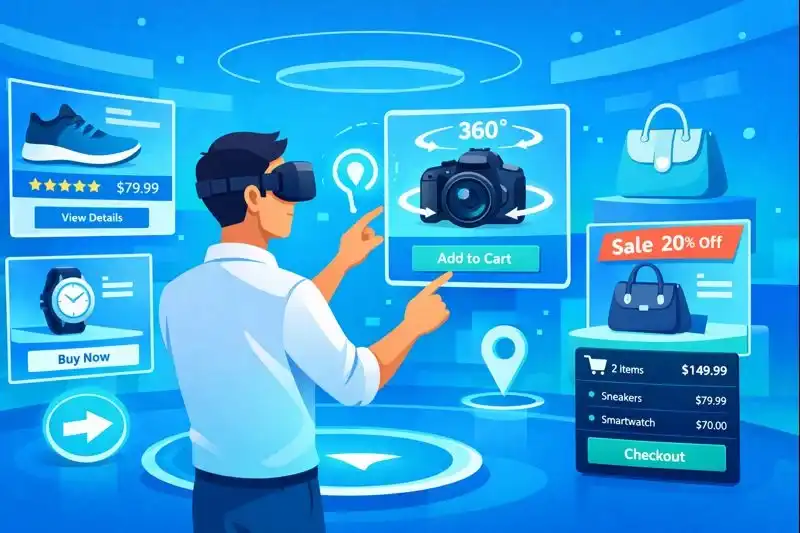
Automotive VR Showrooms
Virtual car dealerships enable customers exploring vehicles in 3D, customizing colors/options, even virtual test drives. Audi VR experience lets customers configure cars and view in photorealistic detail.
Benefits: Reduces dealership visits for browsing, educates customers before test drive, showcases configurations not in stock. 80% of auto shoppers want VR experiences (Deloitte Automotive, 2024).
Implementation: $100,000-$500,000+ for professional automotive VR. Justified for luxury brands and major manufacturers where 1% conversion improvement = millions in revenue.
Real Estate VR Tours
Virtual property tours enable remote viewing of homes, apartments, commercial spaces. Matterport dominates with 4+ million spaces digitized.
360° cameras capture spaces ($500-$5,000 equipment), VR viewing through headsets or web browsers. Reduces in-person showings 30-50% while expanding geographic buyer reach.
Cost: $100-$500 per property for scanning service. DIY: $500-$2,000 for equipment and software.
Furniture and Appliance VR Configurators
Virtual kitchens, living rooms, bedrooms where customers design complete spaces. Place furniture, change wall colors, experiment with layouts.
Benefits: Visualize complete room designs, test multiple configurations, increase cross-selling (buy entire room vs. single item).
Leading example: Wayfair's VR app (though limited adoption due to headset requirement). More practical: Web-based 3D room planners bridging gap until VR mainstream.
Measuring AR/VR Impact and ROI
Data-driven measurement justifies AR/VR investments and guides optimization.
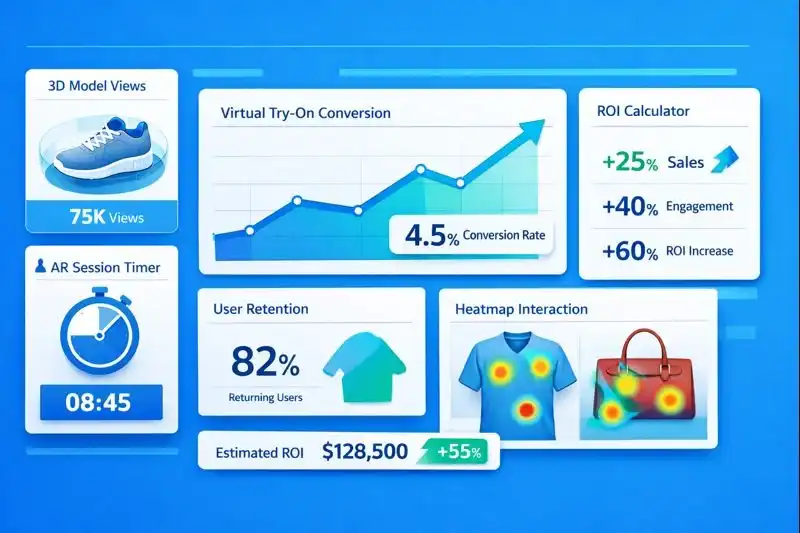
Key Performance Metrics
AR engagement rate - percentage of product page visitors activating AR features. Benchmark: 8-15% for well-implemented AR.
AR-to-purchase conversion - users who view AR vs. convert. Target: 20-40% conversion from AR users (vs. 2-5% baseline e-commerce).
Return rate reduction - comparing AR users vs. non-AR users. Target: 25-50% lower return rates for AR-assisted purchases.
Average order value - AR users often purchase higher-value items through confidence. Benchmark: 10-30% higher AOV for AR users.
Customer satisfaction scores - CSAT and NPS for AR users vs. general customers. Expect: 15-25% higher satisfaction scores.
ROI Calculation
AR Investment Costs: 3D model creation ($50-$5,000 per product × catalog size), platform fees ($0-$499/month depending on solution), development/integration ($5,000-$50,000 one-time), ongoing maintenance (10-20% of initial cost annually).
Revenue Impact: Conversion rate improvement (baseline 3% → 5.8% with AR = 93% lift), return rate reduction (20% → 12% = 40% fewer returns), AOV increase (15% higher for AR users).
Example ROI: E-commerce site with $2 million annual revenue, 10,000 monthly visitors, 3% baseline conversion, implementing AR for 50 key products. Investment: $50,000 (3D models + platform + integration). Results Year 1: +$380,000 revenue (conversion lift), -$60,000 return costs saved = $420,000 benefit - $50,000 cost = $370,000 net = 740% ROI.
A/B Testing AR Features
Test AR vs. non-AR product pages with identical products. Measure conversion, engagement time, return rates. Statistical significance requires minimum 1,000 visitors per variant.
Test different AR implementations - placement button location, tutorial vs. no tutorial, AR-first vs. images-first layouts.
Frequently Asked Questions
What products work best for AR/VR shopping?
AR works best for products where visualization uncertainty drives purchase hesitation. Top AR categories: Furniture and home decor (96% of consumers want AR for these categories) - placement in actual room resolves "will it fit?" and "does it match?" concerns. Fashion and apparel - virtual try-on addresses fit/appearance anxiety. Beauty and cosmetics - try-before-you-buy eliminates color mismatch risk. Eyewear - glasses/sunglasses virtual try-on drives 60% higher conversion. Home improvement - paint colors, flooring, wall treatments visualized in real spaces. Products that struggle with AR: Consumables (food, beverages) - taste/smell can't be replicated. Commodity items (basic supplies) - visual inspection unnecessary. Ultra-low-cost products ($5-$15) - AR development cost unjustified. Best candidates: $50-$5,000 price range, visual/spatial uncertainty, high return rates (20%+), differentiation opportunity.
How much does AR shopping implementation cost?
AR investment ranges from $5,000 to $100,000+ depending on scope and approach. Budget AR ($5,000-$15,000): Shopify AR for existing Shopify stores (included), 3D model creation for 10-20 products via services ($50-$200 each), Google Model Viewer integration (free platform). Suitable for: Testing AR with limited product lines. Mid-range AR ($15,000-$50,000): Professional 3D modeling for 50-100 products, 8th Wall or similar platform ($99-$499/month), custom integration and branding, basic analytics. Suitable for: Established e-commerce with proven product-market fit. Enterprise AR ($50,000-$200,000+): Comprehensive 3D catalog (hundreds/thousands of SKUs), custom AR platform, virtual try-on technology, advanced features (measurement tools, customization), dedicated support. Suitable for: Large retailers, Fortune 500 brands. Ongoing costs: Platform fees ($0-$499+/month), model updates (10-20% of initial modeling cost annually), technology maintenance. ROI timeline: Expect 12-18 months to positive ROI through conversion improvement and return reduction.
Do customers actually use AR shopping features?
Yes, and adoption is accelerating rapidly. Usage statistics: 120 million Americans used AR shopping in 2024 (37% of population). 75% of consumers expect AR from retailers. 61% prefer stores offering AR experiences. 71% would shop more frequently with AR availability. Engagement rates: Well-implemented AR features see 8-15% activation rate from product page visitors (impressive considering novelty). AR users spend 2.7x longer on product pages vs. non-AR users. Demographics: Gen Z (ages 18-27): 82% use AR shopping. Millennials (28-43): 67% use AR. Gen X (44-59): 41% use AR. Baby Boomers (60+): 23% use AR. Category differences: Furniture/home decor: 20-25% AR usage (highest). Fashion: 12-18%. Beauty: 15-22%. Improving adoption: Prominent "View in Your Space" buttons, tutorial for first-time users, social proof ("500K customers visualized this product"), incentives (discount for using AR - captures data + drives adoption).
Is VR shopping worth investing in for most e-commerce businesses?
For most businesses: No, not yet. Focus on AR instead. VR barriers: Headset ownership required - only 17% of US households own VR headsets (Statista, 2024). Development costs ($50,000-$500,000+) dramatically higher than AR. Consumer friction - need to put on headset vs. pointing smartphone. Limited reach - VR restricts audience to device owners. When VR makes sense: Ultra-high-ticket products ($50,000+) - luxury cars, real estate, yachts where 1-2 sales justify investment. Complex spatial products requiring immersive understanding impossible via AR. Brand experience differentiation for luxury positioning (VR as marketing statement). Apple Vision Pro potential: Spatial computing may shift VR adoption, but $3,499 device price limits mass market near-term. Recommendation: Invest in AR now (broader reach, proven ROI), monitor VR adoption for future implementation when headset penetration exceeds 35-40% of target demographic.
How do I create 3D models for AR without expensive equipment?
Multiple accessible options for 3D model creation at various budgets. DIY photogrammetry (Free-$500): Apps like Polycam, RealityScan (free iPhone apps) create 3D models from photos. Capture product from 30-50 angles, app generates model. Quality: Adequate for basic AR, not professional. Best for: Testing AR viability before major investment. Freelance 3D artists ($100-$1,000 per model): Platforms: Fiverr, Upwork, CGTrader Studio. Provide product photos/dimensions, artists create models. Turnaround: 3-10 days per model. Quality: Professional-grade. Best for: Small-medium catalogs (10-100 products). 3D modeling services ($50-$500 per model): Threekit, Hexa, Cylindo offer catalog-scale 3D modeling. Ship products or provide specs, they create models. Volume discounts significant. Best for: Large catalogs (100+ products), consistent quality needs. AI-generated 3D models (emerging): NeRF (Neural Radiance Fields) technology creates models from limited photos using AI. Luma AI, Wonder Dynamics experimenting with this. Quality: Improving rapidly but not yet professional standards. Cost optimization: Prioritize hero products (top 20% of revenue) for professional modeling. Use photogrammetry for long-tail products. Invest incrementally - 10-20 models initially, expand based on ROI data.
Related Articles
- TikTok Shop Integration Guide: How to Sell on Social Commerce - Combine AR product visualization with social commerce selling
- How to Make Shopping Convenient - AR/VR enhances shopping convenience by reducing uncertainty
- Livestream Shopping Guide: Video Commerce - Integrate AR features into live shopping events for interactive demonstrations
Conclusion
AR and VR shopping experiences are transitioning from futuristic novelty to competitive necessity, with the market reaching $12 billion in 2024 and 75% of consumers now expecting AR from retailers. The business impact justifies investment: 94% higher conversion rates, 40% reduction in returns, and ROI of 3-10x within 12-18 months for well-implemented AR programs.
For most e-commerce businesses, AR delivers better returns than VR due to mass smartphone adoption (3+ billion compatible devices), lower implementation costs ($5,000-$50,000 vs. $50,000-$500,000+), and proven consumer engagement (120 million US AR shoppers). Focus on high-impact categories - furniture/home decor, fashion, beauty, eyewear - where visualization uncertainty drives purchase hesitation and return rates.
Start with 10-20 hero products representing top revenue, invest in professional 3D modeling and web AR platform, measure conversion lift and return reduction rigorously. Scale based on data, not assumptions. The immersive commerce future is here - early adopters capture market share while competitors lag in flat-image shopping experiences increasingly perceived as insufficient.

Ready to start selling?
Launch your online store today with LetsCommerce.